
What Does It Mean?
The OBD (On-Board Diagnostics) code P0384 is generic and covers all recent model diesel engine brands, including diesel engines found in Ford, Dodge, Chevrolet, GMC, and VW Volkswagen vehicles. To understand the meaning of this code, its ramifications, and its symptoms, it is important to understand the dynamics at play.
Unlike a conventional gasoline engine, a diesel does not rely on a compressed fuel mixture and an electrical ignition source to operate. Diesel engines have much higher compression than gasoline engines.
This high compression causes the air in the cylinder to exceed 600 degrees – enough to ignite diesel fuel. When the piston reaches top dead center in the cylinder, high-pressure fuel vaporizes into the cylinder. It ignites immediately upon contact with the superheated air, and the expanding gases drive the piston downward.
Glow Plug
Since the diesel engine requires superheated air to ignite the fuel, a problem arises when the engine is cold. When starting a cold engine, it is difficult to overheat the air as its heat is quickly lost to the cold cylinder head.
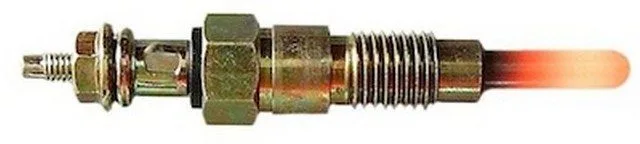
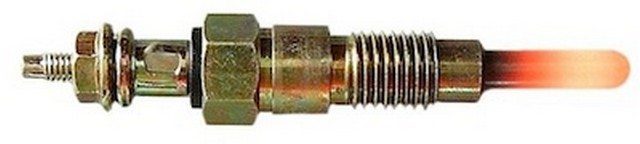
The glow plug is the solution. Installed in the cylinder head, the pencil-shaped plug heats until it glows for up to ten seconds. This results in an increase in the temperature of the surrounding cylinder wall, allowing the compression heat to rise sufficiently for ignition.
A typical diesel engine glow plug:
Glow Plug Circuit
The circuit is common on all diesel engines except for the component used to time the glow plug operation. The vehicle will either have a glow plug control module, or the PCM will do it. Instead of a service manual, simply call an auto parts store and ask if they sell a control module. If not, the computer controls the timing.
Batteries – Check the batteries for a full charge. The compressed air in the cylinders retains its heat for only a fraction of a second, so the engine must crank rapidly.
Glow Plug Relay – Looks like a remote starter relay and is usually located next to the starter relay. The two are not interchangeable because the glow plug relay – by design – handles a much higher amperage.
Oil Temperature Sensor – It is used by the PCM to detect when and how long to operate the glow plugs.
Glow Plug Fuse – The ignition switch powers the glow plug relay while the PCM computer provides the ground to activate it, or in the case of a module, it will provide the ground.
Glow Plug Control Module or PCM
When the ignition is turned on, it powers the glow plug relay. The computer or control module will provide the relay with a ground to activate it. The deciding factor is the oil temperature sensor. When the computer detects a cold engine, it activates the control module or relay by providing the ground.
When activated, the relay powers the glow plugs for the duration determined by the computer or control module.
If the vehicle is equipped with a control module, it only provides a timed ground to the relay. It will have a fused power source, and the computer will provide the ground to turn it on.
A P0384 code is set when the PCM (Powertrain Control Module) detects a high circuit condition with the glow plug control module electrical circuit.
Symptoms
The glow plug warning light illuminates, and the engine starts slowly in warm weather or does not start in cold weather.
If the engine starts, there will be a pronounced knocking noise until the engine reaches its operating temperature. White smoke will be visible from the exhaust as excess fuel from the hard start is burned. The engine will misfire noticeably until the cylinder head temperature increases sufficiently to allow for complete combustion.
Potential Causes
They have a lifespan of 30,000 to 40,000 miles and have reached their service life and need to be replaced. Poor injection timing will lead to excessive wear on the glow plug. Next to time replacement, a stuck glow plug relay or a timer module will burn them out faster than a flea can jump on a slow-moving dog.
Diagnostic Steps
and Possible Solutions
Start by checking for a fully charged battery
Check the wiring for defects.
Using a voltmeter, check the battery voltage at the main power terminal of the glow plug relay. Have an assistant turn the key to the ON position and check the opposite terminal for any voltage drop. If there is a drop of more than half a volt, replace the relay.
Check the power from the ignition switch to the relay with the key ON.
Check the relay activation by disconnecting the oil temperature sensor and turning the key. It will click when activated. Remove the ground from the small relay terminal and connect it to ground. If it works now, there is a problem with the module or PCM.
Check the glow plugs for an open circuit. Remove the connector from the glow plugs. Use a test light and connect it to the positive battery terminal. Touch each terminal for a glow plug. Each should show a good ground. They can also be tested with an ohmmeter. Each should have less than 0.4 ohms or very low resistance.
Other DTCs related to glow plugs: P0380, P0381, P0382, P0383, P0384, P0671, P0672, P0673, P0674, P0675, P0676, P0677, P0678, P0679, P0680, P0681, P0682, P068.