
Code P0046: Turbocharger/Supercharger Boost Control “A” Circuit Performance Issue
Fault code P0046 is a generic powertrain code (OBD-II) indicating a performance problem within the “A” boost control circuit. It applies to vehicles equipped with a turbocharger or supercharger (Ford Powerstroke, Chevrolet/GMC Duramax, Toyota, Dodge, Jeep, Chrysler, VW, etc.). Specific diagnostic procedures may vary by make and model.
Role of Turbocharger and Supercharger
The turbocharger and supercharger are air pumps that compress intake air to increase engine power. A supercharger is mechanically driven by the crankshaft via a belt, while a turbocharger uses exhaust gas energy.
Control System Operation
Many modern vehicles use a Variable Geometry Turbocharger (VGT). This system uses adjustable vanes controlled by the Powertrain Control Module (PCM), typically via a solenoid or electric motor. A dedicated position sensor informs the PCM about the vane status.
On traditional fixed-flow systems, boost pressure is regulated by a wastegate or bypass valve that opens to release excess pressure. The PCM monitors this system using a Manifold Absolute Pressure (MAP) sensor.
Code P0046 is triggered when the PCM detects a performance anomaly in this system’s control circuit, whether it’s a VGT turbo or traditional system.
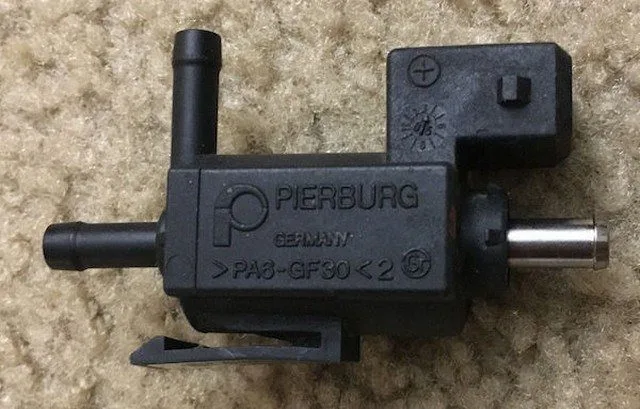
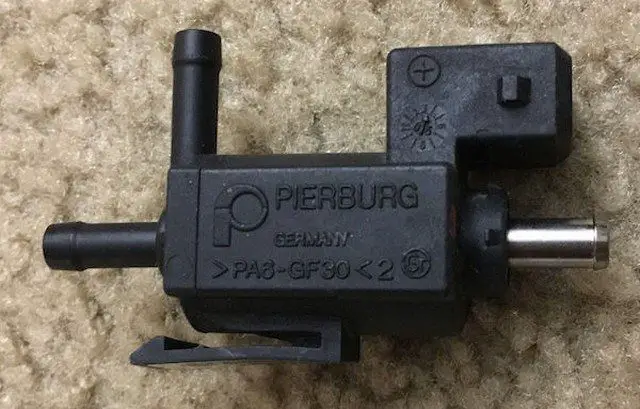
Example of boost control solenoid:
Related Fault Codes
- P0045: Turbocharger/Supercharger Boost Control “A” Circuit Open
- P0047: Turbocharger/Supercharger Boost Control “A” Circuit Low
- P0048: Turbocharger/Supercharger Boost Control “A” Circuit High
- P0049: Turbocharger/Supercharger Turbine Overspeed
- P004A: Turbocharger/Supercharger Boost Control “A” Circuit Intermittent/Erratic
Severity and Symptoms of Code P0046
This code’s severity is moderate to severe. Malfunction can lead to power loss, dangerous overboost (risk of engine knock and damage), or premature turbocharger wear. Diagnosis should be performed as soon as possible.
Common Symptoms:
- Engine power loss (insufficient boost)
- Engine knock and risk of engine damage (excessive boost)
- Malfunction Indicator Light (MIL) illumination
- Abnormal turbocharger noises
Possible Causes of Code P0046
- Faulty or stuck boost control solenoid
- Failed boost pressure (MAP) sensor or position sensor
- Damaged or clogged turbocharger/supercharger
- Wiring issues (short circuit, open circuit, corrosion)
- Vacuum leaks (if system uses vacuum actuator)
- Rare PCM module failure
Diagnosis and Repair Procedures
Always start with visual inspection: check connectors, wiring for damage, and look for vacuum or air leaks. Consult Technical Service Bulletins (TSB) for your vehicle.
General Testing Method:
- Solenoid Test: Using a bidirectional scan tool, activate and deactivate the boost control solenoid at idle (~1200 RPM). Observe if engine RPM changes and if position/pressure sensor PID values on the scan tool vary. No change indicates solenoid, sensor, or circuit issues.
- Electrical Circuit Test: Check for power and ground at solenoid connector (solenoid must be commanded during test). Use wiring diagram to trace any faulty circuits.
- Turbo/Compressor Inspection: Remove intake duct and visually inspect turbine/compressor for physical damage or debris accumulation.
- Sensor Test: Test position/pressure sensor (typically 3 wires: 5V reference, ground, signal) according to manufacturer specifications.
- Solenoid Test: Measure solenoid resistance and compare to manufacturer specifications. You can also power it directly (12V) to test mechanical operation (clicking sound).
⚠️ Warning: This is a generic procedure. For accurate diagnosis, always refer to specific vehicle manufacturer procedures.
Need Help?
Diagnosing boost-related codes can be complex. If unsure about your diagnosis, consult a professional mechanic to avoid costly engine damage.