
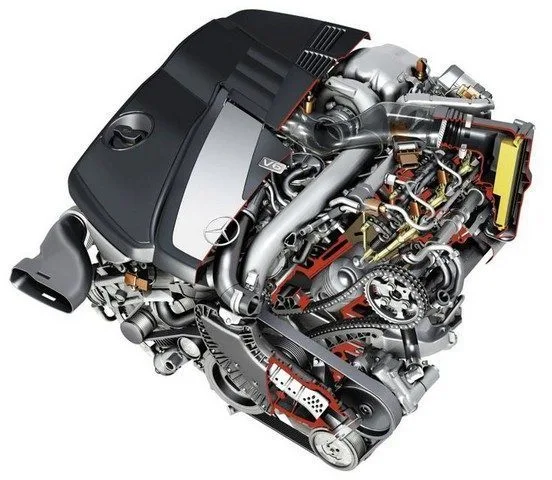
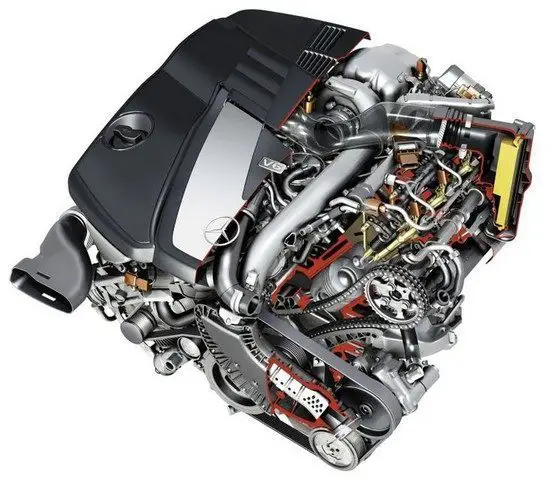
3.0-liter Engine The heart of Mercedes diesel cars like the E320 BLUETEC is a 3.0-liter V6 turbo diesel engine. The engine has four valves per cylinder and each fuel injector is located in the center of the top of the combustion chamber, in the same place where most four-valve gasoline engines place the spark plug, for optimal fuel consumption. A chain-driven balance shaft inside the engine reduces vibrations.
Common Rail Injection
While older diesel engines have a mechanical pump that supplies each cylinder individually, the BLUETEC injectors are fed by a central fuel rail that is supplied with fuel at an extremely high pressure (about 23,000 psi). Diesel combustion is achieved by compressing air to increase its temperature and then injecting fuel. The fuel burns and expands, pushing the piston down. Traditional injectors used a mechanical or magnetic valve. The individual injectors of the Mercedes engine use piezo-ceramic elements whose crystalline structure changes shape when electric current is applied. Piezo injectors can divide the injection cycle into five separate injection events, each specifically timed to maximize combustion efficiency. This not only improves economy and emissions but also reduces noise.
Exhaust Treatment
The BLUETEC system includes a number of components that “clean” the exhaust before it is released into the atmosphere. There are two variants of the BLUETEC system, the NAC + SCR system and the AdBlue system. NAC + SCR is used on the 45-state version of the E320. AdBlue was introduced in the 2008 model year and sold in all 50 states.
NAC + SCR The exhaust leaves the engine and passes through a diesel oxidation catalyst (DOC), which reduces carbon monoxide and unburned hydrocarbons in the exhaust. Next is the NOx Absorber Catalyst, or NAC, which removes and traps nitrogen oxides (NOx is one of the main elements of diesel pollution). During periods of lean operation (low fuel/air ratio), NOx is stored; under richer operating conditions, which can be created by manipulating fuel injection, the NAC undergoes a regeneration process and releases ammonia into the exhaust gases. The ammonia is stored downstream in the selective catalytic reduction (SCR) catalyst, which uses it to further reduce NOx. Between the NAC and SCR catalysts is a particulate filter that traps particulate emissions (soot). When the particulate filter is full, the engine computer manipulates the fuel injection process to increase the exhaust gas temperature, which in turn burns off the particles.
AdBlue
The AdBlue system houses the DOC and the particulate filter in a single unit. In addition to the NAC catalyst, ammonia is supplied by injecting a fluid called AdBlue into the exhaust upstream of the SCR catalyst. Adding AdBlue fluid allows the SCR catalyst to reduce NOx emissions to an even lower level than the NAC-SCR system. AdBlue is carried in an onboard tank that can be refilled during car maintenance. One gallon of AdBlue fluid lasts about 2400 miles.