
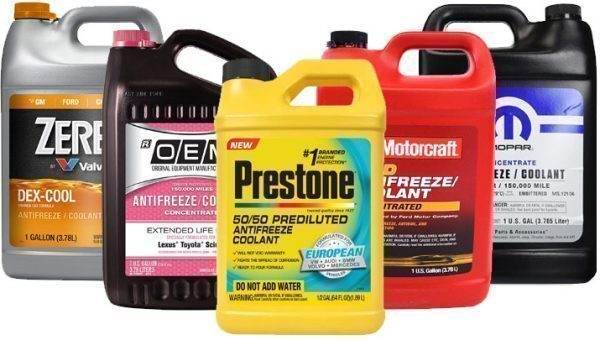

The gasoline or diesel engine in your car or truck produces the power needed to push you down the road. At the same time, that engine produces a considerable amount of wasted energy in the form of heat. And that heat must be drawn out of the mechanisms inside the engine and effectively discharged into the outside air.
How can that happen? Well, unless you are driving an old VW Bug, a Chevy Corvair, or a Porsche, your car will have a water-cooled engine. Your car will also have an engine with internal water passages, a water pump, a heat exchanger called a radiator, and a bunch of flexible hoses connecting these items together.
How does all this work? When the engine is running, the water pump circulates the coolant through the engine and to the radiator. The hoses carry this fluid. As you drive, the water picks up heat from the engine and releases that heat into the air flowing through the radiator. This prevents your engine from overheating.
What is Engine Coolant?
In the above description, “water” is the term used for the coolant. But the coolant will not be just water but a mixture of water and antifreeze. The technical term for this mixture is coolant.
Simply put, coolant is the liquid used to cool your car’s engine. To properly understand today’s automotive coolants, we must first look at the qualities of pure water once used for this purpose.
For engine cooling, water has very positive qualities.
- It has a very high specific heat capacity. That is, water can hold more heat per unit volume than almost any other fluid.
- It has a fairly high boiling point.
- It is available virtually everywhere at a remarkably low cost.
There is no doubt that these three factors made water the coolant of choice in the early 1900s when motor vehicles came on the scene. But there are several problems with using water alone that made it then and even now inferior to the ultimate engine coolant.
- Water has a freezing point of 32 degrees Fahrenheit, making it unsuitable for engines used in most high-latitude climates worldwide.
- Worse, when it freezes, it expands. This behavior can crack any water-cooled engine in winter with water alone. And it can also freeze inside a radiator and easily destroy that expensive part.
- Water promotes corrosion (creates metal oxides or rust) with the materials commonly used in engines and radiators.
Very early in engine development, chemists began modifying water with added chemicals to make it a more suitable coolant. These additives aimed to both overcome the disadvantages of water described above while preserving the benefits that water brings to keeping things cool.
Making Water the Ideal Coolant

Early in the history of engine cooling, the biggest problem was coolant freezing. And chemists quickly discovered that methyl alcohol (methanol) could be mixed with water and thus lower its freezing point. Methanol was the first coolant additive called antifreeze.
Unfortunately, this antifreeze also lowered the boiling point of water, introducing a new and major problem. Fresh water boils at 212° F. Engines reach operating temperatures equal to or greater than 212° and can easily boil water. The lowered boiling point using methanol for antifreeze could not be tolerated.
The next step forward was a chemical called glycerol. It lowered the freezing point of water but was only effective down to -36° F. Not low enough for all winter weather conditions. An even better product was needed.
In 1926, chemists found a lasting answer, a petroleum-based derivative called ethylene glycol. When added to water, ethylene glycol not only lowers the freezing point sufficiently but also increases the boiling point. Ethylene glycol became the new antifreeze of choice for combustion engines.
Ethylene glycol has about half the specific heat value of water. So, when added to water, the amount of heat a given volume of this coolant mixture can hold is reduced. Cooling systems must circulate higher flow rates of this coolant to transfer the same amount of heat that water alone would carry.
Furthermore, pure ethylene glycol is sweet-tasting and toxic. A spill of coolant from your car with this particular antifreeze mixture on your driveway could leave a toxic puddle. Your neighbor’s puppy might be attracted to the taste of lapping it up, leading to sad consequences. Always clean up coolant spills to avoid such a disaster.
Propylene glycol, a second, more recent option for antifreeze, also works well for automotive cooling purposes. And in moderate amounts, it is non-toxic. However, when used in coolant mixtures, it is prone to developing bacterial and fungal growth over time. Special additives minimize this risk.
In 2012, U.S. antifreeze manufacturers agreed to add a bitter-tasting chemical to their antifreeze products to mitigate the toxicity problem. This did not prove to be a total success.
For this reason, the use of propylene glycol has expanded. The chemical, glycerol, whose use for automotive antifreeze was abandoned in 1926, has recently been reconsidered as a possible non-toxic replacement for ethylene glycol.
Antifreeze manufacturers use proprietary additives to extend the life of the antifreeze, minimize corrosion, improve water pump performance, and reduce foaming.
The characteristic antifreeze smell you may have noticed from time to time under the hood comes from a common corrosion inhibitor, tolyltriazole. A secondary benefit with this additive is that antifreeze leaks are often easily detectable with a sensitive nose.
Does It Matter What Coolant I Use?
Yes, absolutely. Your car or truck owner’s manual will give you precise advice in this regard. Ignoring this direction could eventually cost you a bundle in repairs a few miles down the road.
Different Types of Coolant
A popular auto parts store sells 17 different types of antifreeze for cars and trucks. Here, we will try to group this dizzying array into the basic types of antifreeze and antifreeze colors you might expect to find on retailer shelves.
Additionally, you will need to choose between full-strength antifreeze or a 50-50 mix of antifreeze and water.
Full-strength antifreeze will require you to mix it with distilled water before installing it in your car’s cooling system. A 50-50 mix will work for most winter climates, protecting against freezing down to -35° F. For extreme cold, a 60-40 mix of antifreeze to water can be used to provide low-temperature freeze protection.
Furthermore, never fill an empty cooling system with 100% antifreeze, i.e., antifreeze without added water. In this situation, undiluted antifreeze will freeze at about 10° F instead of the -35° F achieved with a 50-50 mix.
Let’s review the colors and types of antifreeze. Coolants are colored to help identify the coolant in an engine. This can help us avoid adding the wrong coolant. Additionally, the loss of its bright color can indicate to us that a coolant is at the end of its life.
#1 – IAT (Inorganic Acid Technology)

Typical Color: Bright Green
This is the oldest coolant mixture and was installed by all domestic automakers until about 1994, with some brands such as Ford continuing until 2002.
Asian and European automakers stopped using this mixture in 1990. It contains phosphates and silicates and works quite well with cast iron engine blocks and copper or aluminum radiators.
IAT coolants must be flushed and renewed every 2 years or 36,000 miles. If left in an engine beyond these limits, the inevitable formation of clogging solids could degrade a cooling system’s performance. Heater core blockages were not uncommon with this coolant years ago if it was not regularly replaced.
#2 – OAT (Organic Acid Technology)
Typical Color: Orange, Red, Blue, or Dark Green
This type of coolant contains neither phosphates nor silicates and is found in most domestic cars built after 1994. The extended coolant life of up to 5 years or 150,000 miles is an advantage with these coolants.
#3 – HOAT (Hybrid Organic Acid Technology)

Typical Color: Yellow, Turquoise, Pink, Blue, or Purple
These coolant mixtures fall between IAT and OAT types and are called Hybrid Organic Acid Technology (HOAT) products. HOATs are commonly installed in new Chrysler products as well as European and Asian cars.
#4 – Dex-Cool
Typical Color: Orange
Dex-Cool, an OAT type, was developed in 1995 for GM cars. When owners mistakenly added green coolant to systems containing the Dex-Cool system, blockages frequently occurred.
In other respects, Dex-Cool is an acceptable coolant but should never be mixed with other types of antifreeze.
Carmaker Branded Antifreeze
For your recent domestic or foreign car model, going to the dealer parts counter for antifreeze may be your best bet. By doing so, you won’t have to interpret the antifreeze specifications and/or usage constraints on those gallon can labels at the parts store.
Although you may pay a bit more, you will also have the assurance of using a coolant formula specially blended for your car.
What Type of Coolant Does MY Car Need?
Your car came from the manufacturer with the type of coolant it needs. For its lifetime, that same type of coolant should be used. The type will be specified in your owner’s manual.
Qualified auto parts specialists can also provide you with this information if you need to purchase antifreeze.
Can I Mix Different Coolants?

No. You should never take that risk. Coolant mixtures are decidedly different.
Of course, there are at least three manufacturers making a so-called “universal” 150,000-mile extended-life coolant (yellow in color). But adding it to your car’s cooling system carries a risk. To be safe, all you need to do whenever antifreeze is required is to purchase the type specified for your specific vehicle.
And what if you are out in the deserts and your cooling system is slowly leaking? If that happens, you can always add distilled water to your cooling system. You can even add clean water from a nearby stream if you are desperate. But that is a temporary solution until you get back to civilization.
Why? Because adding that water will degrade the freeze and boil-over protection. So, you should soon have the system leak checked and the coolant mixture either corrected to restore protection or the system flushed and filled.
Can I Add New Coolant to Old Coolant?
Yes, you can. But here is the rule:
- The new coolant you add must be the same type and color as the existing antifreeze in your car’s cooling system. Failure to follow this rule could cause costly damage to your engine.
Furthermore, when adding coolant, you should always use a pre-mixed 50-50 antifreeze mixture. Most cars will already have a 50-50 mixture installed. Thus, your addition of this fresh coolant mixture will not significantly disrupt the freeze and boil-over temperatures.
What Can Happen if I Use the Wrong Type of Coolant?
Adding the wrong antifreeze to your cooling system can cause the coolant to coagulate and clog the radiator or the entire system.
If severely clogged, the system cannot be easily flushed and may require costly complete disassembly for decontamination.
An Important Caution with Pre-Owned Vehicles
Let’s say you just bought a used car, perhaps five years old or more and/or with over 150,000 miles on the odometer. Your first maintenance job on this car should be a complete cooling system drain and flush with the correct new coolant installed.
You may not know if such service has ever been performed for your “new” car. So, it would be extremely wise of you to take this step.