
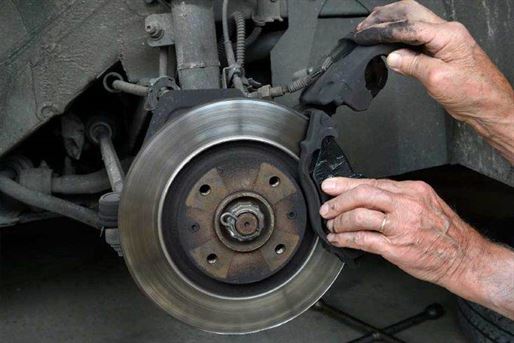
The issue we want to discuss in this article is that you have suddenly started hearing a brake squeal only when you reverse your car. You wonder what has happened to the braking system. Many drivers thought it might be because the brakes were already worn out. Yes, but that’s not the only reason; there are still many causes for your braking system to squeal. Let’s find out why car brakes squeal in reverse!
Why do car brakes squeal in reverse?
Car brakes are designed as a safety device when you drive your car. However, no driver wants to hear an annoying sound every time they press the pedal to get out of their vehicle. Why do my brakes squeak in reverse? The reasons will be revealed just below:
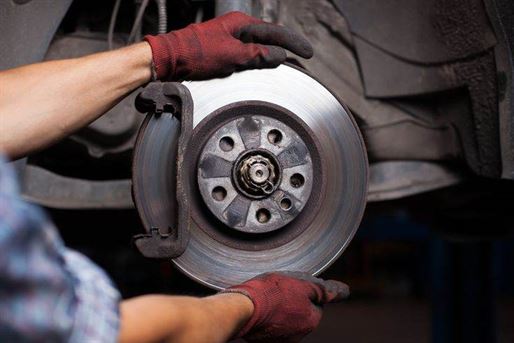
Rear brakes hitting the rotor
Actually, this is not a cause for concern for your car. This problem often occurs on cars equipped with 4-wheel disc brakes due to the relative position of the caliper bracket and the brake pad wear indicator. When you press the pedal and move forward, there is enough tension on the spring steel indicator so that there is no strange noise. But in reverse, you will hear the brakes squealing. In this case, it is a feature of certain car models and not a fault or damage.
Damaged brake pad
The second reason is due to a missing or defective brake pad. These metal parts are often overlooked during disassembly, or forgotten to be installed when changing brake pads, causing brake squeals when the vehicle is in reverse. Therefore, you must pay attention to the installation of the brake pads when replacing them or replace them if they are damaged.
The squealing is caused by the wear indicator bar.
If your car hears a brake squeal even when moving forward or backward, it may be due to the wear indicator bar located at the end of the brake pads. This rod can rub against the brake disc and cause annoying squeals when the vehicle is moving. It is also a sign that you need to replace the brake pads.
Check the friction surfaces
The car squealing in reverse can be caused by a piece of metal getting between the brake pad and the brake disc, causing this squeal. Sometimes, it could be a large rock stuck between the brake disc and the shield guard, which created an annoying noise. You can check and clean the surface of the brake pads and brake discs to solve the problem.
Noise due to lack of lubrication
Furthermore, the noise can also be caused by the brake pads; the back of the brake pads has a metal plate, and they are in contact with the metal brake, so if they are not lubricated, it will cause noise. Thus, when removing the brake pads for replacement, you need to put a little grease on the back of the brake pads to limit noise during braking. But do not apply too much as it could make the brake pads dusty.
Faulty brake pad sensor
The brake pad sensor sometimes makes a noise to signal to the owner that it is time to replace this part; the squealing from this position may be due to metal friction when the brake pads are worn, causing the metal clip to rub against the rotor producing a squeal. One of the consequences of a damaged brake pad sensor is that it is noisy and can damage the rotor, so as soon as you hear this noise, you must replace it immediately to protect the other parts and at the same time improve the operating efficiency of the car’s brake.
Uneven wear of brake discs.
This is also the reason why the car makes noise in reverse or forward. You can move the brake disc forward and backward to have better contact with the brake pads and not cause squealing.
Other reasons
Sometimes, the cause of this problem does not come from the braking system. Because in reverse, we often fully use the steering wheel locking device when we back out of the driveway and move forward onto the road. In this case, the problem may be related to the steering system, as we typically press the brake pedal to stop the car in a fully locked state before the car shifts into drive and begins to steer. Twisted belts and inefficient operation of the power steering pump are the cause of brake squealing when you reverse.
How to prevent brakes from squealing in reverse?

Depending on the cause of the brake squeal, the treatment will be different. To facilitate checking and diagnosing the cause, you need to remove the car’s wheel.
Clean the braking system
If your car’s brakes are squealing due to dirty brake pads or if the brake discs are dirty, simply clean the braking system. Use brake cleaner and a wire brush to clean the rotors, caliper, and caliper bracket; avoid cleaning rubber parts so as not to damage them. If the strange noise is due to worn brake pads, the brake pads must be replaced. If the brakes are noisy due to loose studs, loose brake pads, etc., simply tighten or replace the brake pads if they are worn.
Replace the brake with suitable material
One of the most effective ways to prevent brakes from making squealing noises in reverse is to replace the brakes with a more stable friction material. As you all know, original brake pads are often appreciated in terms of performance and material longevity, but over time, they will have noises due to rust on the brake disc. If you are willing to spend, you can use high-quality metal brake pads or high-quality ceramic brake pads to reduce noise during braking.
However, many manufacturers recommend using high-quality ceramic brake pads. Because this material is capable of operating stably at high temperatures and recovers quite quickly, this material creates dust. It is small and does not affect the brakes like metal brake pads do. So you can be assured that it will not make annoying noise. Furthermore, according to research conducted by the world’s two largest brake pad manufacturers, Akebono and Raybestos, ceramic brake pads have good performance, brake discs wear less during prolonged operation, and most importantly, impressive noise control capability. Finally, you should take your car for periodic maintenance of the braking system to ensure absolute safety when traveling on the road, protecting yourself and other road users.
Note: Before reassembling the entire wheel, you should get into the habit of applying a little anti-seize on the bolts; this will help you avoid problems when removing the nuts in the future.
Try installing the brake pads before applying an anti-seize. If it is too tight, use sandpaper or file the brake pad at the contact point.
Wrap-up
Whenever you hear a strange noise coming from your braking system, whether moving forward or backward. It is always a sign telling you that the braking system needs to be inspected to prevent further damage. Do not put yourself in danger by continuing to drive your car with this symptom. In this blog article, we have discussed the common reasons as well as the solution to fix this problem. I hope this information will be useful to you.