
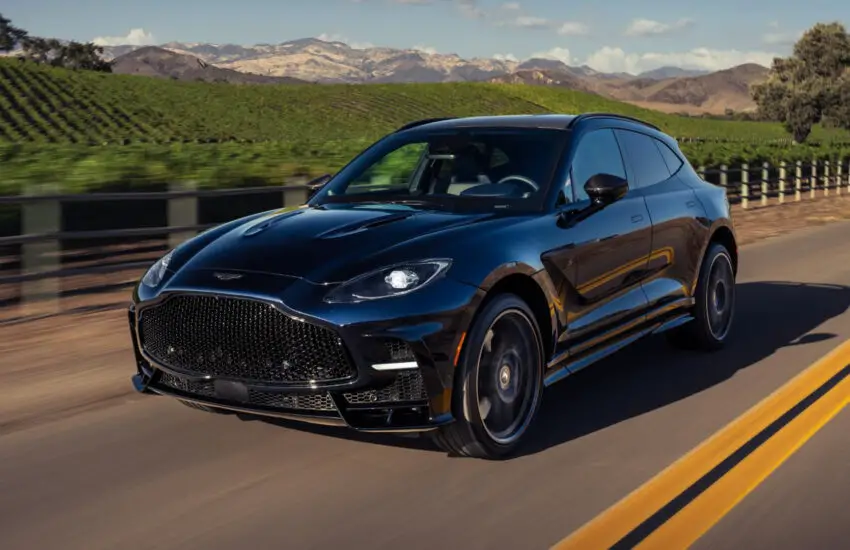
The Mystery of the 200 mph SUV
Last week, I had the opportunity to test the 717-horsepower Aston Martin DBX S. This high-performance vehicle is far more agile than its SUV competitors are willing to admit. This agility is partly due to its weight being 555 pounds lighter than the new BMW M5, while delivering exactly the same power. It shares the title of the world’s fastest production SUV with the Bentley Bentayga Speed, both boasting a top speed of 193 mph. Although I didn’t approach this limit, I observed how the vehicle continues to accelerate until it reaches this astronomical vmax.
The Mythical 200 mph Barrier
This naturally led me to a question: where is the SUV capable of reaching 200 mph?
Thirty-seven years ago, the Ferrari F40 became the first production car to cross this mythical line. Decades later, exceeding 200 mph is no longer the exclusive domain of supercars. Today, there are even Dodge Chargers capable of reaching 203 mph. Do we need an SUV in this exclusive club? No, of course not. But in a world where SUVs dominate the market, base power outputs are increasing significantly, and car manufacturers are constantly seeking new marketing arguments, it seems relevant to explore why no one has yet taken on the challenge.
The Aerodynamic Challenge
The biggest challenge, by far, remains aerodynamic drag. While this issue poses an obstacle for streamlined supercars, it’s easy to imagine that it presents an even greater challenge for elevated family vehicles. Without delving into overly technical details, fundamental physics explains why SUVs encounter such significant aerodynamic resistance at high speeds.
The Issue of Weight and Stability
Beyond aerodynamics, weight represents another major obstacle. By their very nature, SUVs are heavier than sedans or supercars. This additional mass requires significantly more power to reach extreme speeds, not to mention the additional challenges related to braking and stability at such velocities.
Practical and Regulatory Considerations
There are also practical and regulatory constraints. Few roads in the world allow for reaching such speeds legally and safely. Manufacturers must therefore balance the pursuit of records with market reality, where very few customers would actually have the opportunity to fully exploit such potential.
Technological Evolution
Automotive technology is constantly evolving. Advances in composite materials, active aerodynamics, and electric powertrains could soon make what seems improbable today possible. Electric SUVs, with their low center of gravity and instant power, may hold the key to breaking this symbolic barrier.
The Ongoing Performance Race
As manufacturers compete with innovations, the quest for ever more extreme performance continues. The day when an SUV breaks the 200 mph barrier may not be far off. This achievement would then represent a new milestone in the evolution of sport utility vehicles, once again demonstrating how technical limits are meant to be pushed.