
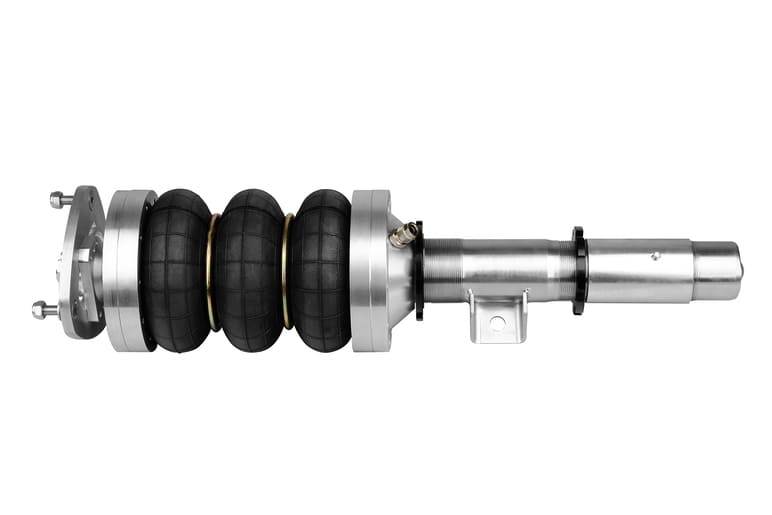
Upgrading your air suspension can improve your car’s comfort.
Whether it’s speed bumps in a residential cul-de-sac, low curbs in driveways, or even potholes or unintended bumps on the road, it’s unfortunate that UK roads aren’t particularly kind to vehicles carrying heavy loads or high-performance sports vehicles. There have surely been times when you wished you could raise your truck or car’s suspension to help it clear an obstacle more easily. Similarly, sometimes when there’s nothing in the back of your van, you sit quite high and feel like you’re riding much slower than usual. While normal suspension systems based on coils and springs are comfortable and provide good vehicle handling, they don’t offer you the ability to lift or lower your vehicle. Enter air suspension.
Air suspension, or air-ride, has been around for a long time, with aftermarket kits first appearing for installation on cars as early as 1920. Besides providing comfort for drivers, it was initially used as a self-leveling suspension for heavy loads. People even used it to help illegally transport moonshine! That’s why, even today, many new trucks and trailers come equipped with air suspension systems, and there’s a whole range of aftermarket kits that can be fitted later.
Air Lift is one of the most well-known companies in aftermarket air suspension and has been around since 1949. Although we tend to associate air-ride as being more comfort-oriented than performance-focused, it was extremely popular in drag racing and NASCAR in the 1950s and 60s.
So, what is this air suspension, why do people want it, and what are the pros and cons of using air suspension?
WHAT IS AIR SUSPENSION AND HOW DOES AIR SUSPENSION WORK?
Conventional shock and spring suspension systems with steel components provide the vehicle with excellent handling and fantastic overall performance. Air suspension, however, replaces these components with robust rubber airbags that can be inflated using an onboard or external air compressor. This allows the vehicle to lift or lower depending on how much the airbag is inflated and can make a car much more comfortable to drive or give it a better appearance. Does air suspension affect performance? Yes – but not necessarily in a bad way. Modern kits also include features like adjustable camber top mounts and adjustable damping, meaning you can have the best of both worlds.
It’s important to note that there are two different types of air suspension: “semi” air suspension and “full” air suspension.
“Semi-air suspension” supports a car’s existing suspension. It’s often found on heavy goods vehicles or trucks. An air spring is installed between the chassis and the rear axle, which increases the vehicle’s ride height and generates greater spring travel. In this way, semi-air suspension helps increase the level of comfort and stability when traveling in your vehicle.
If you’re experiencing suspension issues, full air suspension could be a fully automatic and adjustable solution. The conventional suspension system is completely replaced by a full air suspension system that filters out road surface irregularities, making the ride much more comfortable.
Ultimately, the only major difference between conventional and air suspension systems is that instead of the car resting on a coil spring, it rests on a rubber bellows filled with compressed air. Since the bags aren’t pre-inflated, they are supplied by an air tank and an electric air compressor, and the car can be raised and lowered simply by inflating and deflating the bag.
WHAT ARE THE KEY COMPONENTS OF AN AIR SUSPENSION SYSTEM?

AIR SPRINGS (BAGS)
These are robust rubber bases that replace the coil spring in a conventional setup. They come in two main styles: the coilover setup or the conventional style. In the coilover setup, the bag has a hole in the middle allowing the shock absorber to pass through it. In the conventional style, the bag is completely independent of the shock absorber.
Modern airbags don’t look like a balloon filled with air as we might imagine. They are solid and durable and designed to expand and contract only vertically. When fully inflated, they can have an air pressure of 100 psi.
SHOCK ABSORBER
If you have a suspension design where the spring is mounted separately from the shock absorber, the same shock absorber you would have used with your conventional coil spring can be used. Fortunately, nowadays, with the growing popularity of airbags in the tuning scene, there are now coilover-type kits for a wide range of cars, offering a matched shock absorber and airbag combination. These kits not only simplify installation but also improve handling and ride quality. Many of them feature shock absorbers with adjustable height platforms for the bags, adjustable damping, and even adjustable camber top mounts.
COMPRESSOR
Air doesn’t magically enter the airbags. That’s what the compressor does. All air suspension kits require at least one compressor, and you’ll typically find that the one supplied is quite small and compact; they often fit perfectly in the car’s boot. They often run on a 12-volt power supply, so they won’t drain your battery. The big issue, however, is that they are often very noisy.
AIR TANK
This compressor noise is what makes the air tank necessary. You could do air-ride without it, but the pump would have to run far too often, and it would take too long to lift the car unless the pump was gigantic. An air tank is used as the main supply for the airbags, and the air compressor is used simply to keep the tank above the minimum pressure. Depending on their size, air tanks allow the suspension to be raised at an acceptable speed without the compressor needing to kick in. However, this also has to be stored in the boot of many cars. You just need to decide what’s more important to you; more boot space or a larger tank.
ADVANTAGES
IMPROVED FUEL ECONOMY
The higher your suspension is, the greater the wind resistance of the truck and trailer, meaning your fuel economy will be worse.

Advanced air suspension systems can adjust the ride height based on the load weight and the type of journey you’re making. For long, smooth highway trips with light loads that compress the suspension less than heavy loads, the suspension can be set lower to maximize your fuel economy. For heavy loads, the suspension can be made as firm as needed, and the vehicle remains lower to the ground due to the heavy load. In both situations, the vehicle stays low, and you save fuel. In a conventional suspension system, if the load was light, the vehicle’s suspension, designed for heavy loads, would remain stiff, and your fuel economy would be much worse due to resistance.
MORE ENVIRONMENTALLY FRIENDLY DUE TO REDUCED CO2 EMISSIONS
Thanks to this decreased fuel consumption and smoother driving, it automatically means less fuel used, journeys are quicker and shorter, and consequently, it’s much better for the environment. That’s something we can all be happy about!
REDUCED VIBRATIONS
Better for your cargo and better for your back on long journeys, air-ride reduces vibrations in the truck or car. Back pain isn’t just something that comes with age; Long-haul truck drivers can experience it if they remain seated for long periods. Vibrations also cause fatigue and discomfort, meaning a happier, fresher, and ultimately safer driver.
Similarly, goods transported by the truck are less likely to be damaged or shift in the back of the van or truck (even though packaging and load restraint methods these days are very good anyway).
Alongside this, a trailer can be used for more types of loads when the suspension setup is flexible. Fragile loads like glass are less likely to be damaged, and loads with difficult weight distribution can be leveled.
IMPROVED TIRE WEAR AND HANDLING
Fewer vibrations and better load distribution through leveling lead to better tire wear. Some air suspensions can even lift unused axles, thereby extending the life of those tires.
Suspension is also a significant factor in how a vehicle behaves. Better suspension could mean a lower risk of rollover. If the vehicle is higher off the ground, it’s much harder to handle, and this can be a problem for vans or trucks with a rigid suspension system when they’re not carrying a load.
EASY INSTALLATION

The advantage of these systems is that they are very easy to install. Five years ago, it might have been a bit different, but nowadays, there are various direct replacement kits for a large number of popular cars. While installing a full air suspension system on a car is still a job for professionals, for most of us, installing a semi-air suspension is no more difficult than installing a set of coilovers and shouldn’t take more than a day. These “plug-and-play” semi-air suspension kits are also relatively inexpensive. Where to install the air suspension isn’t much of a problem either, as these kits are designed to fit current suspension systems, provided there’s boot space for the tank and compressor.
DISADVANTAGES
This isn’t to say everything is perfect for air suspension systems, and they do have some drawbacks.
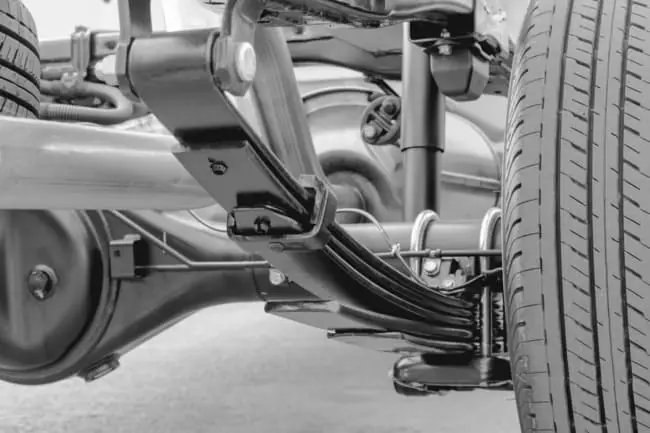
Some truck drivers still claim that the traditional leaf springs of a semi-trailer can provide a better ride, regardless of the load. This could be partly because air suspension can weigh about 50 kg more than leaf spring suspension. This extra weight could actually counteract the “better” handling provided by lowering the vehicle and make driving more difficult.
Since it weighs considerably more, it might be possible to install other aerodynamic devices such as trailer skirts and cab side fairings to achieve the same fuel economy gains.
Leaf spring suspension is also much more durable and typically doesn’t require much maintenance for the first 5 to 7 years, after which it will need to be tightened. In contrast, with air suspension, cars need to be serviced more frequently – up to 3 times the cost over the first ten years. Air suspension can leak, and you’ll need to keep spare air lines and other parts. Air suspension also needs to be tested more frequently, which takes time.
Although leaks are rare, finding them can be a bit frustrating. You’ll also lose some of your boot space. You need a decent-sized tank to prevent the noisy compressor from kicking in when you lift the car. Height changes aren’t as fast as with hydraulics.
Common air suspension problems can also include the air suspension being inactive due to a leak or the control unit being broken. The compressor could also fail, or the air tank could lose pressure. All these components then need to be serviced or replaced, which could cost you more in parts and repair fees at a garage.
THE VERDICT
So, what’s it really like to have air suspension and use it daily? Better than most people might expect. A good kit, properly set up, will perform much better than the conventional suspension of vans or trucks. For your average passenger car, it might not be worth it, as regular suspension will do the job just fine. That said, people have willingly drifted and set respectable lap times on air setups, so if you have a particularly low-slung car, like a Porsche Carrera or almost any Mercedes S or E-Class, it could be an option for you.
You will, of course, lose a bit of boot space to the compressor and air tank, but no more than with a subwoofer box or a nitrous bottle, and there’s very little weight penalty in adding the air-ride kit.
Don’t be mistaken, however: air-ride doesn’t offer the instant height jumps that hydraulic systems do (you won’t be bouncing like a lowrider), but it actually only takes a few seconds, and with a correctly sized tank, it can be done quietly too. If you’re wondering if air suspension is reliable, rest assured it is, and countless people have these systems on their daily-driven cars with no issues at all.