
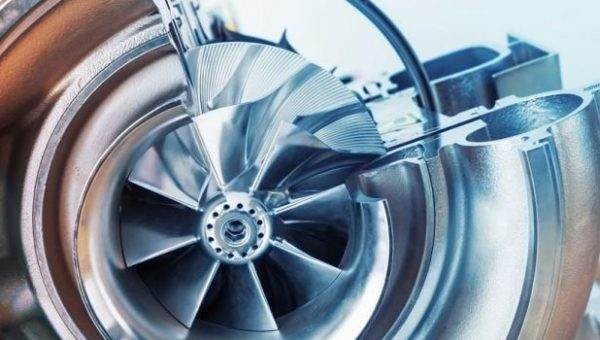

The modern internal combustion engine car is equipped with a turbocharger or even a supercharger. These are intended to improve the energy efficiency and performance of standard gasoline or diesel cars. With the advent of modern technology, the automotive industry is beginning to introduce electric turbos. But what are these strange new devices? Read on and find out what ingenious technology lies behind this name.
- 1 What is a conventional turbocharger?
- 2 What is an electric turbocharger?
- 3 Advantages of electric turbochargers
- 4 Disadvantages of electric turbochargers
- 5 Installing an electric turbocharger
WHAT IS A CONVENTIONAL TURBOCHARGER?
The standard turbocharger, or turbo, is a device that increases the power of an internal combustion engine through the forced induction of compressed air. Since an internal combustion engine generates locomotion by burning a fuel-air mixture, the rate at which this mixture is burned is a major factor in determining the engine’s power. A faster burn rate results in a more powerful operation. To achieve this, the turbo is powered by hot exhaust gases. This results in the rotation of a turbine that compresses the air which is ultimately delivered to the engine.
A supercharger works in a similar way, but the method by which it is powered is different. While a turbo is powered by hot exhaust gases, the supercharger is driven directly by the engine. This results in distinct advantages and disadvantages for both variants: turbochargers take time to start, as they depend on exhaust gases to operate, while superchargers are less fuel-efficient but increase engine power from the moment the engine starts. This tendency of turbos to take time before becoming fully functional is called turbo lag.
WHAT IS AN ELECTRIC TURBOCHARGER?
An electric turbo attempts to offer the best of both worlds: the brutal efficiency of a fully active turbocharger coupled with the elimination of the annoying turbo lag that a supercharger brings to the table. Unsurprisingly, their basic functionality is essentially identical to that of a standard turbo: just like its non-electric counterpart, the E-turbo is powered by hot exhaust gases generated by the engine while the vehicle is being driven. Unlike the conventional turbo, however, it also includes either a small air compressor which in turn is powered by an electric motor, or an electric motor to spin the turbines when there is not enough exhaust gas available. This provides the necessary compressed air to boost engine power before the traditional turbocharger is warmed up and functional.
ADVANTAGES OF ELECTRIC TURBOCHARGERS
The advantages of an E-turbo are clearly visible: it eliminates turbo lag by providing the air input normally supplied by a turbocharger once it is warmed up. Unlike a supercharger, electric turbos are not active all the time and therefore do not reduce engine power at all while providing the same level of torque regardless of engine speed. While the power increase gained from using a supercharger outweighs the cost of engine power to keep it running, an electric turbocharger can avoid undermining the engine’s power to stay active in the first place, thus increasing the power gained by activating the device. They also have the advantage of being able to be deactivated when not needed, for example during long journeys at constant speed. This allows the engine to operate at a higher efficiency and save fuel in the long run. By now, one could argue that the advantages of an electric turbo can just as well be achieved with a twin-charging system, i.e., a combination of turbo and supercharging. While this may be the case, an E-turbo takes up much less space and achieves the effect of the supercharger part of the system without any power loss. Electric turbos also reduce overall emissions and have the potential to use exhaust gases to power generators when they are not needed.
DISADVANTAGES OF ELECTRIC TURBOCHARGERS
Electric turbos are still very new, and not all the flaws of this cutting-edge technology have been resolved. For one, the electric turbo still aims to increase a vehicle’s performance. A reduction in fuel consumption or emissions is not its primary goal, so it will likely lead to an increase in both, even if not as much as with a conventional turbo or supercharger. Furthermore, given its status as an emerging technology, electric supercharging will remain relatively expensive for some time. Its reliability is also largely untested, given the lack of data, which in turn is the result of limited application. It could also be argued that electric turbochargers are increasingly unnecessary given that the writing is on the wall for fossil fuels and thus for internal combustion engines that use gasoline or diesel.
INSTALLING AN ELECTRIC TURBOCHARGER
If you are wondering how to install an electric turbocharger, you should be wary of the nature of many private offers online. In many cases, these electric turbos are little more than fans that provide little or no extra power. Instead, rely on trusted manufacturers and opt for the installation of these devices by experts in a garage sufficiently equipped to maintain this type of technology. If you intend to install the device yourself, make sure you have the necessary experience and read the manufacturer’s instructions carefully to avoid any mistakes.