
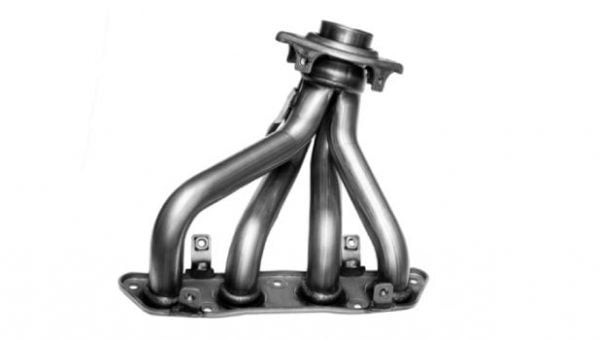

What goes in must come out – what happens to exhaust gases after combustion.
- 1 What is the exhaust manifold and why is it important?
- 2 What are manifolds made of?
- 3
Symptoms
of exhaust manifold problems
- 3.1 An excessively noisy engine
- 3.2 Reduced power and acceleration
- 3.3 Reduced fuel efficiency
- 3.4 Visible rust on the manifold
- 3.5 Visible cracking
- 3.6 Exhaust odor
- 4 How to replace your exhaust manifold and gasket
The combustion process is a wonderful thing. The process of taking only air and fuel and using compression or ignition to create mechanical power is one of the most important scientific discoveries of all time. What accompanies this power, however, are the exhaust gases that must be removed through the exhaust system, and that is precisely the job of the exhaust manifold. This makes it one of the most important parts of your engine, even though it’s just sitting there with gas moving inside.
This vital engine part is partly responsible for keeping the engine cool and allowing more combustion. Without it, all that science would be wasted. But what exactly is it? What is the temperature of exhaust manifolds? Why do exhaust manifold bolts break? Read on to discover everything you need to know about this important element of your car’s engine and how to identify some of the most common problems.
WHAT IS THE EXHAUST MANIFOLD AND WHY IS IT IMPORTANT?
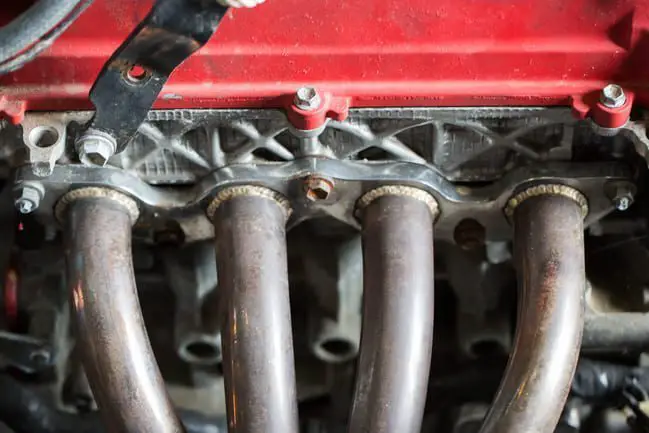
A car’s exhaust manifold is used to direct exhaust gases from the engine cylinders to the exhaust pipe under the body. Once they leave the exhaust manifold, the gases pass through the emissions system and the car’s mufflers and exit through the tailpipe.
The manifold is a metal piece bolted to the side of the engine block on L-head engines and to the side of the cylinder head on I-head engines. Two, three, and four-cylinder engines have one exhaust manifold because there is only one bank of cylinders to extract exhaust gases from.
However, engines with a “V” configuration (V6, V8, and V12) have two manifolds, one for each bank. In some V-8 engines, each manifold is connected to a separate exhaust pipe, muffler, and tailpipe. On others, they are connected by a crossover pipe and exhaust through a shared muffler and tailpipe.
The exhaust valve opens to remove waste from the engine’s combustion process. When the engine’s intake valve opens and the piston descends, meaning the air-fuel mixture is drawn in through the intake valve, the exhaust valve is also slightly open. Without a manifold, all the combustion gases would rush out quickly, making the exhaust valve the path of least resistance for the airflow in the cylinder. With the air and fuel from the intake, the engine would suck cold air through the exhaust valve, exponentially increasing the combustion chamber temperature and quickly melting the exhaust valve, valve seat, and top of the piston. This phenomenon is known as “reversion” and is known to ruin engines. A manifold is key to preventing this.
The gases in the exhaust manifolds are very hot, which increases the pressure. This high pressure in the exhaust manifold forces the gas to “shoot” through the manifold and into the exhaust pipe. Because exhaust gases have mass, they also have inertia, creating a vacuum as they leave the manifold, in what is called “scavenging.” This sucks the remaining gases from the engine and leaves it as well-prepared as possible for the next combustion cycle, thus more efficient. Standard cast iron and “log”-type manifolds typically exhibit little of this power scavenging; the effect is usually most pronounced in tubular headers, which are designed to enhance scavenging.
WHAT ARE MANIFOLDS MADE OF?
Typically, manifolds are made of tubular steel, stainless steel, or iron. Stainless steel is the most expensive because it does not rust and has great longevity, but tubular steel provides good gas flow and is also commonly used.
You will find that most cars, however, have cast iron manifolds. They are cheap to produce compared to others, but they are heavier than steel and become brittle with age and prone to cracking, which we will come back to later.
While most manifolds are simply bare metal, in some cases, a ceramic coating can be applied to the manifold for insulation. This is expensive, and often an “exhaust wrap” is used instead, which is relatively cheap. This “exhaust wrap,” however, shortens the manifold’s lifespan.
Since exhaust manifolds are very hot, most of them are equipped with a metal heat shield to protect other components under the hood. This prevents any unnecessary melting of the engine!
If you are looking to replace your manifold, you can choose between those from your manufacturer, aftermarket alternatives, and even used manifolds salvaged from other cars. Just be sure to check what it is made of and its age first.
SYMPTOMS OF EXHAUST MANIFOLD PROBLEMS
Problems with your exhaust manifold can have serious consequences, such as reduced engine power, slow warm-up times, higher fuel consumption, and premature failure of the catalytic converter. To avoid this, it is important that you know the signs and symptoms that might indicate that your manifold is cracked, leaking, or has another issue.
AN EXCESSIVELY NOISY ENGINE
Engine noises are a good indication that you have a leaking exhaust manifold gasket. The manifold gasket creates a seal between the manifold and the cylinder head to prevent air from escaping, and a faulty manifold gasket sounds like a hissing or tapping. When you start the car cold, the sound will be at its loudest, and it will increase when you accelerate.
REDUCED POWER AND ACCELERATION
If your manifold gasket is leaking, you will notice that your car is not performing as it was or should be. The backpressure provided by the manifold ensures that the combustion process runs as well as possible. If the vacuum is not created, the process will not run as efficiently as it should. Your car will be slower and will not accelerate as quickly from a stop. Get this leak fixed, or the problem will only get worse. It should be noted, however, that a manifold is not the only reason for reduced power and acceleration.
REDUCED FUEL EFFICIENCY
Fuel efficiency goes hand in hand with performance, and as your car loses power, it will consume more gasoline. The car has to work harder and harder to maintain the same level of performance it would have without exhaust problems. While you might consider the cost of repairing any manifold issues, the cost of extra fuel will exceed it over time.
VISIBLE RUST ON THE MANIFOLD
Rust can appear on all metal parts, especially those exposed to air (rust is caused by metal oxidation). Since the manifold is metal, it can be prone to rust, especially if it is made of iron. The fact that the system is close to the ground where it is exposed to moisture and gritty conditions means it is particularly vulnerable. If the rust is severe enough to cause holes or cracks to appear in the manifold, you will start to hear a loud roaring engine noise or a hissing as gas escapes. This will certainly require professional attention and may potentially require replacing the manifold.
VISIBLE CRACKING
Besides possible noises and a drop in performance, the most obvious sign of a cracked manifold is, well, a visible crack on the surface of the manifold. To look for a crack, carefully examine the manifold, especially where it bolts to the engine and where the most heat will be. A large crack will be relatively easy to spot, but a smaller hairline fracture may be harder to locate. You may need to remove the manifold from the engine compartment to inspect the entire surface. This type of problem will let you know when to replace an exhaust manifold.
EXHAUST ODOR
 Symptoms
of exhaust manifold problems” width=”650″ height=”433″ />
Exhaust odor is one of the most obvious symptoms of an exhaust manifold leak. Manifold cracks can also cause excessive exhaust odors, as some of the exhaust gases escape from the crack instead of the tailpipe end. You may not be able to notice this exhaust smell from inside the vehicle, but if you open the hood and the engine compartment stinks, especially around the manifold, it’s a good indicator. If you can smell an exhaust odor, it means the crack or leak must be quite severe, and this can be harmful to your health.
HOW TO REPLACE YOUR EXHAUST MANIFOLD AND GASKET
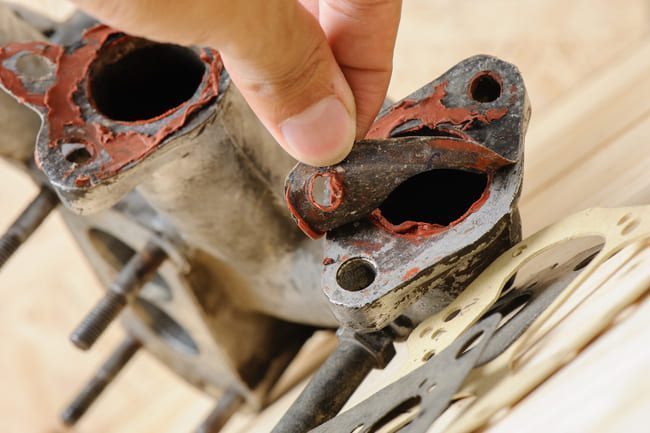
For a cracked exhaust manifold, you really have no other choice but to replace it. Trying to seal cracks is a bad idea, and using some sealant products could even damage the performance of the manifold itself if not done correctly.
Exhaust manifold gaskets can also be replaced to fix leaking issues, but they can also be repaired. A “blown” exhaust gasket can be replaced, or you can use a sealant to stop it from leaking, and a blowing exhaust manifold is something you can easily fix yourself.
The exhaust manifold can be found attached to the engine block. Consult your vehicle’s user manual to find the precise location of it in your vehicle. To replace the gasket or manifold, you will need to undo all the nuts and bolts that secure the manifold to the cylinder head. Sometimes the gasket may stick to the manifold; tap it with a hammer to loosen it. If any manifold studs are broken or damaged, remove them using locking pliers, two nuts and a wrench, or a stud extractor. Once the manifold is safely removed, carefully scrape all gasket mounting surfaces to remove dirt and pieces of the old gasket. Do not let particles fall into the manifold or cylinder head, as this will cause many problems later. This is a good opportunity to see if the manifold itself is cracked or damaged. Check that the surface is not warped.
If you are simply changing the gasket, place it in the position where the old gasket was, making sure it is facing the right way, with all holes aligned. On some engines, a gasket may be in two or three pieces, or inserts may be installed; make sure all parts are properly aligned. Finally, simply reverse these steps to reassemble your exhaust manifold. You should tighten the manifold nuts using a torque wrench and ensure you adjust them to the recommended setting in the car’s service manual. You should tighten them in order, starting from the center of the manifold and working outward toward the ends.
You might encounter problems here with the exhaust manifold bolts. It is important that you know how to remove exhaust manifold bolts without breaking them, and it can be a bit mysterious why exhaust manifold bolts break in the first place.
Since most manifolds are made of cast iron, when exposed to intense heat and then cooling, they regularly expand and contract. This expansion occurs naturally, and initially, the manifold and mounting bolts are in a state of “elastic deformation,” meaning they retain their original size and shape during these cycles and can be flexible, even when expansion/contraction puts pressure on the bolts.
Over time, however, expansion and contraction can subtly affect the manifold’s dimensions, and this means that increasingly larger tensile forces stretch the manifold beyond its “elastic deformation” point. This fractures the mounting bolts, leaving the manifold permanently deformed and dimensionally altered. This expansion and stretching of the manifold bolts over many service cycles eventually causes excessive stress on the bolt(s), stretching them beyond their capacity and causing them to fail. If this has happened, when you remove the bolts to replace the manifold, it may seem like you broke them, but this fracture occurred long before.
If you need to remove an exhaust manifold and the bolts (or even the manifold itself) are rusty and corroded, you will want to remove the bolts without breaking them. If you break them while removing them, it could risk parts falling into the engine itself and require much more work. It is best to leave this to the experts, but it can also be done using an acetylene torch to heat the studs that hold the bolts. This will allow you to remove them easily, but it certainly means you need to replace the manifold.