
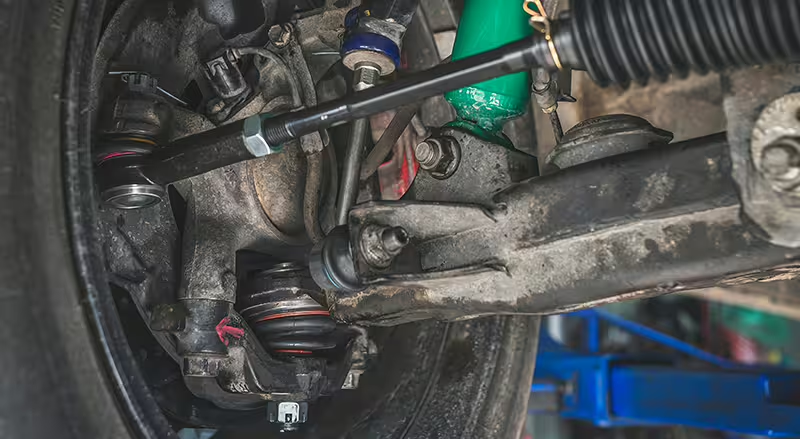
Ball joints, which are part of the suspension system, play an essential role. These ball joints are responsible for connecting a car’s or any other vehicle’s control arm to the steering knuckles. In this way, the ball joints manage the overall movement of the front wheels and the suspension. Sometimes, ball joints wear out, but this can be identified using the symptoms of a faulty ball joint.
Before learning how to tell if a ball joint is faulty or the signs of bad ball joints, let’s find out what a ball joint is in a car.
What is a Ball Joint in the Suspension System?
A ball joint is an essential component of a car’s suspension. In modern car generations, all cars use ball joints. Furthermore, a ball joint is a spherical bearing placed in a mechanical socket. It plays a crucial role in the car, much like the ball-and-socket structure in the human body. In the car, it acts as the pivot point to connect the car’s control arms to the steering. The front ball joints allow the front wheels and suspension to move in different directions, thus providing optimal vehicle movement.
Ball joints are hinges for your vehicle’s wheels. So, if a situation of “faulty ball joints” occurs, the wheel’s performance will be worse, and the wheel will not retract into alignment. The wheel will not move straight, and this will have various other side effects on your car’s performance as well as safety. Therefore, it is necessary to diagnose the symptoms of a faulty ball joint to save your car in time.
Symptoms of a Bad Ball Joint: Knowing if a Ball Joint is Faulty
We will describe here some situations that occur only when there is a problem with the suspension system or the ball joints. In other words, these are the symptoms of a broken ball joint. It is recommended that once you encounter any of these conditions, take your car to a professional repairer, as leaving your car with the symptoms of a worn ball joint will damage your car and your health as we mentioned above.
The Steering Wheel Wanders
The first symptom of a faulty ball joint is the steering pulling to the left or to the right. At first, the signs may be subtle or not very pronounced and become noticeable enough during a single trip. However, this is one of the symptoms of a faulty ball joint, where the overall driving experience is compromised. When you feel that the vehicle is no longer as stable as before, something is not working correctly.
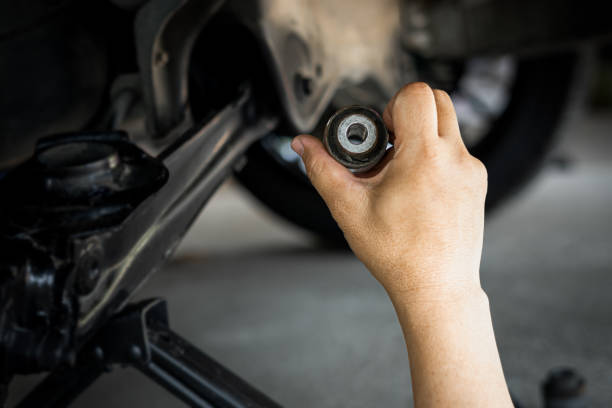
It is quite noticeable every time you use this steering wheel, and it makes you think instead of giving you that stability. It’s as if the steering wheel shakes every time you take turns that were once precise.
This can be considered a stage where the ball joints have started to wear out, and therefore, one should not wait any longer. Driving without fixing the situation only makes it worse. The ball joints are not necessarily worn out, but they may be loose. Entrust it to a professional and find out the exact reason why you are not getting a quality drive.
Noise: Clunking or Knocking
If you hear a loud, dull noise while driving, it is due to faulty ball joints. Even a slight bump or your car going over a pothole can make you hear this noise. This indicates that there is a problem with the suspension and that due to worn parts, the shock absorption property is not working well.
At first, the noise may not be unpleasant, but over time, if you do not address the issue, it becomes more intense. This situation can be life-threatening and only gets worse over time. Ball joints affect the overall chassis of the vehicle, and if a ball joint breaks completely, you will have no control over the vehicle when moving it in a particular direction.
Tire Wear
Tire tread is also a good factor for recognizing whether your car has symptoms of faulty ball joints or not. You may experience an irregular ride where the tires wobble unusually. This happens because the ball joint causes the tires to point outward. As a result, the tire appears worn on one side and in good condition on the other. This condition is easily visible on both front tires when there is a problem with the joints.

The wear occurs on one side of the tire tread and extends to the middle area to some extent. This pattern repeats on both tires, resembling camber wear, but in a milder version. The problem directly shows that the issue comes from the suspension system, and most often, it is the ball joint.
Excessive Vibrations from the Front of the Vehicle
One of the symptoms of a bad ball joint is excessive vibration coming from the vehicle’s suspension. Worn ball joints will be loose in their housings and vibrate excessively when the vehicle is in motion. The vibration usually comes from the affected ball joint, either on the right or left side of the vehicle. In some cases, car owners may even feel the vibration through the steering wheel.
The Danger of Worn Ball Joints
A worn ball joint is not a problem to postpone: a catastrophic failure of a ball joint will cause the front suspension to break and loss of control of your vehicle. Therefore, you should absolutely have your vehicle checked by your trusted mechanic, who has experience in diagnosing and repairing suspension problems.
If you continue to drive a car showing symptoms of faulty ball joints, the entire suspension can be damaged. In some cases, your car’s ball joint can easily seize. When it seizes, the movement it usually absorbs does not disappear, which has detrimental effects on the car’s performance. Therefore, the movement will be transferred to other components that are forced to accept the unusual movement due to the ball joints being the suspension arm bushings. As a result, the bushings will easily become damaged.

Secondly, worn ball joints can lead to car accidents when they break completely. The ball joint can break in different ways. First, it can detach from the socket and break. Regardless of the type of break, the result is usually dreadful. Any damage to the ball joint means the car’s wheel can move in any direction. This problem can affect your ability to maintain optimal control of the vehicle when driving on the road. Car accidents can happen at any time. Be aware of this and take your car to the mechanic for testing and repair as soon as you notice the unusual movement of your car.
How Far Can You Drive with Faulty Ball Joints?
It depends on the severity of the damage to the ball joints or how worn they are. If you are driving with faulty ball joints, in most cases, you can drive for 800 km without a serious problem. However, you must first measure the intensity of the worn ball joints. If you find that the entire chassis is moving here and there, it is not safe to continue driving.
However, car owners can still drive a few kilometers even if their vehicle is making squeaking noises. So, there are no fixed rules regarding how many kilometers you can drive; you must prove your presence of mind in this case.
The Overall Replacement Cost
Generally, the overall cost of replacing a faulty ball joint depends on the condition of your vehicle. A rough estimate would be $220 to $300. This includes both the cost of parts and labor. Furthermore, the overall condition of the suspension system also affects the cost. To prevent your car battery from draining on its own, read the maintenance tips here.
You should go to several auto parts suppliers and confirm the prices. Choose the one that seems to offer a reasonable price, but don’t rush for a cheap alternative. The cost can be much higher if multiple parts are damaged in the suspension system or elsewhere in your car. Replace only the faulty joints; you are not obliged to replace all joints at the same time if some of them are working properly.
How Often Should Drivers Replace Ball Joints?
There is no fixed rule regarding the replacement of ball joints. However, whenever you take your car for maintenance or an oil change (if you don’t do it yourself), you can ask the repairer to ensure that everything is fine with the suspension. If you think you haven’t taken your car to a repairer for a long time, you should take it then and have the ball joints checked.
By regularly checking your car, you will never notice these symptoms. And if you notice any of these issues, try to get your car repaired as soon as possible.
Tip: drivers should check all symptoms of a bad ball joint, as they are easy to diagnose. It is always better to take precautions than to have regrets.
Conclusion
There are many different situations with ball joints: some ball joints lose their lubrication and can therefore be serviced. You will save money by performing an overhaul rather than a replacement. By having these ball joints re-lubricated, they do not let in external factors during driving and can thus come back to life.
We hope you now understand the symptoms of a bad ball joint and know what to do if it’s the same case for you.