
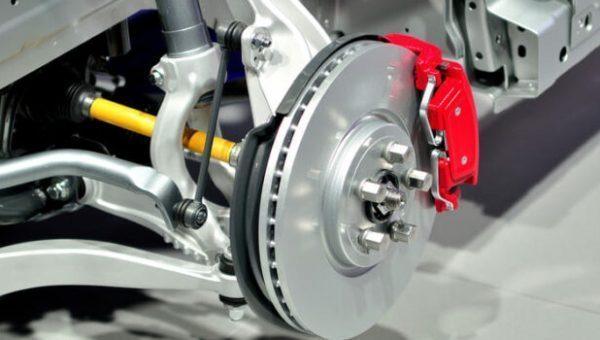

The ins and outs of discs, drums, shoes, and the hydraulic system: how your brakes protect you.
Brakes are as important as the engine of any car and they are essential to ensure your safety when driving. The basic principle of brakes is simple: they take the kinetic energy of the moving vehicle and transfer it into thermal energy through friction so that the car stops. All brakes follow the same principle, but different systems achieve this friction in different ways.
Many factors will determine the type of system your car has and the components it uses, as all systems vary slightly, but here are the systems your car is likely to have, how they work, and what the key components are likely to be. Understanding a car’s braking system and vehicle braking systems can be vital, so read on!
BRAKING SYSTEM COMPONENTS
Before discussing the type of system a car may use for braking, it’s worth mentioning the key components, especially if you’re considering repairing or replacing parts of the braking system. The types of parts your braking system uses will often depend on the car’s make and model, the speeds it can reach, the car’s price, and its age. A braking system will use a drum or a disc and will contain brake pads.
DRUM BRAKES

Drum brakes are the oldest way to stop a car. A drum is attached inside the wheel, and inside are two heat-resistant pads. When the pedal is pressed, the pads push outward and press against the drum, and the drum stops the wheel. The friction caused between the pads and the drum causes the kinetic energy to transfer into thermal energy.
These types of brakes were commonly used on cars until the 1980s. As cars became more powerful, drum brakes couldn’t meet the challenge of stopping them. They get very hot under intense conditions of frequent braking, and if they get too hot, they can’t convert motion energy into heat and they stop working. After the 1980s, many cars started using disc brakes instead.
This isn’t to say, however, that drum brakes aren’t used at all. They are still adequate and they do the job. They are often used for the rear wheel brakes, as when a car stops, most of the pressure is applied to the front brakes. Since drum brakes are cheaper to manufacture and simpler to maintain, they are often used on entry-level or cheaper models.
DISC BRAKES
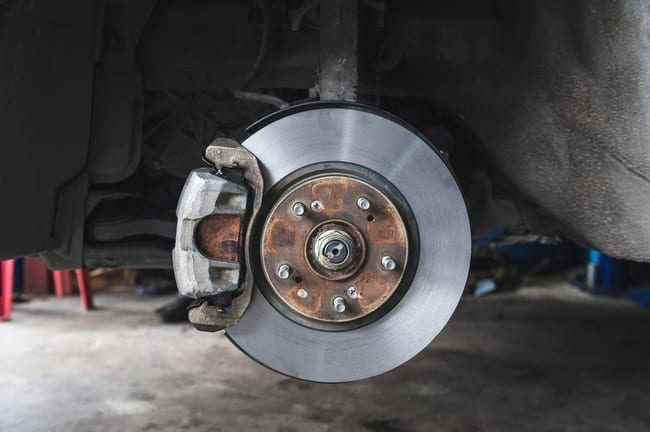
Disc brakes are what “replaced” drum brakes as the most popular choice for most cars. Drum brakes push, and this doesn’t create as much pressure as squeezing the wheel. So experts designed a system where something is squeezed rather than pressed. They also discovered that a larger surface area also means more friction and is essential for improving braking at high intensities. The combination of finding something to squeeze and seeking a large surface area led to the adoption of disc brakes.
A disc brake is a mechanism to slow or stop the rotation of a wheel from its motion. A disc brake is normally made of cast iron, but in some cases, it is also made of carbon or ceramic composite. This is linked to the wheel and/or axle. To stop the wheel, a friction material in the form of brake pads is forced against both sides of the disc. The friction caused on the disc wheel will slow or stop it.
Some discs have modifications to ensure they cool faster and remain more effective. This is often achieved by letting air in, so modifications like a hole in the middle, small gaps around the outside, or fins will allow air to access the disc and ultimately mean a more efficient braking system.
BRAKE PADS

Whether it’s a disc or a drum used by your car, the main component contained in the disc or drum is a brake pad (sometimes called a “shoe”). These are what create the friction. Many different materials are used for brake pads, but some common pads can be organic (using glass, Kevlar, carbon, etc.), ceramic, semi-metallic, or fully metallic. All materials used are designed to absorb as much heat as possible.
Organic brake pads are very quiet and don’t wear the disc, but they need to be changed more frequently as they tend to wear out. Ceramic pads are also very quiet, last a long time, and have great braking capacity, much better than organic pads. Semi-metallic pads even exceed the capacity of ceramic pads, but due to the metal flakes in the synthetic material, they wear the disc more, so the brake disc will need to be changed more often. Finally, there are fully metallic brake pads.
This is what race cars use. They have incredible stopping power, but are noisy and will wear the disc like ice melting in the sun. Your car is likely to have synthetic or ceramic brake pads, and these are two good choices for everyday driving.
MECHANICAL BRAKING SYSTEMS
Mechanical brakes were the first of the types of braking systems installed on automobiles when they were mass-produced in the 20th century. These systems involved a series of pulleys, cables, cams, and other devices to apply friction to the brake drum and stop the car. When the pedal was pressed, it pulled on a cable, the “brake line,” which in turn forced the drum to press against the wheel and stop the car.
There were many problems with these braking systems. For one, they required a lot of maintenance because the brake lines and all other moving parts had to be kept in perfect condition for the brakes to work. When the brake cables were under too much pressure or the force required to stop the vehicle was too great, they could also break easily, and this would be very dangerous. The systems also needed maintenance due to their precision; if a lever was off or the cable tension wasn’t quite right, different wheels would receive different braking pressures, making the car very difficult to control.
Because of all these issues, by the late 1950s, mechanical brakes were rarely seen on cars, and they were replaced by hydraulic brakes.
That said, most cars still have a form of mechanical brakes: the handbrake. In addition to having main hydraulic brakes, cars often have a mechanical handbrake that uses a lever and an arm inside the brake drum to help stop the car. They are operated by a cable from the handbrake lever inside the car. A ratchet on the handbrake lever keeps the brake engaged once it is applied. A push button disengages the ratchet and releases the lever. All cars have a handbrake system (sometimes electric and not mechanical) that acts on two wheels – usually the rear wheels. This mechanical system is only meant to secure the car when parking rather than stopping it, so a mechanical system is suitable.
HYDRAULIC BRAKING SYSTEMS
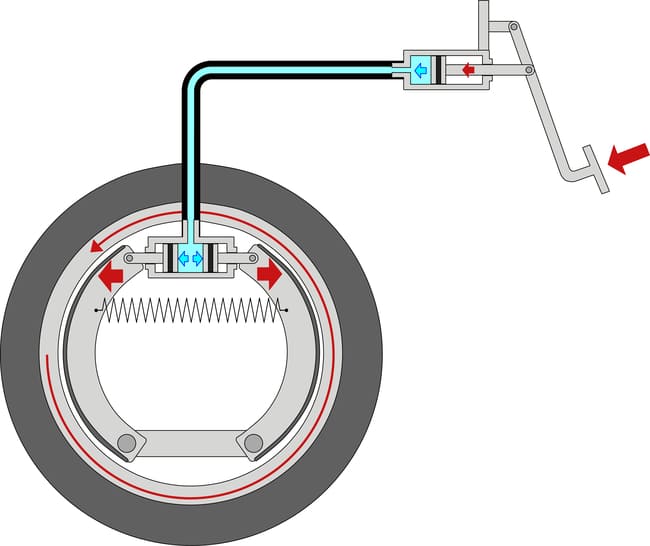
The most common braking system for modern cars is a hydraulic braking system, and your car is almost certainly equipped with hydraulic brakes. Cars usually have this on all four wheels, and hydraulic systems can use a brake disc or a brake drum.
Unlike older mechanical braking systems, hydraulic systems use a fluid to apply pressure to the brakes. Hydraulic fluid is stored in the brake lines and is used to transmit the pressure or force from the brake pedal or brake lever to stop the car. Brake fluid, or hydraulic fluid, is a non-compressible substance that can operate at high temperatures and high pressure.
In this type of braking system, the mechanical force comes from the driver pressing the brake pedal. This force then pushes the brake fluid through the lines and, since it is not compressible, toward the braking system. In a device known as the master cylinder, this force is then converted into hydraulic pressure that is sent to the brake calipers or drum segments (depending on the type of system).
Each brake caliper contains a series of pistons (up to 6), and the hydraulic pressure forces the caliper to clamp onto the disc or drum. The brake pads attached to the brake caliper create friction when they rub against the brake disc or drum, and this is what ultimately stops the car.
Hydraulic braking systems also have distinct advantages.
First, the force generated in the hydraulic braking system is higher compared to the older mechanical braking systems used in cars. These are rather primitive and rely on levers, linkages, or cams, which don’t transfer as much force as hydraulic braking systems. Mechanical systems can also lose their efficiency over time as working parts break down.
The risk of hydraulic brake line rupture is very low, and they require very little maintenance, again in contrast to mechanical brakes. They are also incredibly fast and responsive to the pedal, and very little force needs to be applied to the brakes to exert pressure on the drums or discs.
Since a hydraulic system has far fewer moving parts than a mechanical system, the wear on these parts and any associated or resulting maintenance is also reduced. This makes the system cheaper and more reliable than a mechanical system. Since mechanical systems could also vary significantly in their design and construction from one car to another, this often made repairs tricky. Hydraulic systems have a relatively simple design and are easy to assemble, making maintenance easier.
SERVO BRAKING SYSTEM
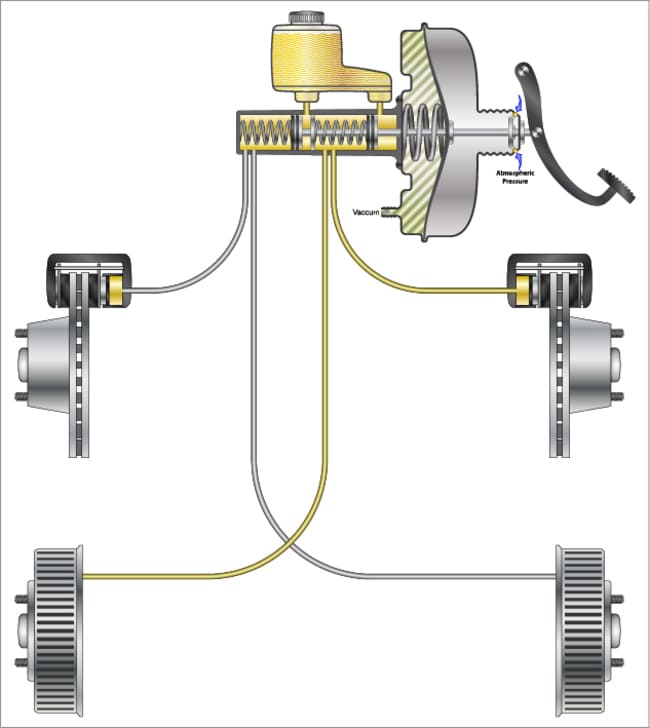
Often also called power brakes, or servo brake or brake booster, a servo braking system is designed to provide additional power to reduce the effort needed to apply the brake and will work in conjunction with hydraulic brakes.
The brake servo works by creating a partial vacuum, which then increases the force applied to the master cylinder. With a brake servo, the brake pedal first presses on an attached rod, which then allows air to enter the servo while closing the vacuum. The pressure then increases on the rod that connects to a rod inside the master cylinder.
The brake servo became more common in cars as disc brakes replaced drum brakes as the standard setup in vehicles. Disc brakes require cars to be equipped with power brakes to eliminate the majority of the force a driver must exert to stop the car.
Inside the brake servo system, a vacuum multiplies the force exerted by the driver on the brake pedal. The outer aspect of a brake servo is a cartridge that contains a diaphragm, a valve, and is usually constructed of metal. Attached to the brake servo is also a one-way valve, which limits the direction of air to outward only to eliminate the risk of losing braking function while the car is operating.
If the vacuum fails because the engine stops, for example, the brakes still work because there is a normal mechanical linkage between the pedal and the master cylinder. But much more force must be exerted on the brake pedal to apply them.