


The anti-lock braking system (ABS) is not only a crucial element of a new car’s safety system, it makes braking much more efficient and easier. Here is our guide to what it is and how it works.
-
- anti-lock braking systems guarantee drivers a comfortable driving experience, almost nothing has done more than the introduction of anti-lock braking systems. It has been present on cars since the 1970s and EU legislation since 2004 states that it is now mandatory for all cars to be equipped with it.
Anti-lock brakes were first used in the 1950s, originally to prevent airplanes from skidding on the runway during landing. The hydraulic system reduced stopping distances during aircraft landing and the risk of tire blowouts. In a short time, engineers began to realize that this type of system could also make automobiles much safer.
Even for the most experienced drivers, roads can be filled with unexpected hazards that might force you to think quickly and slam on the brakes to avoid a collision or imminent danger. This type of sudden braking, as well as any type of driving on slippery roads, is exactly what your car’s ABS is designed to help with and while most people know their car is equipped with ABS and may know what that acronym means – but few know exactly what it is for and how it works.
HOW DO ANTI-LOCK BRAKES WORK
Simply put, an anti-lock braking system uses electronics to monitor the brakes and prevent the wheels from locking during braking. Wheels can lock when the brake is applied harder than the tire can handle and the wheel stops rotating, often causing the entire car to skid. A car’s anti-lock brakes will take effect when this happens and when they sense the wheel is about to lock, so anti-lock brakes reduce the risk of skidding when a driver brakes too abruptly, for example in a turn or an unexpected hazard on the road or when the brakes lose their grip on a slippery surface.
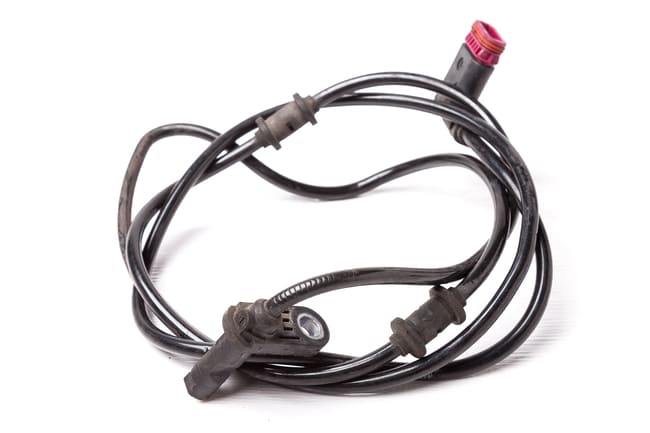
Anti-lock braking systems work through detection sensors installed on a car’s wheels. Each of these sensors is mounted in the wheel hub and takes readings of the rotational speed of each wheel. It looks for decelerations in the wheel that are out of the ordinary. Just before a wheel locks, it will undergo rapid deceleration. If nothing is done, the wheel would stop much faster than any car. It can take five seconds for a car to stop at 96.6 km/h (60 mph) under ideal conditions, but a locking wheel can stop rotating in less than a second.
These sensors assess whether one is about to lock when a driver brakes. The information is transmitted to the ABS electronic control unit, which determines which wheel is skidding and may lock. If a wheel begins to lock, the sensors communicate with the open hydraulic valves to slightly reduce the brake pressure and prevent the wheel from becoming completely stationary, thereby preventing the car from skidding. The cut-off corresponding to the wheel about to lock momentarily disengages from the brake master cylinder and the wheel is then controlled by the valves, which increase wheel locking, and the pumps, to reduce it, ultimately meaning the car can still be steered effectively. The result is that the tire slows at the same rate as the car, with the brakes keeping the tires very close to the point where they will begin to lock.
It’s as if the electronics are pumping the brake as a driver might do to avoid or prevent wheel lock-up. When the ABS system is active, you will feel a pulsation in the brake pedal; this comes from the rapid opening and closing of the valves. Some ABS systems can cycle up to 15 times per second, allowing them to achieve threshold braking, thus preventing loss of traction and the onset of a skid.
ADVANTAGES AND DISADVANTAGES OF ABS
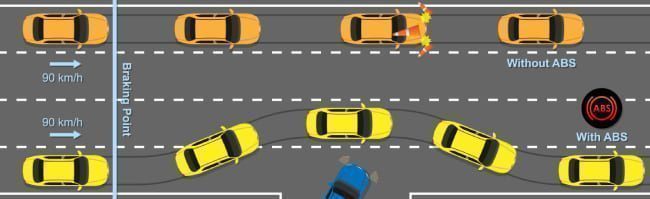
ABS is particularly effective and now almost indispensable during emergency braking. It not only reduces the braking distance (assisted braking is much more effective than stopping via a completely locked wheel), it also allows the driver to maintain control of the vehicle during braking, which could help avoid serious problems.
Linked to this, ABS can help extend tire life. Tires that regularly skid on the road wear out much faster than those that do not, and as a result, anti-lock braking systems greatly help ensure that tires last as long as possible.
ABS also allows for safe driving in more challenging weather conditions like snow or during heavy rain. Although speeds should always be reduced in bad weather, ABS means there is less risk of tires losing their grip on the road and locking, making driving safer when weather conditions are not optimal, as the vehicle can still be steered effectively.
That said, however, ABS increases the braking distance on a slippery or snowy road, including on dirt paths. So, while it is good for steering in difficult weather, it is important to always consider the increased braking distance.
WHAT CAN GO WRONG: COMMON PROBLEMS WITH ANTI-LOCK BRAKE SYSTEMS

Since anti-lock brakes are so important, it is essential that you have an insight into what could go wrong with them. Helpfully, there is an ABS warning light on the dashboard that illuminates whenever there is a problem with your system.
Since the system is an electronic system, any wiring issues can cause problems. In particular, when an electrical wire is torn from the ABS sensor in one of the wheels, the correct measurements will not be received and the system will not function properly. The sensors are the most essential part of the system and, over time, they can become oxidized from prolonged and repeated exposure to moisture.