
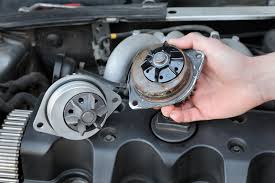
Your car’s water pump circulates coolant throughout the engine, where it absorbs heat, and into the radiator, where the coolant is cooled and then recirculated back to the engine to start the process over. (For this reason, the water pump is sometimes called a “coolant pump,” since coolant is a mixture of water and antifreeze.) If the water pump fails to circulate the coolant, the engine will typically overheat very quickly. So, what can cause a water pump to fail and when should you consider replacing it?
What can cause a water pump failure?
Sometimes, it’s not the pump itself that fails; it’s what drives the pump. While most automotive water pumps are driven by the engine via a belt, in some cars, particularly hybrids, the water pump is driven by an electric motor.
In the case of a belt-driven water pump (found in most cars on the road today), the pump will stop working if the belt driving it breaks. This is typically the accessory drive belt, which you can usually see on the outside of the engine (it’s often called a serpentine belt due to how it winds around the pulleys of the components it drives). In some cases, however, the pump may be driven by the engine’s timing belt or timing chain, located inside the engine.
If the pump is driven by the serpentine belt and the belt breaks, you will usually get a “warning” because the battery light should come on on the dashboard or the steering wheel will become hard to turn. This is because the serpentine belt also typically drives the alternator that recharges the battery and, in some cases, the power steering pump.
If the battery light comes on, stop the car as soon as possible and check if the serpentine belt is still in place. (The battery light can also come on because the alternator is faulty, but that is less likely to cause an immediate problem; overheating can.)
In some cars, the power steering pump is also driven by the serpentine belt, and the steering wheel will become hard to turn if the belt breaks. However, many newer cars have electric power steering, in which case the “hard steering” warning will not materialize. If you continue driving, the next indicator will likely be the temperature light coming on.
If the water pump is driven by the internal timing belt or chain and the belt or chain breaks, you don’t have to worry about the engine overheating because the engine will stop running immediately.
Whether the water pump is driven by a belt or an electric motor (which can also fail), the pump itself can have issues. These problems often start with a coolant leak or a squealing noise, so either would warrant taking the car to a mechanic to have it checked. Your engine overheating is another indication that the pump might be faulty.
When should the water pump be replaced?
Although a water pump contains wear components such as seals and bearings, as well as a fan-like impeller that can fail, it is not typically replaced simply as a maintenance item, as it’s not uncommon for a water pump to last at least 100,000 miles. You can help extend the pump’s life by replacing the coolant at the intervals recommended by the manufacturer, as coolant contains additives that help lubricate the pump and prevent corrosion, and these additives “wear out” over time.
However, if the water pump is driven by the internal timing belt or chain, it is often recommended to replace the water pump when you replace the belt or chain, as it will eventually wear out. This is because a large part of the repair cost is due to the amount of labor, and the mechanic often has to remove the water pump anyway.