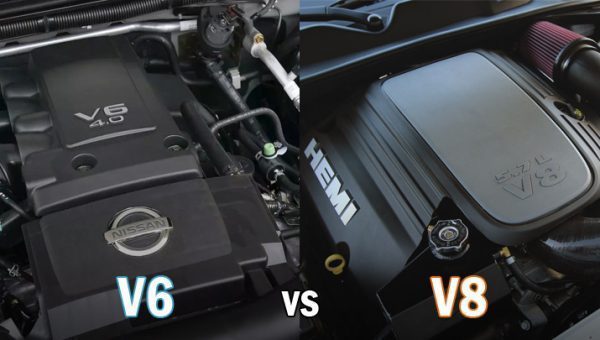

When buying a new vehicle (especially a truck), you’ll often have more than one engine option. Right up there with the 4-cylinder vs. 6-cylinder debate is the V6 vs. V8 argument.
Should you go for the extra power of a V8 or the better fuel economy of a V6? Unfortunately, it’s not that simple.
The V6 vs. V8 debate has been argued for decades. Keep reading to learn more about the history of each engine and how they compare in nine different metrics to help you answer the question of which engine is the best option for you.
V8 Engine History
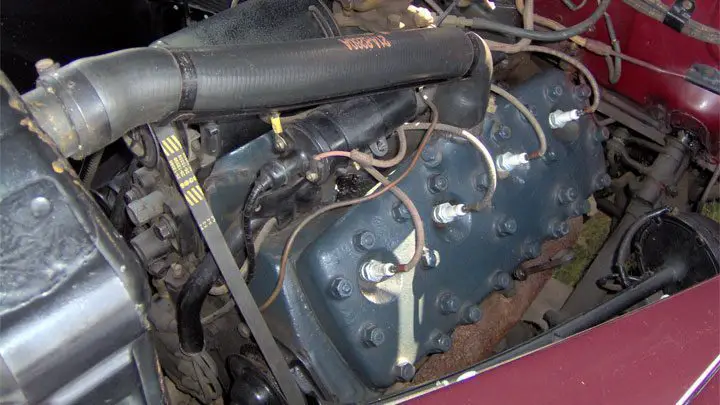 1932 Ford Flathead V8
The V8 engine had its humble beginnings in France, as a man named Léon Levavasseur filed the first V8 patent in 1902. By 1904, he was building these engines for early airplanes and motorboats. In 1906, the British manufacturer Rolls Royce built V8s for only three of its expensive sedans.
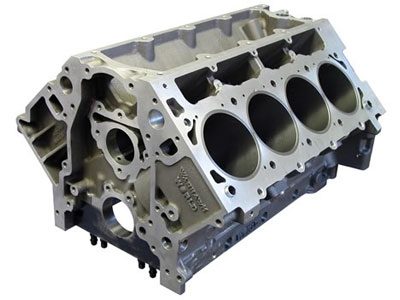 Modern V8 block
Henry Ford’s company had limited experience with large V8s during the Roaring Twenties. In 1932, Ford made its biggest contribution to the V8 world. The famous Ford flathead engine appeared in a newly designed coupe, the Model 18 to replace the popular Model A.
In just one year, Ford delivered nearly 300,000 copies of this model, although the 221 cu. in. V8 had many startup problems. Ford persevered with the basic engine configuration and continued to be produced with significant improvements until 1953.
V6 Engine History
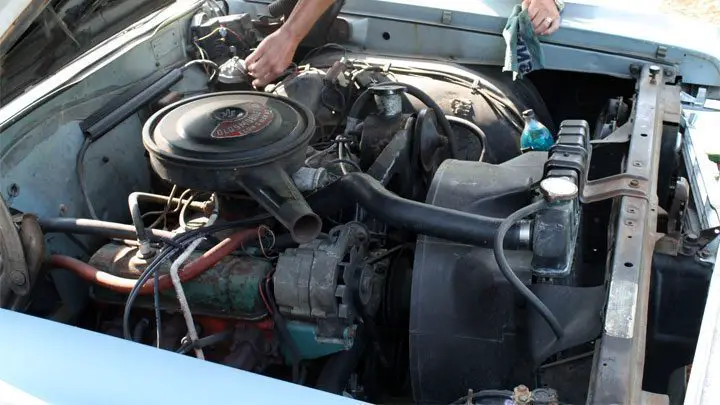
V6 engines first appeared on the Italian Lancia Lambda in 1924. These inauspicious beginnings were short-lived. It wasn’t until 1950 that Lancia placed a new V6 engine design in its Aurelia model. The Aurelia was produced until 1958 and took the checkered flag in several prestigious European car races.
In the United States, Buick took note of the Lancia V6 design and introduced its first V6 model in 1962, the Buick Special. This was the first mass-produced V6 in the automotive world.
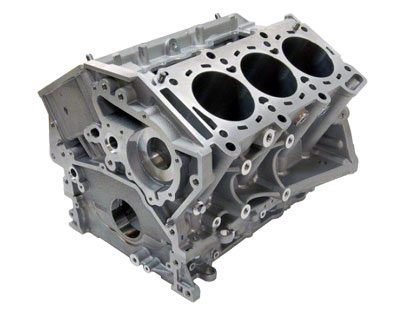 Modern V6 block
In Japan, Nissan (then Datsun) released a V6 engine in 1983. In the United States, this engine first appeared in the 1984 240Z, which replaced the inline-six engine that first came with this two-seater.
V6 development has remained very active to this day, keeping pace technologically with the more powerful and larger V8s. Today, the V6 is second in popularity only to the smaller inline 4-cylinder engines; V8s come in a distant third.
What Does the “V” Stand For in a V8 or V6?
The “V” simply represents the geometric arrangement of the cylinders if you look along the engine parallel to the crankshaft.
Nowadays, all 8-cylinder engines produced are V8s. But not all 6-cylinder engines are V6s, as inline-six (straight-six) and flat-six cylinder orientations are made by some car manufacturers.
V8 vs. V6 Comparison
In this comparison, we will discuss car engines available for road use and costing less than $125,000. Racing car offerings and derivatives of these cars can produce engines with much higher horsepower and torque. Due to the purchase price, these cars rarely grace our garages.
#1 – Engine Size

V8 engines, having two more cylinders than V6s, will typically exceed V6 engines in size. And this includes physical size, displacement, and engine weight. What are the main design attributes of these two engine types?
- V8 engines, due to the cylinder arrangement (4 cylinders aligned in each row), are inherently easy to balance. Well-balanced engines run smoothly. The absence of vibration is essential for the high RPMs required when seeking maximum power.
- V6 engines are fundamentally unbalanced due to the odd number of cylinders in each bank. There are very limited ways to reduce vibrations due to the sequence of piston power strokes occurring in each bank.
Vibration issues limit the size of V6 engines to less than about 4.0 liters (L). Two fine examples close to this limit come to mind:
- Nissan’s world-class 3.7L V6 is typical of the smoothness possible with proper design. This non-turbocharged engine can deliver up to 350 hp.
- The Chevrolet Camaro’s 3.6L V6 is another elegant design that offers vibration-free operation and excellent power. It is rated at 332 hp.
To smooth out larger V6 engines, balance shafts are required. One or more of these can help mitigate vibrations. But balance shafts add weight and complexity and cannot always provide optimal smoothness across the entire RPM range of an engine.
Winner: V8 Engine
#2 – Power
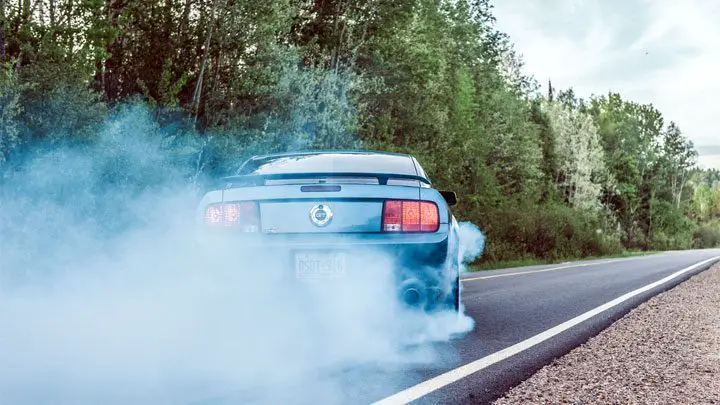
In these most basic considerations, V8 engines win hands down. The reason is that V8 engines can comfortably exceed the V6 displacement limit of 4.0L with little detrimental effect on engine smoothness.
V8
Coupled with the relative ease of engine balancing, large V8 engines like the 6.4L Hemi in the Dodge Charger produce 485 brake horsepower (hp). And this is without a turbocharger.
With some internal modifications and a supercharger, the Hemi in the Dodge Challenger offers horsepower numbers above 800. V6 engines can hardly compete with that.
The Mustang’s 5.0L V8 comes close to the 6.4L Hemi with less displacement for a power output of 480 hp. By adding a supercharger, the slightly larger Ford 5.2L V8 jumps to 760 hp.
V6
Nissan’s 3.7L V6 develops a maximum power of 350 horsepower. A twin-turbocharged 3.8L version of this engine in the Nissan GT-R produces 565 hp. This almost race-ready car just pushes our $125,000 price limit.
Lincoln will offer a Lincoln Aviator this year with a 3.0L V6 producing 400 horsepower. This is accomplished with two turbochargers.
With the use of turbochargers, a V6 can come close to and even, in some cases, surpass a naturally aspirated V8 in power. But there will be a significant cost for this kind of power.
Although possible, turbocharged V6 engines over 400 horsepower are complex to build. The cost factor limits their use to high-end sports cars and sedans or SUVs like the Lincoln Aviator.
Example Comparison
The Alfa Romeo Giulia Quadrifoglio offers 505 hp from a 2.9L twin-turbo V6. The car is a gem in every respect, but the base sticker price starts at around $76,000.
On the other hand, a fully loaded 485 hp Dodge Charger will have a sticker price of around $45,000. The 480 hp Mustang GT is offered in this same range.
If you’re looking at the Alfa Quadrifoglio’s price, you might also consider an 807 hp Challenger Hellcat or a 760 hp Mustang GT 500. Both are offered in the same range as the Quadrifoglio.
Winner: V8 Engine
#3 – Handling
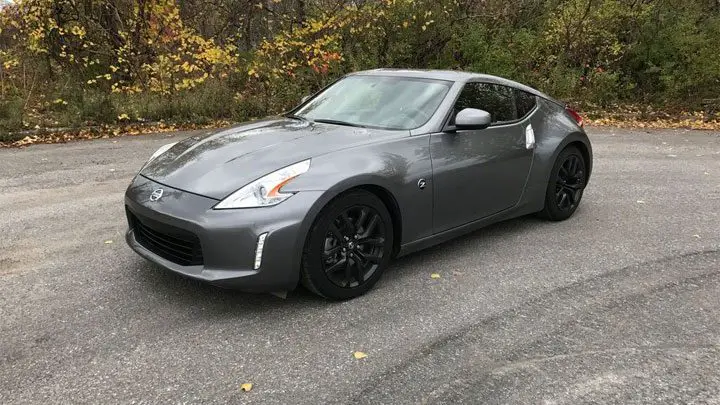
Car handling can be a very subjective discussion. The feel, steering, cornering, acceleration, and braking of a car can be measured and summarized in a report.
With little argument, V8 automobiles will generally weigh more than V6s. V8 engines are heavier than V6s. Heavier cars generally perform worse than their lighter siblings.
So, considering the weight factor alone, V6 automobiles will generally handle better than V8s. But let’s add designer intelligence to the mix. Here we will see that many larger V8 sedans and sports cars handle remarkably well.
I’m thinking of the Chevrolet Corvette. Yes, it has a V8 with a lot of power but with excellent handling too. Mustangs and Chargers are both heavy cars but still handle well despite the large engines.
More powerful turbo V6 engines add money to the sticker price, which can also translate into surprisingly good handling and fast V6 cars.
But for automobiles that share the same price range, V6 offerings in terms of handling will only exceed this attribute compared to V8s at the same price.
Winner: V6 Engine
#4 – Towing and Payload Capacity

In this regard, power is king. None of the V6 offerings, even with turbos, will out-tow a V8 car, SUV, or light truck. V6 platforms will also not carry a larger payload than an equivalent V8 vehicle, although some van ratings might argue otherwise.
For high loads and greater maximum towing capacity, slower-revving V8 engines remain in the driver’s seat.
Winner: V8 Engine
#5 – Fuel Economy