
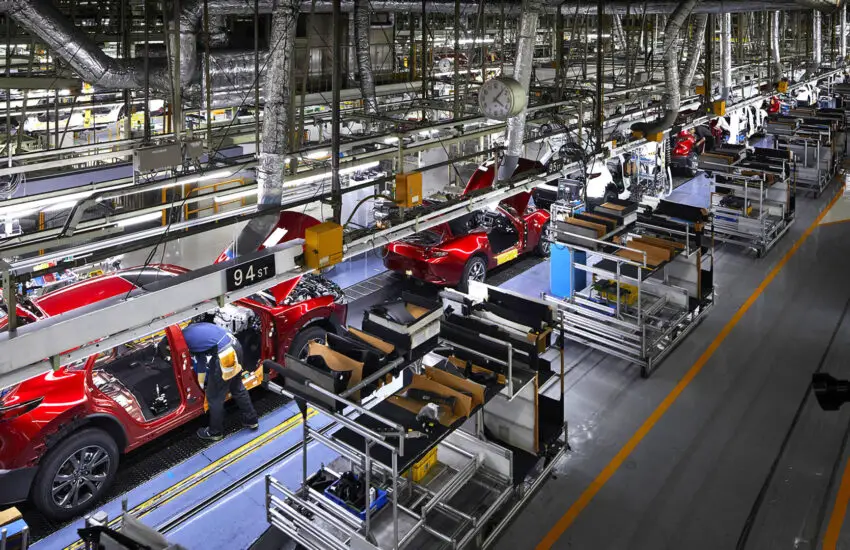
Toyota recycles old electric vehicle batteries to power Mazda’s production line. As electric mobility becomes widespread, the issue of what happens to end-of-life batteries becomes crucial. Faced with this challenge, Toyota has developed an innovative solution: the Sweep Energy Storage System.
The Sweep System: A Second Life for Batteries
This ingenious system collects all high-voltage batteries, regardless of their chemistry and wear, to integrate them into a factory energy storage system. A full-scale test has just been launched at the Mazda production site in Hiroshima.
How Does Sweep Technology Work?
The Sweep Energy Storage System recovers batteries from electrified vehicles (hybrid or 100% electric) and connects them to the electrical grid. The energy management logic developed by Toyota monitors and redirects the energy flow in fractions of a second, prioritizing healthy batteries and bypassing less efficient ones.
An Economic and Ecological Innovation
The system also reuses the inverters from electrified cars, eliminating the need for additional power conditioners and thus reducing costs.
The Hiroshima Site: An Ideal Testing Ground
The Mazda campus in Hiroshima has relative energy autonomy, with its own thermal and solar power plants. This makes it a perfect location to install the Sweep equipment and demonstrate its benefits for Japanese automakers.
Towards Optimized Renewable Energy Management
Toyota and Mazda’s systems were connected via their respective energy management systems. In the future, this storage system will be used to regulate the supply and demand of renewable energy, which fluctuates according to weather and time of day, thus contributing to carbon neutrality.
Promising Results as Early as 2022
Toyota and the Japanese energy company JERA launched the first Sweep system in 2022, connecting it to the Chubu electrical grid. This unit achieved a peak power of 485 kW and stored 1,260 kWh, enough to power more than 1,200 households for one hour. Its flexibility in accepting batteries of varying quality and chemistry makes it a practical and scalable solution for recycling.