

Hydrogen Cars: Just Another Hype or the Holy Grail of Green Automotive?
Cars equipped with hydrogen fuel cells burn no fossil fuels, produce no pollution or greenhouse gases, operate with the same chemical reaction that powers rockets, and travel twice the distance of a Tesla, meaning they are a credible and effective alternative to electric cars as part of a fossil fuel-free future.
If you haven’t heard of this utopian car yet, you wouldn’t be alone. Only Toyota, Honda, and Hyundai have already established fuel cell vehicle (FCEV) production lines, and it’s rare to see one outside of California, the hub where this technology is slowly but surely developing.
This could change, however: the UK government announced in 2017 a £23 million fund to support the development of cars with hydrogen fuel cells and infrastructure, and Transport Minister John Hayes noted that “hydrogen fuel cell electric vehicles can play a vital role… in helping us reduce harmful emissions.” This funding is certainly needed, as there are currently only about 17 hydrogen refueling stations in the UK (most in London, you guessed it) and none in the US outside of California.
There are clearly startup issues, but if FCEVs follow the same path as electric vehicles, it’s important to ask what these hydrogen cars are, how good they really are, and what are the best hydrogen cars on the market?
HOW DO HYDROGEN CARS WORK?
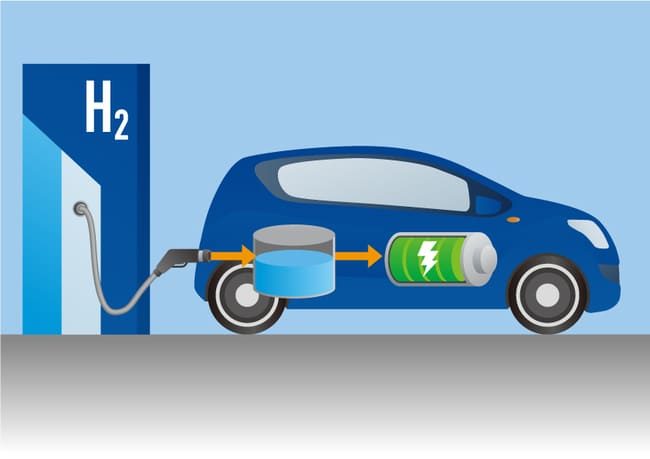
Despite running on gaseous fuel, hydrogen cars are technically also electric cars; they are powered by an electric motor rather than a gasoline or diesel engine. Hydrogen is stored in a tank, which is connected to the fuel cell. Hydrogen enters the fuel cell and mixes with oxygen from the ambient air. Hydrogen and oxygen react and combine to produce electrical energy and harmless water vapor, which is then expelled as a byproduct.
There are no moving parts in the fuel cell, just a chemical reaction that creates electricity to power the engine. The battery where electricity is stored, known as the Peak Power Battery, is significantly smaller and therefore lighter than the battery of a standard electric vehicle, as it is constantly recharged by the fuel cell, as well as by regenerative braking in some models, a process in which the electric motor converts the car’s kinetic energy into electrical energy and feeds it into the backup battery.
Hydrogen tanks are refueled in a way that is almost the same as gasoline and diesel; gaseous hydrogen is pumped into the tank as you would with gasoline. For a vehicle that could change the world, the system as a whole is incredibly simple.
THE ADVANTAGES OF HYDROGEN CARS
- Quiet Engines: Like most other electric vehicles, hydrogen cars have virtually no engine noise and dynamic startup, as electric motors provide maximum torque, even at low speeds. They are actually so quiet that some cars have been equipped with pedestrian warning systems to make noise when hydrogen cars are parking, reversing, or maneuvering.
- Faster Refueling: The biggest complaint about electric cars is often that they take forever to refuel. Even with a high-power charging station, it can take up to 30 minutes for a normal electric car and several hours if a normal charging station is used. A hydrogen vehicle can be fully refueled in just three to five minutes. It’s also familiar to refuel using a pump, as you would with a gasoline or diesel engine.

- No Harmful Emissions: The only thing emitted by a hydrogen fuel cell car is water. This means no CO2 emissions from the car.
- A Range That Rivals Diesel and Gasoline Equivalents: Another issue with normal electric cars is that even with a full battery, they may struggle to cover half the distance of a conventional car with a full tank of gasoline. With a range of about 300 miles per tank, hydrogen cars are on equal footing with many conventional vehicles. Once it also has a full tank, a fuel cell vehicle can travel as far as a gasoline vehicle. The Toyota Mirai has the shortest range of all commercial fuel cell sedans currently on the market, and it travels 317 miles on a full tank. That’s nearly 50% more range than the 220 miles that the base Tesla Model 3 can travel on a single charge. More importantly, this range does not deteriorate in cold weather, as can happen with other electric vehicles.
- It’s a Growing Industry: As we’ll see in a moment, the infrastructure and support for hydrogen cars are not quite where they need to be at the moment. That said, one of the advantages of hydrogen cars is that some key players are investing. In addition to BMW and Mercedes-Benz in Germany, General Motors is researching a fuel cell van in the US, and Toyota is testing a hydrogen tractor-trailer. Residents of Orange County, California, have been able to take a fuel cell bus to their destination since 2016, and 25 of them are in service in the county. This is good news for anyone looking for a new car that will last and avoid being forced to upgrade due to government environmental legislation. Fuel cell cars are also likely to be a good investment and retain their resale value, unlike gasoline or diesel cars.

THE DISADVANTAGES OF HYDROGEN CARS
- Refueling: This is one of the major problems with hydrogen cars. There are currently only 17 hydrogen car filling stations in the UK, and each station costs £1.3 million to build. By the end of 2019, there were only 40 in the US and about 80 in Germany, the European nation that has perhaps shown the most interest in hydrogen as a car fuel. The problem is also a bit of a catch-22 situation: because so few hydrogen cars exist, no one wants to invest in refueling stations, and because there are so few refueling stations, no one wants to buy hydrogen cars. This problem won’t be resolved anytime soon.
- Expenses: Although the cost of refueling a hydrogen car is similar to that of traditional fuels (about 17.4 pence per mile for a hydrogen car versus 16.3 pence per mile for a conventional car), storing gasoline isn’t cheap, and the technology itself is expensive to develop. Fuel cells are expensive, and that makes the cars themselves expensive too. The few models currently on the market cost an average of $80,000 (just under £62,000) for a mid-range or upper mid-range vehicle. That’s almost twice as much as comparable all-electric or hybrid vehicles. Part of the problem is the need for the precious metal platinum, which acts as a catalyst when energy is produced. That said, the UK government supports their purchase with a grant of about £3,000.
- Car Size: Hydrogen tanks take up a lot of space in cars, and most hydrogen vehicles so far have more than one. This means they tend to be quite large (SUVs or large sedans), which once again means they are not cheap and may not be ideal for driving hydrogen cars in UK cities. However, this is something that the small Welsh car manufacturer Riversimple is trying to solve with its small and stylish Rasa car. It’s worth looking into if you can see a hydrogen car in your future.
- Possible Safety Risks: Gasoline is flammable, but we’ve been driving gasoline cars for years without complaint. Hydrogen is also flammable, but many people perceive it as a huge risk. In June 2019, two incidents occurred that seem to prove the critics’ point: a chemical plant producing hydrogen in Santa Clara exploded, leaving FCV users in California short of fuel, and a few days later, a refueling station in Sandvika, Norway, exploded. For many, this clearly showed that hydrogen can be a dangerously explosive gas and led some to wonder: are hydrogen cars safe?
5 BEST HYDROGEN CARS
TOYOTA MIRAI

Toyota clearly has big plans for the Mirai, as it means “future” in Japanese. Its sleek and elegant look complements its excellent handling, but it is expensive and rare: starting at £65,000 before the government’s £3,500 ultra-low emission grant, only 15 will be released in the UK in 2020.
HONDA CLARITY
With Clarity, of course, referring to the lack of emissions from Honda’s first fuel cell vehicle, that’s not the only thing it has going for it. The Clarity offers attractive performance, top-notch engineering, and provides great range and comfort. Unfortunately, it can’t even be leased in the UK yet.
HYUNDAI NEXO

Following on from the Hyundai ix35 FCEV, the Nexo offers a guaranteed great range of 414 miles, with even more possibilities thanks to regenerative braking. The South Korean manufacturer claims it can even purify the air around it – and for a huge amount of £68,000, you’d expect that at a minimum.
MERCEDES-BENZ GLC F-CELL

The GLC F-Cell is Mercedes’ first attempt with an FCEV, and it looks promising so far. The tank has a capacity of 4.4 kg of hydrogen, giving it a range of 478 km and a power output of 155 kWh. More importantly, 90% less platinum was used, making it potentially very affordable.
BMW HYDROGEN X5

Scheduled to go into production in 2022, the X5 will have a total power of 368 hp, a total of 6 kg of hydrogen in its two H tanks, and regenerative braking to help support the battery. Refueling is said to take between three and four minutes, and this could be a very strong offering for the future.