
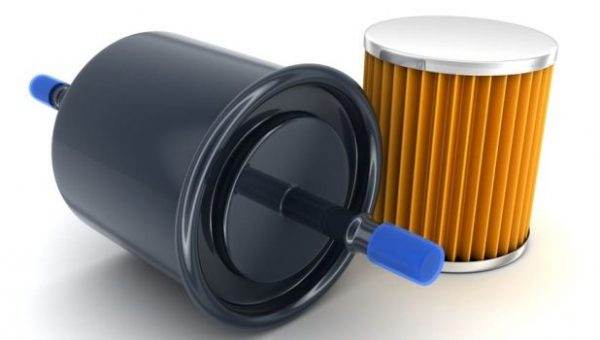

Fuel filters are a necessary part of contemporary internal combustion engines. Their main function is to protect against rust particles and dirt and to regulate the flow of fuel and air into the engine. They are essential for protecting the environment by reducing fuel consumption and emissions. Replacing or cleaning the fuel filter yourself can save you a lot of money since labor is expensive. For example, in the UK, the average replacement cost is £114. Therefore, being a DIY-type car owner will have a positive effect on your wallet.
You will find the fuel filter inside the fuel tank in the opening of the fuel hose that supplies your car with gasoline or in the fuel hose typically located at the bottom of your vehicle.
HOW DO I KNOW IF MY FUEL FILTER NEEDS CHANGING OR REPLACING?
If your car starts showing the following warning signs: misfires or irregular idling, difficulty at low speed and stalling, or loud noises from the fuel pump, you likely have a blocked or clogged fuel filter, or perhaps water in the filter. Your car will tell you if there is a problem with your fuel filter. If the warning light comes on as soon as you start your car, it’s time to change or unclog your filter. You might be tempted to keep driving with the light on, but it’s important to drain the filter as soon as possible. If you wait too long, water could accumulate and eventually enter your engine, where it could cause serious damage.
FUEL FILTER MAINTENANCE FOR OPTIMUM PERFORMANCE

Like many vehicle parts, fuel filters require regular maintenance. To maintain optimal performance, it is recommended to regularly replace your filter. In the past, the recommended interval was every 20,000 to 30,000 miles. Nowadays, thanks to improvements in vehicles and fuels, filters can be replaced every 60,000 miles. If your car uses a paper or nylon filter, you can simply install a new one. In the case where you have a metal filter and it’s not too dirty, you can simply wash it and reuse it.
REMOVING YOUR FUEL FILTER
If you decide to clean the filter, there are a few important steps to keep in mind. First, only work on your car in a well-ventilated area. Consult the owner’s manual and locate your fuel pump fuse. Remove it, then start your engine and let it run for about two minutes. Now, turn off your engine and open the hood. Locate the negative terminal of your battery and using a wrench, loosen the cable. Place the cable to the side of the battery to prevent it from accidentally touching its terminal.
Remember that if your terminals are red and black, the negative terminal is black. Not disconnecting the battery can cause sparks and ignite residue and gasoline vapors flowing from the fuel lines. Now locate the filter. As mentioned above, its location may differ depending on the make and model. Most likely, you will find it under the car just behind the fuel pump. Sometimes, it is located in the engine compartment. If it is necessary to lift your car, consult your manual to locate your vehicle’s jack points. Place a jack under one of the jack points, then repeatedly press or turn the handle to lift the vehicle. Be cautious and do not rely on the jack to support the weight of your car and do not work under a vehicle that is not supported by jack stands.
Place a container, such as a bucket, under the filter to catch any fuel that might spill. Then, detach the clips that secure the fuel line to the fuel filter. The precise design of the clips may differ by model. Look in your manual, or online, for your vehicle’s design. You can use your hands to remove them or pry them out with a flat-head screwdriver.
Detach the fuel lines using a wrench or hose clamps to remove the fuel lines from the filter. Remove the lines from the nozzles at both ends of the filter. When disconnecting the fuel lines, wear gloves and safety glasses to prevent injury. Make sure to point them towards your bucket or container to catch any fuel that might flow out. Now detach the filter from the bracket. Either loosen the bolts holding it in place, or simply slide it out of the bracket. Be sure to pay attention to its position before removing it, so you remember how to reinstall it correctly.
CLEANING THE FILTER
There might still be fuel in the filter, so carefully drain the fuel inlet and outlet nozzles into the container you used to catch the spilled gasoline. You will find them at each end of the filter.
Use a cleaner provided with an application straw. Attach the straw to the nozzle of the bottle or can and spray inside both nozzles. Gently tap the filter against the container you used to hold the spilled gasoline. Let the dirt, debris, and spray from both nozzles fall out. Repeat this procedure once more and let the filter air dry for at least one hour.
REINSTALLING THE FUEL FILTER AND FINAL STEPS
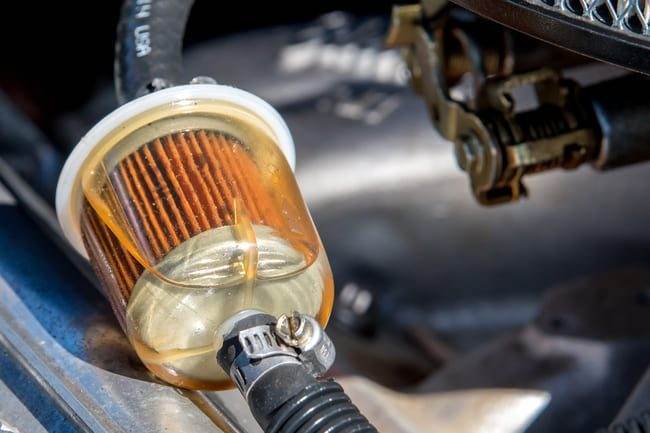
To reinstall the filter, slide it into the bracket in the correct position. Replace the bolts you removed, if necessary. Make sure you have securely attached the lines to prevent any leaks. Now reattach the clips that secure the lines to the nozzles.
If necessary, lower your car and reconnect the fuse and battery. If you lifted your car, lift it further to remove the supports, then lower it to the ground. Use a wrench to reconnect the cable to the negative battery terminal and replace the fuel pump fuse.
Now that you have reconnected the fuse and battery, let your engine run for a few minutes. Due to the need to restore fuel system pressure, you may need to try several times before it starts. Once it has started running, look under your vehicle to see if there is a fuel leak.
If you see leaks, you will need to jack up the car again (if necessary), disconnect the battery, and tighten the fuel lines. If, after a few minutes, your engine does not start, check your fuses again. In case the interior lights and dashboard do not light up or are dim, you may need to restart your battery. If the fuses and battery are working, check that the fuel lines are not loose and that you have put the filter back in the correct position.
CORRECT PETROL DISPOSAL
Make sure to dispose of the old gasoline properly. If it is not too contaminated with dirt or debris, reusing it in gasoline-powered equipment, like a leaf blower, is the most environmentally friendly solution. If it is full of debris and not reusable, place it in a safe container for gasoline storage and bring it to a disposal center. The container must be tightly sealed when moving it – and remember that it is extremely dangerous to light a fire or smoke near flammable liquids.