
Turbochargers play an essential role in engine performance by increasing power while reducing fuel consumption. However, not all turbos work the same way. Here is a comparison between the conventional turbo and the variable geometry turbo (VGT), which will help you better understand their differences and respective advantages.
1. Basic Operation of Turbochargers
A turbocharger uses exhaust gases to drive a turbine, which in turn compresses the air sent into the cylinders. This allows the engine to burn more fuel, thereby increasing its power.
2. Conventional Turbo (or Fixed Turbo)
Operating Principle
The conventional turbo is equipped with a fixed geometry turbine, meaning the size and position of the vanes inside the turbo are fixed.
Advantages:
- Simple Design: Fewer moving parts, making it more robust and cheaper to produce.
- Reliability: Less prone to failure due to its mechanical simplicity.
- Effective at High RPM: It excels in engines requiring constant power at high RPM.
Disadvantages:
- High Response Time (Turbo Lag): There can be a delay between acceleration and power increase, especially at low RPM.
- Less Efficient at Low RPM: The fixed turbo requires a high exhaust gas flow to operate efficiently.
3. Variable Geometry Turbo (VGT)
Operating Principle
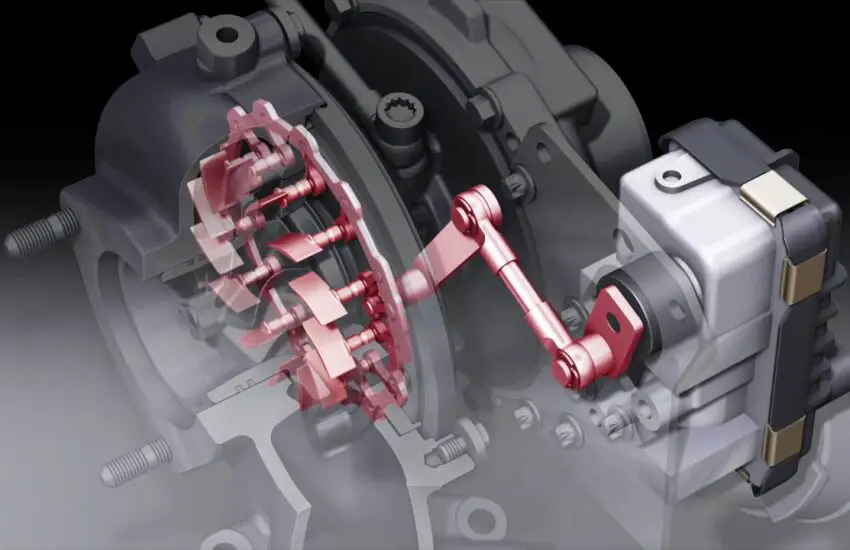
The VGT has movable vanes inside the turbine. These vanes can open or close depending on the engine RPM, thus optimizing the exhaust gas flow at all times.
Advantages:
- Reduced Turbo Lag: The adjustable vanes improve performance at low RPM.
- Efficiency Across the Entire RPM Range: The VGT provides more consistent power, whether at low or high RPM.
- Better Fuel Economy: By optimizing exhaust gas flow, the VGT enhances energy efficiency.
Disadvantages:
- Mechanical Complexity: The movable vanes and control system require more precise maintenance.
- Higher Cost: The advanced technology makes the VGT more expensive to produce and repair.
- Sensitivity to Fouling: The movable vanes can get stuck due to soot deposits, especially in diesel engines.
4. Comparison Table: Conventional Turbo vs. Variable Geometry Turbo
| Criteria | Conventional Turbo | Variable Geometry Turbo |
|---|---|---|
| Design | Fixed vanes | Movable vanes |
| Responsiveness at Low RPM | Low | Excellent |
| Efficiency at High RPM | Good | Very Good |
| Complexity | Simple | Complex |
| Cost | Cheaper | More Expensive |
| Sensitivity to Fouling | Low | High |
5. Common Uses
- Conventional Turbo: Often used in older vehicles, sports cars, or high-performance gasoline engines.
- Variable Geometry Turbo: Widely adopted in modern diesel engines and some high-end gasoline engines to optimize performance and fuel consumption.
6. Conclusion: Which Turbo to Choose?
The choice between a conventional turbo and a variable geometry turbo depends on your needs:
- If you seek simplicity, reliability, and lower cost, a conventional turbo is a good option.
- If you want optimal performance across the entire RPM range and better fuel economy, the VGT is more suitable, although it requires rigorous maintenance.