

During intense summer heat, few vehicle features are as appreciated by the average motorist as air conditioning. A vehicle’s air conditioning system stops the sweltering summer in its tracks, replacing it instead with comforting coolness.
Today’s modern air conditioning systems are even equipped with dual-zone climate control, allowing each occupant of a vehicle to set the cabin temperature to their liking.
However, a vehicle’s air conditioning system is only as good as its ability to function correctly, without any electrical or mechanical faults. Unfortunately, air conditioning problems of varying severity can and do occur occasionally. When this happens, cabin temperatures soar as discomfort sets in.
One of the most common faults related to the air conditioning system is one that manifests as an inoperative AC compressor clutch. When problems of this nature occur, the refrigerant in an air conditioning system does not circulate, thereby preventing cooling from taking place.
Read on to learn more about the causes of an inoperative AC compressor clutch, as well as how to remedy such issues should they arise in the future.
What is an AC Compressor Clutch?
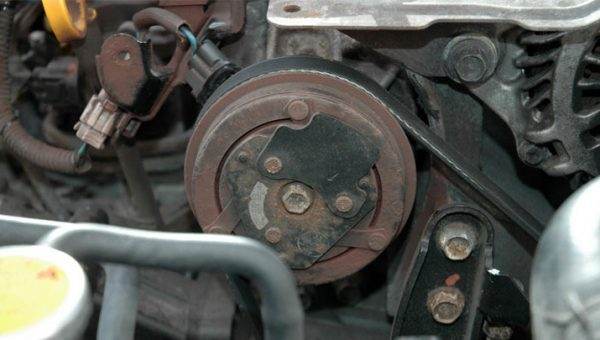
A vehicle’s AC compressor clutch serves as the on/off point for distributing power to the internal drive components of an AC compressor. When the air conditioner is turned off, the compressor pulley’s coils are disengaged.
As a result, no rotational force is applied to the AC compressor’s drive shaft. This avoids placing an additional load on a vehicle’s engine and prevents excessive internal wear on the compressor.
When a vehicle’s air conditioning system is turned on, power is distributed to the AC compressor clutch’s magnetic coil. This energizing of the clutch coil creates a magnetic field and facilitates clutch engagement by pulling the clutch’s drive plate inward, where it meshes with the compressor’s clutch body/pulley.
In the “on” or “engaged” position, an AC compressor’s clutch transmits 100% of the rotational force applied by an engine’s serpentine belt directly to the compressor’s drive shaft.
However, when a vehicle’s air conditioning system is turned off, the accompanying clutch coil is de-energized. In turn, the AC system’s clutch disengages.
Causes of an AC Compressor Clutch That Won’t Engage
An AC compressor clutch may fail to engage for a number of reasons, many of which are electrical in nature. The exact cause of such issues also tends to vary slightly from one vehicle model to another.
Here are some of the most common causes of an inoperative AC compressor fan clutch.
#1 – Blown AC Clutch Fuse
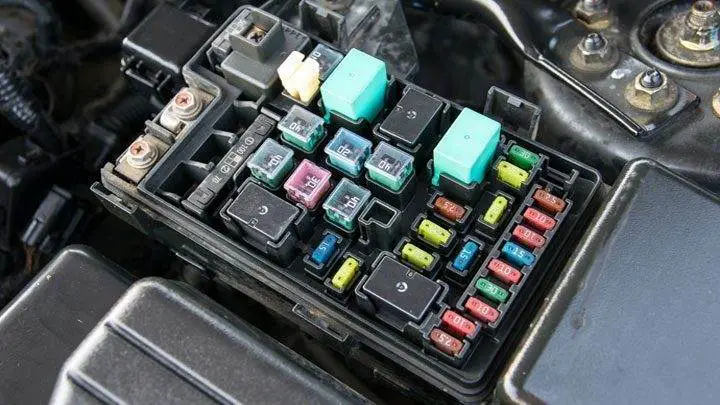
In many situations, a blown AC compressor clutch fuse can be the cause of a clutch that does not turn on or engage. However, the reason for the fuse’s failure must also be determined. This could be the result of a short in the power wire or a faulty clutch.
#2 – AC Clutch Relay Failure
Most vehicles rely on the use of a relay to control the operation of the AC clutch. A failed or stuck relay can prevent power from reaching the clutch coil.
#3 – Faulty Switches
Modern automotive air conditioning systems rely on the use of several switches to function effectively. These switches directly influence the provision of power/ground to an AC clutch.
The most notable of these switches include low-pressure switches, high-pressure switches, and evaporator temperature sensors. The failure of any of these sensors can render an AC clutch inoperative.
#4 – Faulty Wiring
A compressor’s AC clutch assembly is powered and grounded via a pigtail that branches off from a vehicle’s main engine wiring harness in most cases.
If there is an open condition on any of the wires in this circuit, the compressor clutch will not operate. In some cases, the wiring itself may be good, but the connector is the problem.
#5 – Low Refrigerant Charge
An air conditioning system’s low-pressure switch is designed to cut power/ground to the compressor clutch in the event of low system pressure. Therefore, a lack of compressor clutch operation can often be attributed to a low refrigerant charge.
#6 – High Refrigerant Charge
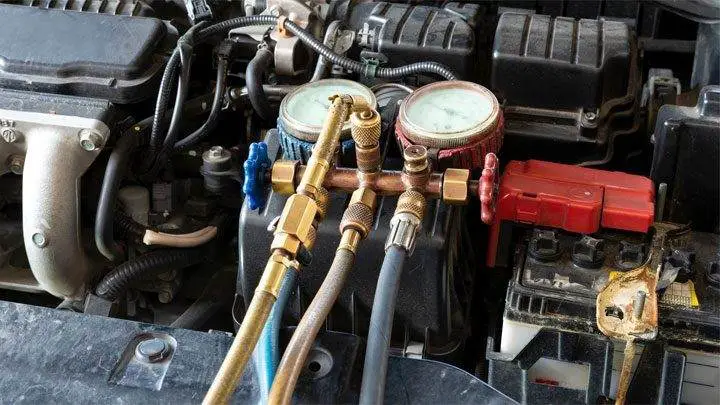
Similarly, an air conditioning system’s high-pressure switch is designed to cut power/ground to a compressor’s clutch in the event of over-pressurization.
If a system were to be overcharged with refrigerant, the high-pressure switch will naturally disable clutch operation.
#7 – Faulty AC Clutch
Over time, a compressor’s clutch assembly can begin to show its age. In many cases, an AC clutch will begin to slip as the face of its clutch disc begins to wear.
In other cases, an AC clutch’s coil can fail altogether, thereby preventing clutch engagement.
#8 – Control Head/Computer Failure
An AC clutch receives its operational commands via inputs made by a driver through the system’s dash-mounted control head. A failure of any kind within this unit can prevent a clutch’s coil from being powered.
Many systems also route signals from the control head through a vehicle’s ECM/PCM. Because of this, a partial failure of a control module can also result in compressor clutch operation issues.
How to Manually Engage an AC Compressor Clutch
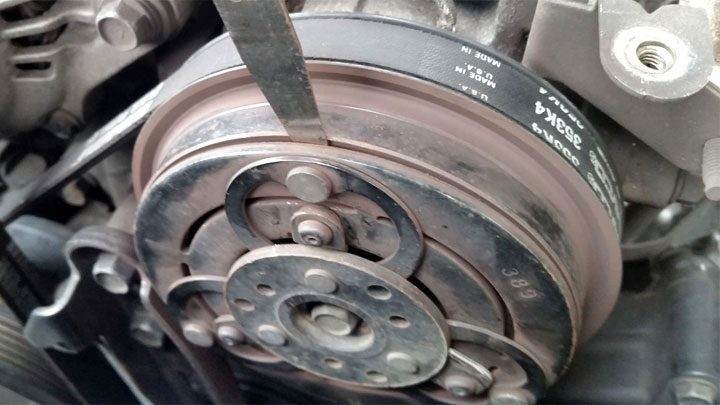
There are several instances where manually engaging an AC compressor’s clutch can prove useful. Perhaps the best use of this practice is to attempt to determine whether or not the clutch itself has failed.
Providing the clutch coil with alternative power and ground sources can help you identify the root cause of compressor clutch-related issues.
The following steps will help you manually engage your AC compressor’s clutch assembly using the jump method.
- Disconnect the clutch wiring pigtail: You must first identify and disconnect the wiring pigtail that corresponds to your compressor’s clutch assembly. The wiring for this assembly typically comes from the rear of the AC, at the front of a vehicle’s compressor.
- Identify the power and ground wires: Next, you need to identify the power and ground pins within this connector. When in doubt, always consult a factory wiring diagram for your specific vehicle.
- Create jumper wires: You will now create jumper wires for the power and ground ends of your compressor’s control circuit. It is important to include an in-line fuse in the jumper intended for use on the positive side of the circuit. It is also helpful to attach alligator clips to the power end of these jumper wires, which can be easily connected to your battery’s terminals.
- Connect the jumper wires: It is now time to connect your new jumper wires. Ensure that the fused jumper wire is connected between your clutch coil’s positive wire and your battery’s positive terminal. Similarly, hook the remaining jumper wire between the clutch coil’s negative wire and your battery’s negative terminal.
- Interpret the results: Based on your observations, you will now be able to determine whether or not your AC clutch is faulty. If your compressor’s clutch does not engage when jumped, compressor replacement is advised. Engagement will be evident by the sudden inward movement of the assembly’s clutch disc, which will be accompanied by an audible “click.” If your AC compressor’s clutch does engage when jumped, further diagnosis will be necessary, as the underlying fault lies within the system’s control circuit.
Replacing the AC Compressor Clutch vs AC Compressor
In the past, replacing the AC clutch was considered a cost-effective alternative to replacing an entire AC compressor. However, this is rarely the case today. Almost all major automakers now recommend compressor replacement in the event of AC clutch failure.
In fact, many of today’s AC clutches can no longer be serviced independently. This necessitates compressor replacement, totally eliminating the possibility of clutch renewal.
Even if a particular vehicle’s compressor were equipped with a serviceable clutch, one often spends just as much upfront to replace the AC compressor clutch assembly in its entirety.
Today, aftermarket AC compressors can be purchased at a reasonable cost, thereby eliminating the monetary advantage associated with clutch replacement.
It is also important to consider the fact that replacing an AC clutch requires the use of specialized tools and is generally far more complex than replacing a system’s entire compressor.