

When discussing gears, there are several types. The most commonly used gears are straight-cut gears and helical gears.
Many people are unsure if straight-cut gears are useful, as helical gears seem to have a more positive image. Today, we will clear up your doubts about straight-cut gears.
Straight-Cut Gears: Advantages and Disadvantages
Straight-cut, as the name implies, features teeth cut in a straight shape rather than a helical or spiral form. Straight-cut gears are more widely used in race cars than in ordinary cars.
There are many reasons why straight-cut gears are preferred. Let’s discuss them and understand the advantages and disadvantages.
1. Advantages of Straight-Cut Gears
Straight-cut gears are known for not producing any axial load like helical gears. Since there is no axial load, no restrictions are placed on torque. Therefore, straight-cut gears are used in race cars, as torque is an indispensable aspect in racing.
The elimination of thrust force in straight-cut gears protects output shafts and other bearings from tearing. This way, straight-cut ensures safety as well as torque even under significant force.
A straight-cut transmission does not produce any heat due to the absence of axial load. Axial load is responsible for increased friction and heat, as well as decreased energy that occurs in helical gear systems.
Due to the simple nature of straight-cut gears, they are always easy to assemble. Moreover, since there is no axial load, no bearings or output shafts are needed.
As a result, this reduces overall loads and lightens the engine, which is a huge advantage in race cars. Thanks to their reduced weight, race cars perform efficiently and well every time.
Spur gears or straight-cut gears are also cheaper. This proves beneficial, especially in the reverse gear section where three speeds are needed to perform the reverse action.
Since they are inexpensive, they are used for reverse operation. Straight-cut gears also do not require synchronizers, making them even cheaper.
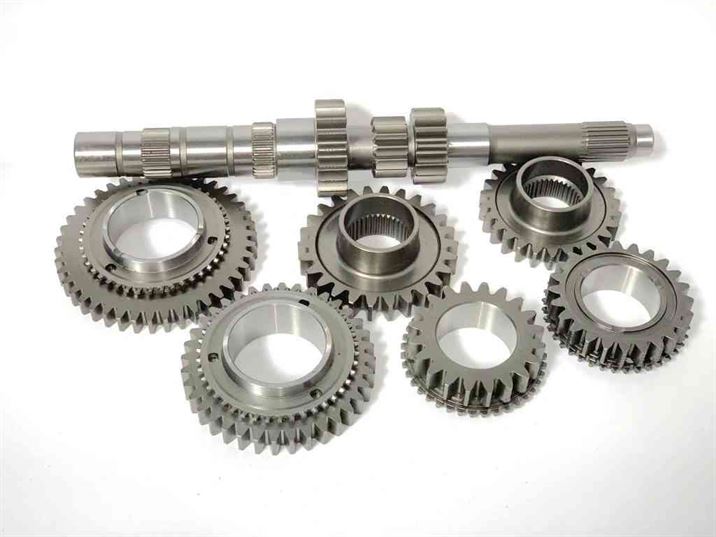
Advantages in brief:
- Straight-cut gears make the drive lightweight
- They do not produce any axial force
- They provide more torque
- Easy to assemble
- Reduces overall engine space
- Designed for race cars
- Cheaper in price
2. Disadvantages of Straight-Cut Gears
Nothing is without drawbacks, and straight-cut gears also have their disadvantages.
Due to their straight cut, they mesh with each other all at once, which creates a lot of noise. Thus, they are not used for ordinary cars as they are not known for quiet operation.

When straight gears meet their parts simultaneously, they tap against each other and thus produce a whining sound. They are less smooth and less efficient than helical gears, which come together in small segments and therefore do not produce any instant tapping.
As speed increases, the tapping also increases and the noise continues. So now you know why race cars are so noisy when moving.
Additionally, straight-cut gears are not meant to handle heavy loads that helical gears can effortlessly support.
This happens due to the distributed force from the spiral teeth of the gears. Want to know if you can drive with a bad engine mount?
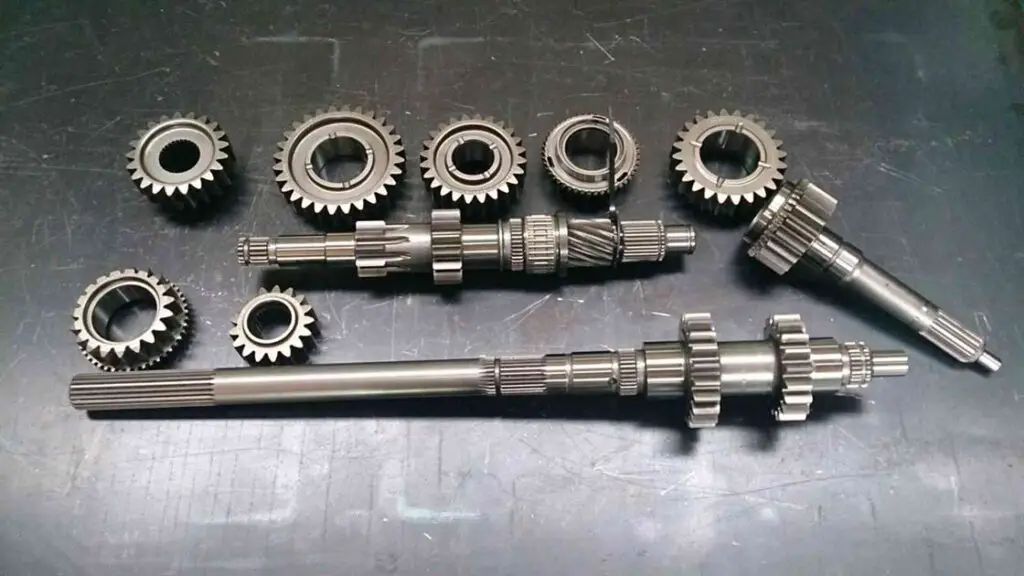
Disadvantages in brief:
- Noisy operation
- Not intended to carry heavy loads
- Not good for passenger cars
FAQ on Straight-Cut Gears
- Why are straight-cut gears used in racing transmissions?
Straight-cut gears are popular in racing transmissions because they can handle the high RPM and torque demands of racing engines. They also allow for faster and more precise gear shifts, essential in racing situations.
- Do straight-cut gears make more noise than other types of gears?
Yes, straight-cut gears are known for producing a distinctive whine or hum, especially at high speeds. This noise is due to the way the gear teeth engage and is one of the characteristics of straight-cut gear trains.
- Are there any disadvantages to using straight-cut gears?
A notable disadvantage is the increased noise level, which can be undesirable in some applications. Additionally, straight-cut gears may produce more vibrations and are less smooth than helical gears.
- Can straight-cut gears be used in everyday vehicles?
While straight-cut gears are excellent for high-performance and racing applications, they are less common in everyday vehicles due to their noise and vibration characteristics. Helical gears are typically used in most passenger cars for smoother and quieter operation.
- How do straight-cut gears differ from helical gears?
Straight-cut gears have teeth cut straight across the face of the gear and mesh directly with each other.
Helical gears have teeth cut at an angle or in a spiral shape, resulting in smoother engagement and quieter operation but sacrificing some efficiency and durability compared to straight-cut gears.
- Are straight-cut gears more efficient than helical gears?
Straight-cut gears are generally more efficient in terms of power transmission because they have less friction and energy loss during operation. However, their increased noise and vibrations may limit their use in some applications.
- Can straight-cut gears be lubricated the same way as helical gears?
Yes, straight-cut gears can be lubricated with the same types of gear oil or lubricants as helical gears. Proper lubrication is essential to minimize wear and extend gear life.
- Are there any maintenance considerations for straight-cut gears?
Regular inspection and maintenance are important to ensure the longevity and performance of straight-cut gears. This includes checking for wear, proper lubrication, and addressing any abnormal noise or vibration.
Watch this video by Donut to learn more about helical and straight gears!
Conclusion
More and more sports cars are adopting the concept of helical gears thanks to technological advances so that torque is not compromised.
There are still cars that gracefully use straight-cut gears and allow the driver to finish the race with all their charm. So, as long as the noise during driving doesn’t bother you, straight-cut gears are not such a bad transmission.
Some engine enthusiasts prefer to convert their gear system to a straight-cut gear mechanism to improve efficiency and speed. Ultimately, it all depends on preferences if you want to opt for smooth and quiet driving or for power and noise.