
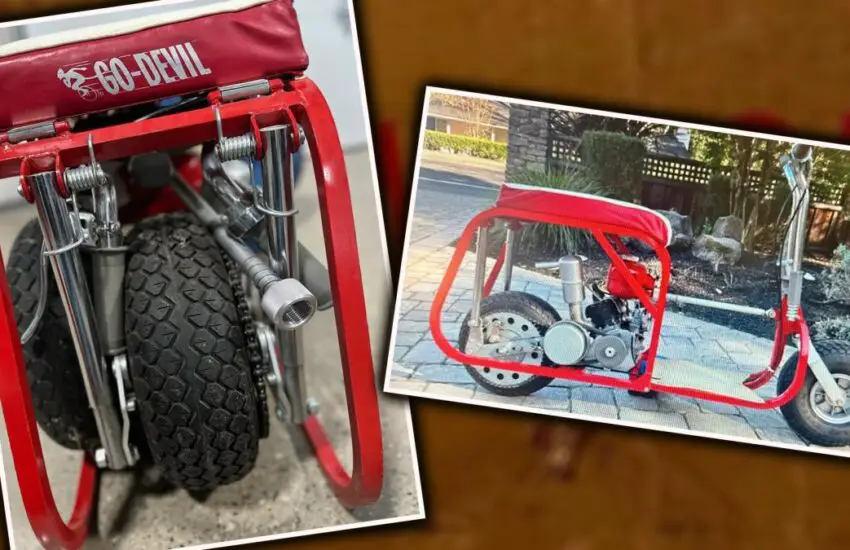
The 1965 Fuji Go-Devil: Japan’s Forgotten Folding Scooter
Long before the modern era of electric micro-mobility, a pioneering Japanese machine laid the groundwork for the folding scooter concept. Emerging in 1964, the Fuji Go-Devil is a largely overlooked chapter in automotive history, predating more famous successors by decades. This compact two-stroke represents a fascinating and mechanical approach to urban transport that has recently resurfaced to capture the interest of collectors.
A Mechanical Marvel of Compact Design
The Go-Devil’s design was focused on pure utility and space-saving ingenuity. Unlike today’s electric models, it was powered by a 50cc two-stroke gasoline engine, offering a simple and mechanical riding experience. Its most notable feature was a clever folding mechanism that allowed the handlebars and seat to collapse down, transforming the scooter into a relatively portable package. This innovation was aimed at urban dwellers and those needing “last-mile” solutions, a concept far ahead of its time in the mid-1960s.
Precursor to an Iconic Lineage
The Fuji Go-Devil’s significance is cemented by its place in the historical timeline. It debuted nearly two decades before Honda’s iconic 1981 Motocompo, which is often mistakenly cited as the pioneer of the Japanese folding scooter genre. The Go-Devil also establishes a direct lineage to contemporary models like the Honda Motocompacto, proving that the core idea of a ultra-compact, stowable personal vehicle has enduring appeal. Its existence recontextualizes the evolution of these practical machines.
A Rare Find for Collectors
Today, the Fuji Go-Devil is an exceptionally rare find. Examples, such as a 1965 model recently noted in the collector market, are prized for their historical value and unique engineering. For enthusiasts, it represents the raw, mechanical origin of a concept that continues to evolve. This forgotten scooter stands as a testament to early innovation in personal mobility, offering a tangible link to the pragmatic and inventive spirit of 1960s Japanese engineering.