
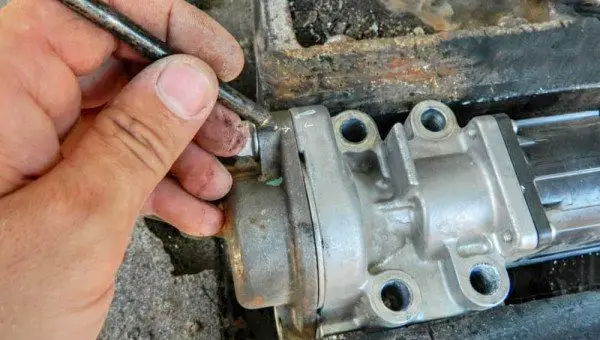

Most modern vehicles on the road now feature an EGR (Exhaust Gas Recirculation) system.
The EGR uses an EGR valve that often wears out due to lack of maintenance and leads to poor performance. In this article, we will discuss the symptoms you might notice if the EGR valve is damaged and how to handle the situation.
EGR valves are partly known for failing often and they can result in a costly replacement. EGR valves must withstand heavy wear from hot air and the amount of carbon that builds up inside.
But is it cheap or expensive to replace? Can I replace it at home? In this article, I will answer these questions for you.
Signs of a Bad EGR Valve
faulty diesel egr valve
Since the EGR deals with exhaust gases such as carbon dioxide and NOx, it has a good chance of being damaged or clogged over the years. This, in turn, reduces the car’s performance and also increases pollution. If there is a problem with the EGR valve, the check engine light or the EPC light (VW) may appear on your dashboard.
The two main issues faced by EGR valves are that either the valve stays open, or it closes completely.
Here are some common symptoms you will notice if you have a bad EGR valve.
1. Poor / Irregular Idle
This occurs when the engine is at low RPM and the EGR valve remains open, allowing extra gases and ultimately leading to a drop in engine performance.
2. Black Smoke from the Exhaust
If the EGR valve remains open at all times and exhaust gases are constantly routed to the engine, the engine is deprived of oxygen. With too much fuel burned and less oxygen, black smoke is produced and escapes from the exhaust pipe, especially when the car is idling.
3. Check Engine Light Comes On
If the car’s onboard computer detects a problem with the vehicle’s EGR valve circuit, it will trigger the check engine light. Please note that the check engine light can also be triggered for many other reasons. You can read the computer at home with an OBD2 code scanner.
4. Decreased Fuel Consumption
With incorrect fuel/air supply, the engine will not run properly and this will lead to decreased fuel consumption.
5. Engine Stalling
If you notice the engine stalling at higher RPMs, it may be due to a bad EGR valve. This can also cause the engine to choke.
6. Turbocharger May Fail
If the EGR valve and cooler remain closed and the exhaust gases are not cooled, the engine temperature will increase significantly. When the engine overheats, it breaks down the engine oil that heads to the turbocharger, causing the turbocharger to fail.
7. Engine Disintegrates
If the engine overheats too much, it will consume all the lubrication and even start using its own engine oil instead of diesel fuel. This will cause the engine to disintegrate.
Exhaust Gas Recirculation sounds like an explicit term but its application is a bit complicated yet sophisticated. The EGR system recirculates exhaust gases into the intake manifold and uses them for combustion.
This process not only reduces harmful NOx emissions but also helps the car stay within the legal pollution limit. As the exhaust gases are recirculated, the combustion temperature decreases, preventing the production of NOx. There are some drawbacks to EGR, such as loss of fuel economy, low performance, and in diesel engine cars, soot production increases.
However, modern engines use smart technologies for an efficient process, for example, new diesel engines now use an EGR cooler that cools the exhaust gases by passing coolant.
Where is My EGR Valve Located?
If you want to find where your EGR is in your engine compartment, check around the intake manifold and you have a good chance of finding it. It is usually located with a pipe going from the intake to the exhaust manifold.
Due to the heat, the screws can be difficult to remove after a while and there is a good chance you will destroy the bolts when trying to remove them. Always spray some 5-56 or WD40 on the screws before attempting to remove them.
Repairing / Cleaning a Broken EGR Valve
clogged diesel egr valve
Repairing an EGR valve can sometimes work, but in most cases, it will be cheaper to buy a new one. Older vacuum-controlled EGR valves are easier to repair because their function is much simpler. If you have a vacuum-controlled EGR valve, you can often replace the membrane inside and clean it to make it work like a new EGR valve.
New EGR valves contain a lot of electrical parts and can be very difficult to repair if you are not an expert. It may also be impossible to find spare parts for the inside of the EGR. It is very likely that you will have to buy a new one. There are also cars with an electric EGR motor, but a spring valve. These can often get stuck and it may be helpful to clean and lubricate the shaft to free them.
If you plan to clean your EGR valve, scrape the carbon off with a knife and clean it several times with brake cleaner. After that, you can lubricate it with 5-56 or WD40 to ensure all parts move as they should.
If you want to replace the EGR valve yourself, you must remember that if you have an electronic EGR valve, you need to use an OBD2 scanner to clear the fault codes after replacement and set a basic setting for the new EGR valve. If you do not relearn the settings for the new EGR valve, you risk ending up with the same
fault code again, and you will have to take it to the mechanic anyway.
Now that you have concluded that the EGR valve is faulty, it is time to repair it. You can either take it to the official dealer or try these methods to save money.
Most of the time, the EGR valve is dirty and clogged when it is constantly recirculating gases. Follow these steps to clean the valve and remove blockages and determine if it is working properly.
- Disconnect the battery
- Disconnect the sensors and clips
- Loosen the bolts holding the EGR valve
- Clean the valves and pipes with carburetor or EGR cleaner. You can find one on Amazon: Genuine EGR System Cleaner – 1 Liter
- Reconnect the battery
- Make sure not to spray the cleaner on other electrical components. Instead, buy an electrical cleaner that will help you clean those certain components. For beginners, we recommend entrusting your car to an auto specialist who can effectively diagnose the problem and provide you with a solution.
On average, replacing the EGR valve should cost between $200 and $900. The component itself costs about $70 to $490. It is often the repair time that is expensive.
Diagnosing a Bad EGR Valve
The diagnostic procedure depends a lot on whether you have a vacuum-controlled or electronic EGR valve. Follow these steps before replacing your EGR valve. The steps below are quite advanced and you may need prior knowledge about cars.
Vacuum-Controlled EGR
Check the vacuum hose between the intake and the EGR.
Use a vacuum pump to open the EGR valve and see if it holds pressure.
If it does not hold pressure, replace the membrane if possible or replace the entire EGR unit.
Remove the EGR valve and check if it opens when you use the vacuum pump.
If the EGR valve works correctly, check the solenoid that controls the EGR valve and check if you have power and ground there.
Electronically Controlled EGR
Remove the EGR valve unit if necessary to see the valve opening and closing
Connect a car battery charger while performing the diagnostic procedure, to ensure the voltage in the car is good while doing it.
Open and close the EGR valve with an OBD2 scanner several times to check operation.
Perform a basic setting/reset and relearn the stored settings with the scanner.
Look for possible wiring issues to the EGR/measure with an electrical wiring diagram.
Open the EGR valve and look for any corrosion/water infiltration inside the EGR valve or inside the connector and clean it with electrical cleaner if you find corrosion.
Reinstall the EGR valve and try again; if still faulty, replace the EGR valve.
Causes and Function
EGR Valve on a Diesel Engine
The EGR valve on a diesel engine usually gets much dirtier and needs to be replaced and cleaned more often. Carbon buildup can also destroy the EGR valve and you need to replace it more frequently. Many people reprogram the EGR valve to not function in order to reduce the amount of carbon buildup in the engine. Remember that this is against the law and bad for the environment.