


There’s nothing as welcome as the cool breeze from a vehicle’s air conditioning in the midst of summer heat. After all, without these modern conveniences, our daily commutes would be much less bearable, no matter their length. This notion, in itself, places greater importance on the condition of our vehicle’s air conditioning system as a whole.
As most drivers well know, a vehicle’s air conditioning system must be properly charged to achieve the highest degree of operational efficiency. For this reason, it’s important to periodically recharge a vehicle’s air conditioning system, especially if there is a leak of any severity in the system. The charging can be done using DIY kits or can be performed by a professional.
However, many often wonder if their vehicle’s air conditioning system is overcharged, especially if they have refilled it themselves. It’s also natural to contemplate the outcomes of such overcharging, as well as the symptoms that such a condition might present.
Read on to learn more about the various symptoms associated with an overcharged air conditioning system, as well as how to resolve such an issue, should it arise in the future.
What Does an “Overcharged” Air Conditioner Mean?
Every air conditioning system ever assembled has a maximum charge rate, and those found in today’s vehicles are no different. This “maximum charge” details the total refrigerant capacity that a particular system can accept.
Based on this knowledge, the idea of system overcharging is quite simple. An overcharged condition exists in an air conditioning system whenever an excessive amount of refrigerant has been introduced, which typically equates to a total system charge exceeding that specified by the system’s manufacturer.
Whenever an air conditioning system is charged beyond its capacity, a number of troubling symptoms can occur, most of which are detailed below. However, suffice it to say that an overcharged air conditioning system is largely incapable of operating at its peak efficiency, to the great dismay of any driver who depends on its functionality for their comfort.
How Does It Happen?
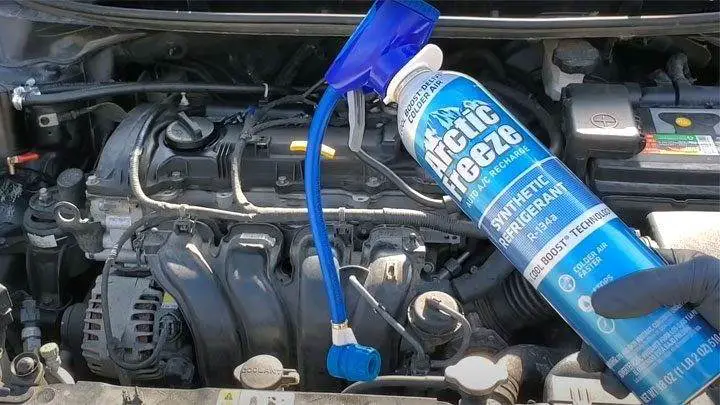
Air conditioning system overcharging typically occurs whenever a vehicle owner attempts to charge the system in question themselves, using basic recharge kits that can be purchased at any auto parts store.
When using a kit of this nature, many find themselves limited in their ability to accurately measure the amount of refrigerant being introduced. Furthermore, some kits come with few viable instructions.
Additionally, most DIY A/C charging kits only come with a single gauge, intended to display readings in a system’s low-pressure circuit. In this case, no high-pressure reading is obtained, limiting the ability to fully observe a system’s response to one’s charging efforts.
Most often, a driver is unaware that they have overcharged their vehicle’s air conditioning system until undesirable cooling is noticed. Moreover, a number of additional symptoms can also occur, leading one to wonder whether or not they have overcharged the system as a whole.
Overcharged AC Symptoms
The presence of too much freon in a vehicle’s air conditioning system is often accompanied by a host of secondary symptoms. Recognizing these symptoms can prove helpful when attempting to quickly remedy the current situation.
Here are some of the most common symptoms associated with air conditioning system overcharging.
#1 – Warm Discharge Air

An overcharged air conditioning system rarely cools as it should, often blowing warm air from the system’s vents. If you have recently refilled your vehicle’s refrigerant but are getting no relief from the heat, an overcharge of refrigerant might be to blame.
#2 – Odd Noises
If you have just had your vehicle’s air conditioning serviced and now notice strange noises coming from under the vehicle’s hood, it might be wise to have the system’s refrigerant charge checked again.
System overcharging can cause an air conditioning compressor to struggle, often resulting in an audible gurgling or whining sound.
#3 – Irregular Pressures
Overcharging an air conditioning system often causes system pressures on the high side to skyrocket. System overheating can also result, adding further insult to injury and preventing any level of cooling from being achieved.
#4 – Freezing of the Suction Line
Freezing of a system’s suction line can easily occur in the event of a slight overcharge. This primarily happens when the heat load in the evaporator is rather minimal and system freezing temperatures are reached.
What To Do

In all cases, the issue of a vehicle’s air conditioning system overcharging must be resolved promptly. A vehicle owner’s failure to act can quickly lead to serious and irreversible damage to components. This, in turn, can require additional expense on the part of the driver to restore the system’s full functionality.
In short, one must purge their vehicle’s air conditioning system to achieve the desired charge rate. Unfortunately, this will almost certainly require a trip to the local service center, as most do not have a refrigerant recovery machine available at home.
Venting refrigerant into the atmosphere is highly illegal, as freon is recognized by the EPA as an environmental pollutant.
If you are unsure whether your vehicle’s air conditioning system has been overcharged or not, a trip to your local automotive service center is highly advised. It is far better to address the issue in a timely manner than to suffer a system failure due to complacency.
Can Overcharging Damage the A/C Compressor?
Overcharging a vehicle’s air conditioning system can prove detrimental, if not catastrophic, to the system’s compressor. This stems from the fact that a compressor is subjected to a significantly increased load under such conditions, thereby causing significant fatigue.
Furthermore, extreme overcharging can lead to compressor slugging, which describes a condition where liquid refrigerant enters the intake side of a compressor, often with devastating consequences.
Significant damage to a vehicle’s air conditioning compressor not only requires replacement but also a complete system overhaul. This is due to the high likelihood of system contamination when debris from a failing compressor is forced downstream. In any case, damage of this nature is quite costly to repair.