
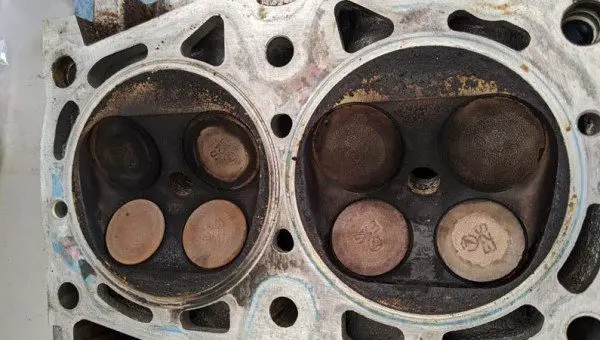

Valves control the movement of a fluid through a system. Inside your car’s engine, this fluid is air.
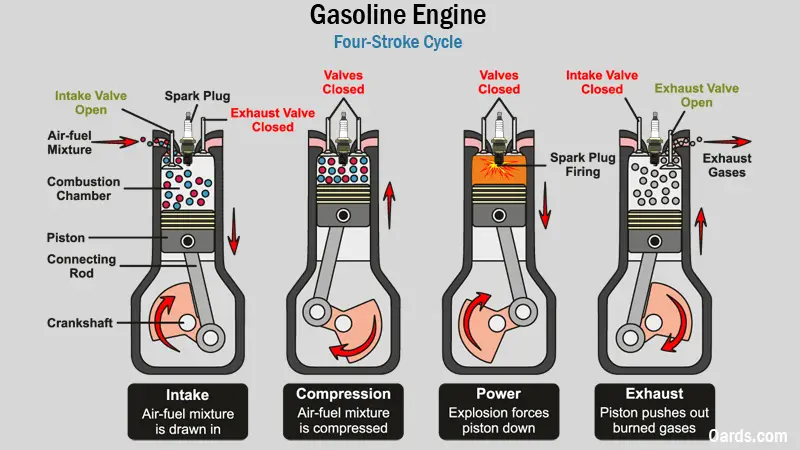
During the intake stroke, the intake valves must open to allow fresh air to enter the combustion chamber. During the exhaust stroke, the exhaust valves must open to allow the burnt combustion mixture to exit the combustion chamber.
On the compression stroke, both the intake valves and the exhaust valves must remain closed to generate potential energy before the combustion mixture is ignited. The force of this combustion is what gives your vehicle its power.
Almost all vehicles equipped with internal combustion engines have intake valves and exhaust valves. These valves are housed inside the cylinder head(s). Usually, there are two intake valves and two exhaust valves per cylinder, so a four-cylinder engine would have 16 valves in total (2 * 2 * 4 = 16).
1) Engine Over-revving
An automobile manufacturer sets an engine’s redline based on many factors. For example, the weight and balance of the rotating assembly, the strength of the valve springs, heat, harmonics, and the available oil supply can all be considered in the engine’s design and stress testing by engineers. Even the transmission can play a role in this decision.
On vehicles with manual transmissions, it is possible to exceed the engine’s RPM by downshifting into a gear that is too low for the speed the car is traveling. Also known as a “money shift,” this is a costly mistake that can cost you an engine.
If you engage the clutch while the wheels are spinning too fast for the selected gear, the computer cannot do anything to prevent you from causing serious mechanical damage. Your own brain is the transmission computer for a stick shift, after all.
It is generally not recommended to spin the engine above the manufacturer’s redline unless you upgrade many of the engine’s internal components. The upgrades you need vary for each make and model.
Excessive engine RPM is usually not possible on vehicles equipped with automatic transmissions (including CVTs). In these vehicles, the Transmission Control Module (TCM) should prevent you from spinning the engine higher than the car was designed for.
2) Poorly Timed Engine
Subaru Timing
The “timing” of an engine can refer to the ignition timing, which tells the spark plugs when to fire. Timing can also refer to the mechanical timing of the engine’s cam. Cam timing tells the valves when to open for each cylinder as the crankshaft rotates.
Cam timing is typically managed by running a timing belt or timing chain over a set of pulleys and sprockets. As the crankshaft rotates, it turns a belt which rotates each cam according to a predetermined ratio relative to the camshaft’s rotation.
In many engines, it is possible for the pistons to come into contact with the valves if the engine’s cam timing is incorrect. This design is called an interference engine.
A non-interference engine is an engine design where the valves and pistons are spaced far enough apart from each other that they cannot make contact, regardless of timing.
If the timing belt or timing chain is replaced but the engine is not properly timed, it is very easy to bend a valve on an interference engine.
If you change a timing belt yourself, it is important that you follow all the vehicle manufacturer’s instructions according to the factory service manual. Turn the engine over by hand several times to ensure no internal components are making contact before putting everything back together and starting it.
3) Broken Timing Belt
Bad Timing Belt
If the timing belt were to snap on an interference engine, there is a very good chance that a piston will contact a valve and bend that valve. This is one of the reasons why it is essential to change your timing belt on time.
Timing belts usually work perfectly fine until they don’t. There may be no warning before the timing belt snaps. At the very least, a broken timing belt will leave you stranded.
Timing chains typically require no maintenance unless there is a problem with a chain tensioner.
Most modern V8s have 32 valves, but the LS engines used in Corvettes (the LS3, LS4, and LS5) only have one intake and one exhaust valve per cylinder, for a total of 16 valves.
4) Low Engine Oil
Engine Oil Pressure Warning Light
Engine oil is essential for your engine’s health. If the engine oil level is too low to provide adequate oil pressure to the entire engine, a number of problems can occur. One such problem is a valve sticking in the valve guide, which could bend the valve if it protrudes and a piston can make contact.
Few problems caused by oil starvation are cheap to fix, but checking and maintaining your oil level is very cheap. Don’t forget this crucial step of vehicle ownership.
How to Tell if Your Valves are Bent
The best way to know if you have a bent valve is to remove the cylinder head so that you can physically get your hands on the valves. Since this involves a lot of work, most people will perform a compression test or a leak-down test instead.
A compression test will tell you the compression of each cylinder. It is a quick and easy go/no-go test to assess your engine’s health.
If you perform a compression test and find that the compression on one cylinder is low, you can then move on to a leak-down test. A leak-down test will tell you exactly where air is escaping from your engine during the compression stroke, when the combustion chamber is supposed to be sealed.
A leak-down test is performed by hooking compressed air to a vehicle’s spark plug hole and turning the crankshaft until that cylinder is on the compression stroke. Once achieved, you should be able to listen for which part of the engine the air is escaping from the fastest.
If you hear air hissing through the intake, you may have a bent intake valve. If you hear air hissing out of the exhaust, you may have a bent exhaust valve.
Please note that simply hearing air escaping from these places does not necessarily mean you have a bent valve. You may simply have carbon buildup around the valves, causing air to escape from a poor seal.
This would still require valve work to fully correct, but you might be able to mitigate the issue with an additive like Seafoam.