
Bearings are components that are designed with high precision to ensure they support the proper functioning of mechanical movements.
In addition to simply facilitating movement, bearings also help carry heavy loads with great ease and efficiency. There are different types of bearings, and among them, ball bearings and roller bearings, commonly used in cars. This type is used particularly because they can support both radial and axial loads.
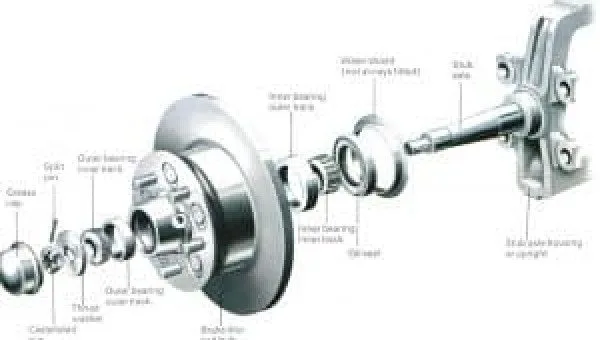
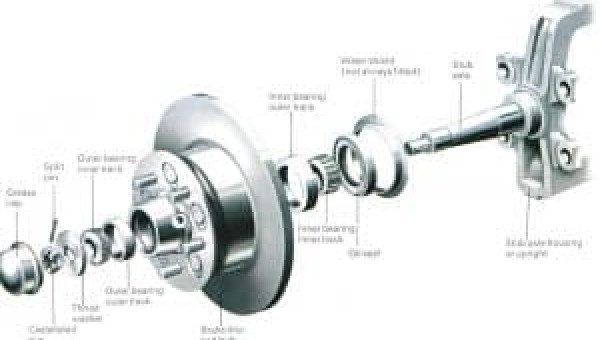
Wheel bearings are truly necessary for the operation of your car. They are located on a metal axle shaft and are permanently installed in the hub. The wheel bearing is essential for the proper functioning of the hub, tire, and wheels of the car so that they can work together.
The wheel bearing ensures smooth movement and rotation of the entire hub assembly, thus ensuring smooth rotation of the tires and wheels.
A malfunctioning wheel bearing leads to a variety of signs or symptoms, some of which are clearly visible and others are confusing. It is difficult to diagnose because the car must be driven to diagnose the problem.
Symptoms of a Bad Wheel Bearing
A faulty wheel bearing can exhibit various symptoms and effects. They are as follows:
1. Grinding or Grating Sound from the Wheel
wheel bearing hub
WHEEL BEARING WITH HUB. EASIER TO REPLACE BUT MORE EXPENSIVE.
One of the most common and recognizable symptoms associated with bad wheel bearings is noise coming from the wheel of a moving vehicle. You might confuse this with engine noise, but if you listen carefully, you will likely hear a cracking or grinding noise that gets louder as the vehicle accelerates.
Because wheel bearings are not known to wear out so often, the noise is usually mistaken for something else and the problem is ignored.
Most of the time, wheel bearings are made of hardened steel and can withstand many forces. Bearings are usually destroyed by heat and water. Heat is generated when there is little or no lubrication, and water can sometimes penetrate the wheel bearing. In most cases, newly manufactured wheel bearings are fully sealed.
These seals help protect the wheel bearing from destructive elements such as water, dirt, etc. However, if this seal is broken, the wheel bearing begins to fail and make noise.
2. Shifting the Car’s Weight
Another result is that if you drive the car at a speed of about 50 miles per hour and if you steer it left and right by shifting its weight from left to right, it will start making noise. Be sure to steer gently, as high speeds and sharp turns can overturn your car.
If you steer from left to right or right to left, the sound effect will be different. For example, if you turn right and the noise decreases, it means your left wheel bearing is damaged, and if you turn left and the noise decreases, it means your right wheel bearing is damaged.
3. Worn Patches on Tires
Sometimes tires that are partially worn or cut in various patches make grinding or pinching noises when speed is increased. This noise is somewhat similar to the noise of a worn wheel bearing. Therefore, it is recommended to also check the tires. But remember that these spots on the tires can also be the result of worn wheel bearings.
4. Your Car Feels Loose
Wheel play, also called wheel wobble, is another common symptom of a bad wheel bearing. When the bearing is damaged, it starts to loosen inside the wheel hub and wheel axle, making the vehicle feel loose when steering.
Wheel Bearing Replacement
Wheel bearings do not fail immediately; they often give some time before needing replacement. In the worst case, the failure of a wheel bearing can lead to the complete locking of the wheel hub and the car can no longer move. But it is not necessary to replace them immediately; sometimes you can simply continue with faulty wheel bearings and nothing happens; the noise just gets louder and louder.
Replacing a bearing is a bit expensive because it requires a lot of work. Especially for four-wheel drive or front-wheel drive vehicles, several parts need to be removed to access the bearing.
Some cars have a hub that can be easily replaced, others require special equipment to replace it. If that is the case, it is probably easier and cheaper to have the mechanic do the work for you. However, if you wish to replace it yourself, you can do so in the following way:
(Remember that this varies considerably depending on the car model)
Remove the Tire
First, the vehicle is lifted on a jack and placed on a jack stand. The rear wheels are blocked with a chock to ensure your vehicle does not move. Then, the tire is unscrewed first and a hubcap on the tire rim is removed.
Remove the Axle Nut
After removing the cover, put the tire back on, secure it with 2-3 nuts, loosen it, then remove the axle bolt. Use wrenches with long handles, as axle nuts are usually very tight and require high torque to remove.
Removing the Brake Rotor
As soon as the axle nut is loosened, reinsert the jack and remove the tire. It is recommended to place the removed tire under your vehicle to prevent damage to the vehicle in case the jack fails. Then remove the axle nut and remove the brake rotor.
Remove the Bearing Hub
As soon as the brake rotor is removed, it is recommended to hammer the axle shaft inward to free it and move it inward. Then move the hub as desired and remove the bolts that hold the hub to the body. Remove the ABS sensor, then use a slide hammer to remove the hub from the steering knuckle. If there is high friction, use penetrating fluid and hammers to allow some external movement.
Disassemble the Hub
Once the hub is removed, you can easily see your bearing. Then remove the bearing from the hub and replace it with the new bearing. It is recommended to
use sandpaper and clean all nearby areas, i.e., the hub mounting area, of rust and deposits.
Mounting the Bearing
If your new bearing is equipped with an ABS wire, remove the old ABS connection from the hub and motor and connect the new bearing. Then reassemble all parts, tighten your axle, place the hubcap on your tire, remove the jack, and you are ready to go.
Conclusion
Wheel bearings are an essential component of your vehicle. They assist the movement of the vehicle’s wheels. A malfunction of the wheel bearings can lead to serious problems or simply annoy you with their increasing noise. It will cost you a lot of money, but it is always recommended to perform the repairs as early as possible.