

It can be quite difficult for drivers to understand all the markings on a tire’s sidewall. But these letters and symbols are very important when you buy a new or different set of tires. If you are a novice, these symbols might look like an algebraic equation or a line of code that needs solving.
Understanding this, we will provide you with some useful knowledge by decoding a popular question: T vs H speed rating, what does it mean? and the difference between the two letters to eliminate your confusion about these symbols.
What Does T or H on Tires Mean?
T and H represent the tire’s speed rating – the parameter indicating the tire’s maximum permissible speed. Knowing this indicator will help drivers choose the right type of tire for the terrain as well as adjust driving speed appropriately to ensure safety in traffic. Therefore, distinguishing these indicators is part of the important knowledge that car owners should equip themselves with.

What Does T on a Tire Mean?
If you were to look at the tire speed rating chart, you would see that the letter T corresponds to 190 km/h (118 mph). This means that the maximum speed you can drive is 118 mph and you should not exceed this speed limit. You typically see this letter on tires for vehicles like minivans or family sedans. These tires are suitable for small vehicles; they are quite robust and can perform on a number of different terrains, but they are better suited for highway driving.
What Does H on Tires Mean?
The H speed rating indicates that your tire can withstand speeds of up to 210 km/h (130 mph) under optimal conditions. The H speed rating is at the lower end or the beginning of the performance tire speed ratings. You can usually see it on coupes and sports sedans. The H speed rating can be a good choice for drivers who always drive at high speeds or need to enhance their car’s performance. This is the maximum speed you can drive at. If you exceed this speed, you risk damaging the tire.
T vs H Speed Rating: What Are the Differences
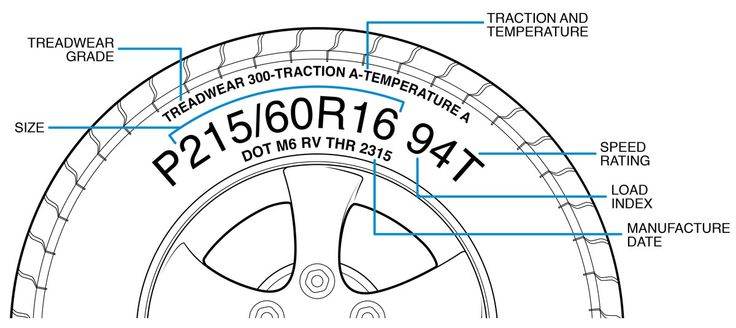
Based on the definitions above, we can see that the T and H symbols on tires represent the maximum speed they can handle, the recommended tire pressure, a certain load capacity, and ideal road conditions. The H speed rating can handle speeds of 130 mph while T-rated tires can handle speeds of 118 mph. This could be the first difference you easily notice when discussing these tires.
The higher the speed rating, the softer the compound and the more grip the tire offers. Better grip means the tire will stop more quickly, turn more precisely, and have better acceleration.
Thus, the H speed rating will have better handling and braking compared to the T rating. Not only that, but H-rated tires also withstand a higher level of friction and heat resistance than T-rated tires.
The final difference between these two types of speed ratings is their intended use. T-rated tires are suitable for low-speed vehicles (trucks). In contrast, an H-rated tire, due to its better cornering and braking capability, generally makes it suitable for vehicles such as sedans, multi-purpose vehicles, or SUVs.
How to Choose the Right Tire Based on Speed Rating?
Drivers need to know how to choose the right type of tire for the terrain to avoid misuse and unsafe driving. Experts recommend that the vehicle’s speed be 10 to 15% lower than the tire’s speed rating. This is a way to prevent tire wear and potential damage. In case you need to replace a tire, the speed rating must be equal to or greater than the tire installed by the manufacturer. However, the car manufacturer does not recommend users use tires with a lower speed rating, as it can seriously reduce the vehicle’s ability to remain safe.
Furthermore, the tire’s speed rating is directly proportional to the vehicle’s traction and braking force, but this can reduce the tire’s lifespan and performance when operating in low-temperature conditions. This is why tires with high-speed ratings like V, Z, W, and Y are generally suitable for high-performance vehicles in warmer climates.
Additionally, drivers can increase the tire’s speed rating to enhance performance. But car owners must absolutely not lower this rating without reducing the vehicle’s maximum speed to a lower level. The tire’s speed rating indicates the maximum speed at which the tire can maintain its operation under the load pressure specified by the manufacturer. Knowing how to read the speed indicator not only helps drivers choose the right tires but also to control speed more effectively on each terrain to ensure safety on every road.