
Without a universal joint (or U-joint), you cannot drive a vehicle. To ensure your car’s health and your safety on the road, you need to be able to detect the signs of a bad U-joint.
What is a Universal Joint?
The universal joint is a driveshaft component found in rear-wheel drive trucks, SUVs and four-wheel drive trucks, as well as all-terrain vehicles.
This component transfers power from the transmission to the differential and compensates for the height misalignment between the transmission and the rear axle. Present in pairs on the driveshaft assembly, you cannot drive a vehicle without functional universal joints.
Each end of the driveshaft is connected to a universal joint. With each rotation of the driveshaft, the joints bend to correct the misalignment. Nowadays, rear-wheel drive cars use constant velocity joints instead of U-joints for smoother driveshaft rotations. In automobiles, there are two universal joints placed along the driveline. Car owners can locate them at the engine as well as the rear differential of rear-wheel drive cars. In some four-wheel drive automobiles, there are more U-joint connections along the drivetrain than in other vehicles.
Signs of a Bad Universal Joint: Clues to Look For
There will be certain symptoms of failing universal joints. Detecting these warning signs of a bad U-joint will likely prevent your car from being towed to a repair shop.
Squeaking Noises
Does your car squeak when it starts moving after the engine starts? It becomes noticeable when the car moves forward or backward, but disappears when the vehicle accelerates to more than 5 to 10 mph.
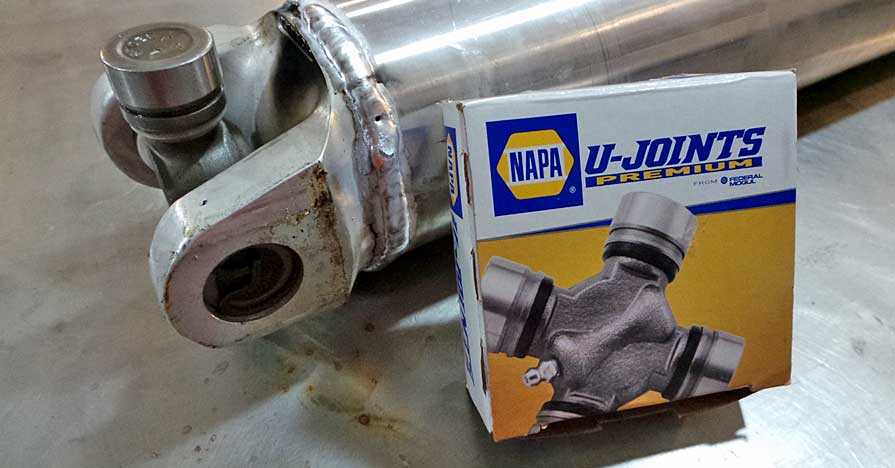
Why does this happen? Universal joints contain factory-lubricated bearing components. However, this grease can run out or evaporate over time. Each rotation of the driveshaft slightly twists the bearings. Thus, dry bearings cause metal-on-metal contact and excessive friction leads to squeaking and corrosion.
The squeals are a reminder that it is necessary to call a professional mechanic to diagnose and service the universal joints. Prompt maintenance will extend the life of the joints and prevent driveshaft failure.
A Clunking Sound
Clunking sounds are signs of a bad universal joint, especially when you hear them when shifting the vehicle from “Drive” to “Reverse”.
The clunking sound means the bearings allow the driveshaft to rotate a bit before stopping abruptly when the power is reversed. This may simply be the next stage after producing squeaks due to an insufficient amount of grease in the bearings. Some damage has already been caused at this stage and you cannot repair it, but maintenance will certainly slow down the deterioration.
Vibrations When Accelerating
The next stage of problematic bearings is a strong vibration felt when you accelerate the vehicle. This results from the unbalanced movement of the driveshaft.
When the grease dries out and the bearings are worn enough that they can no longer control the movement of the driveshaft. Its deviation from its regular rotation path causes this vibration.
Are you familiar with the vibrations caused by unbalanced wheels? The frequency of this vibration will be more intense because a driveshaft rotates at least three times faster than the wheels.
This symptom means that the universal joints have started to affect other components, including the transmission. Diagnostic and repair work is necessary at this point if you wish to avoid further damage.
Transmission Fluid Leak
This fluid leaks for many reasons and bad universal joints are one of them. You can be sure of this when the leak occurs at the rear of the transmission.
If you ignore the vibrations, the unstable rotations of the driveshaft are likely to wear out the transmission tailshaft bushing and the output shaft seal, causing a fluid leak.
When this happens, carefully inspect the transmission to discover the source of the leak and take repair measures.
The Car Doesn’t Move
This is the final stage of universal joint failure. You may have already seen a vehicle parked on the side of the road with its driveshaft lying underneath. This means the driveshaft literally fails and detaches from the rear axle or transmission. Repair at this stage may require replacing the driveshaft and even more.
Disconnected Driveshaft
In other cases, the U-joint is completely deteriorated and cannot connect the driveshaft. More precisely, the driveshaft has fallen off the car and become disconnected. In this situation, car owners must call a tow truck in order to replace a new driveshaft.
Causes of Universal Joint Failure
The universal joint typically wears out, like any other automotive component. However, the driveshaft angle or speed is damaged most of the time primarily by extreme vehicle use. Other reasons are bearing lubrication, as well as vehicle modifications. As usual, if car owners can identify the cause of faulty universal joints, they can easily avoid problems and select a suitable replacement. In this article, we will list some of the most common causes of bad universal joints:
Heavy-Duty Use
One of the most common causes of universal joint failure is demanding tasks. Machines are like humans; they have limits. If car owners force their vehicles to perform heavy tasks such as off-roading and racing, they will be damaged quite easily. This also affects automotive components. Driveshaft and U-joint, for example.
If vehicles must regularly perform heavy tasks, owners may consider replacing standard U-joints with heavy-duty U-joints. The reason is that these automotive parts are designed for more strenuous activities.
Normal Wear and Tear
Even though they have a very long lifespan, universal joints can still wear out from intense driving, long-distance driving, as well as unfavorable driving conditions. This usually happens with SUVs and trucks, as they primarily drive off-road, towing, or hauling. As a result, the U-joints are more likely to wear out and need to be replaced much sooner than for a normal driver.
Loss of Grease
Last but not least, lack of lubrication is the cause of most bad U-joints. Car owners must take care of their universal joints, and proper chassis grease is part of that.
How Long Can You Drive with a Bad U-Joint?
When universal joints fail completely, you have no choice but to tow the car to a mechanic. To avoid this, you must detect the signs of a bad universal joint mentioned above.
Normally, universal joints last the lifetime of a vehicle. But anything in your car can break down at any time, so the joints may also need to be replaced.
If they are not functioning properly, you will need to replace them as soon as possible. Also consider replacing them in pairs to avoid more problems in the future. If you must drive for a while with faulty universal joints, do so without engaging 4WD. Using four-wheel drive can cause the axles to explode or tear.
The safest option for you and your vehicle is to seek professional help when you start noticing the symptoms of universal joint failure.
Conclusion
As stated earlier, universal joints are much less expensive than transmission work or a new driveshaft, so inspecting or changing them at the first signs of trouble is the best idea. Some factors can accelerate wear and cause premature failure. Therefore, selecting the right U-joint to mitigate these factors can mean better overall operation and less chance of them needing replacement.
Moog offers several replacement options, manufactured to standards higher than the originals, so we suggest trying them if you need to replace your vehicle’s universal joints.