
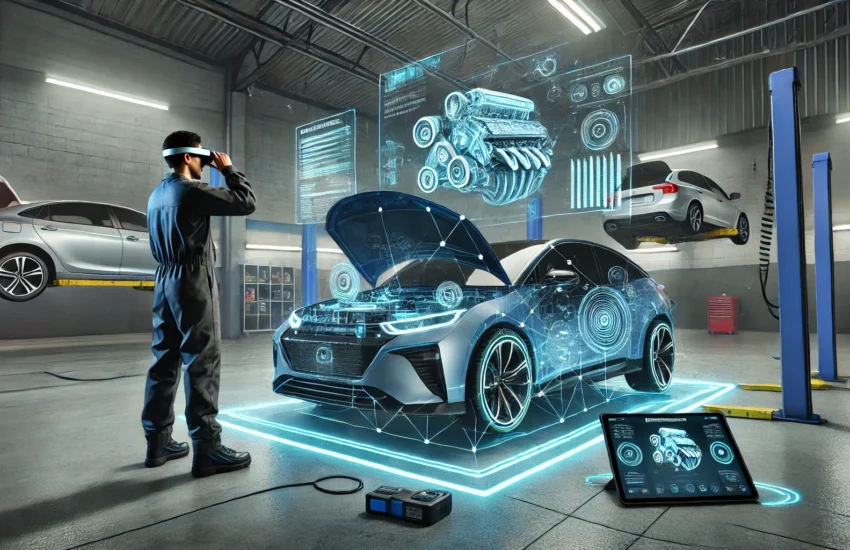
The field of automotive diagnostics has undergone a dramatic transformation in recent years thanks to technological advancements. From traditional tools to modern connected solutions, these innovations enable drivers and mechanics to detect problems more quickly and with increased accuracy. Here is an overview of recent technologies revolutionizing automotive diagnostics.
1. Connected Diagnostics: The Era of Bluetooth and Wi-Fi OBD-II
Traditional OBD-II tools are evolving into wireless versions that connect directly to smartphones and tablets:
- Bluetooth/Wi-Fi Scanners: These devices allow real-time communication between the vehicle and a mobile application.
- Advantages:
- Instant reading of error codes.
- Real-time monitoring of engine performance.
- Advanced features like maintenance management and alerts.
Applications like Torque, Carly, or FIXD make these tools accessible even to non-expert users.
2. Integration of Artificial Intelligence (AI)
AI plays a key role in analyzing the complex data generated by modern vehicles:
- Predictive Diagnostics: AI-based systems can identify problems before they occur, reducing the risk of breakdowns.
- Advanced Code Analysis: AI platforms cross-reference OBD code data with global databases to provide accurate diagnostics.
- Examples: Bosch and Delphi are working on AI-powered solutions for professional workshops.
3. Cloud Diagnostics and Telematics
With the emergence of cloud connectivity, diagnostic data can be sent remotely for analysis:
- Telematics: Manufacturers like Tesla use these technologies to monitor vehicle status and perform remote software updates.
- Data Sharing: Technicians can access vehicle information in real-time, reducing wait times and improving repair efficiency.
4. Augmented Reality (AR) for Repairs
Augmented reality is becoming a valuable tool in automotive diagnostics:
- Visual Guide: Technicians can use AR glasses to overlay diagrams and instructions directly onto vehicle components.
- Practical Examples:
- Quick identification of faulty parts.
- Step-by-step instructions for performing repairs.
Companies like Bosch have already integrated this technology into their tools for garages.
5. Advanced Sensors and Autonomous Vehicles
Modern vehicles are equipped with hundreds of sensors that constantly monitor all aspects of the car:
- LiDAR and Camera Sensors: In autonomous vehicles, these sensors play a crucial role in detecting operational anomalies.
- Real-Time Analysis: These sensors enable instant identification of issues related to braking, steering, or suspension.
6. Simplified User Interfaces
Modern diagnostic tools are increasingly user-friendly:
- Mobile Applications: An intuitive interface makes it easier to understand error codes even for beginner users.
- Detailed Reports: Applications generate clear reports with specific advice on necessary repairs.
7. Eco-Friendly Diagnostics: Towards a Greener Future
With a focus on electric vehicles (EVs) and hybrids, new specialized diagnostic tools are emerging:
- Battery Analysis: Modern tools can assess the condition of high-voltage EV batteries.
- Energy Consumption Tracking: Drivers can monitor energy efficiency and reduce their carbon footprint.
Conclusion
Recent innovations in automotive diagnostic systems are transforming how problems are identified and resolved. These advancements, combining connectivity, artificial intelligence, and interactive tools, make diagnostics faster, more accurate, and accessible to everyone.
Are you curious to learn more about a specific technology or want to explore solutions tailored to your vehicle? Share your questions in the comments!