
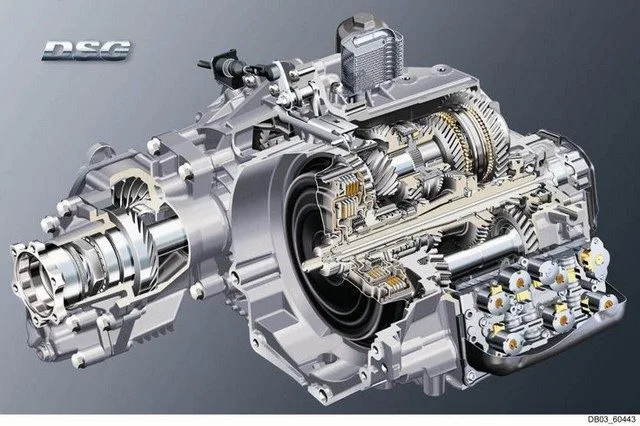
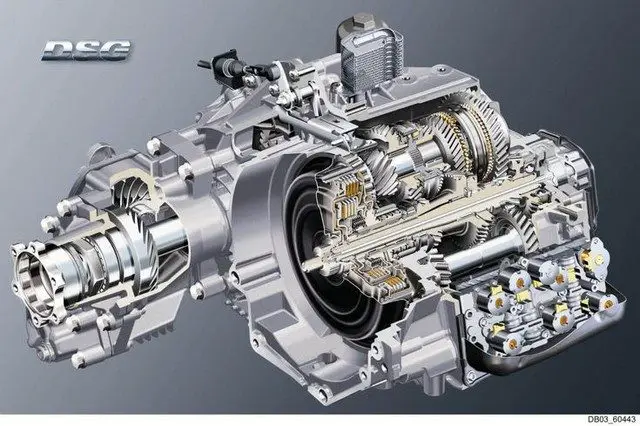
The dual-clutch transmission, also known as Direct Shift Gearbox (DSG) or double-clutch transmission, is an automated transmission that can shift gears faster than any other geared transmission.
Dual-clutch transmissions offer more power and better control than a traditional automatic transmission and faster performance than a manual transmission. Originally marketed by Volkswagen as DSG and Audi as S-Tronic, dual-clutch transmissions are now offered by several car manufacturers, including Ford, Mitsubishi, Smart, Hyundai, and Porsche.
Before DSG: The SMT
The dual-clutch automatic transmission is a development of the sequential manual transmission (SMT), which is essentially a fully automated manual transmission with a computer-controlled clutch, designed to offer gear-shifting performance with automatic convenience. The advantage of an SMT is that it uses a solid coupling (the clutch), which provides a direct connection between the engine and the transmission and allows 100% of the engine’s power to be transmitted to the wheels. Traditional automatics use a fluid coupling called a torque converter, which allows some slippage. The main drawback of the SMT is the same as that of a manual – to change gears, the engine and transmission must be disconnected, interrupting the power flow.
Dual Clutch: Solving SMT Problems
The dual-clutch transmission was designed to eliminate the inherent lag in SMTs and manuals. The dual-clutch transmission is essentially two separate transmissions with a pair of clutches between them. One transmission provides odd gears, such as first, third, and fifth gears, while the other provides even gears like second, fourth, and sixth gears.
When the car starts, the “odd” gearbox is in first gear and the “even” gearbox is in second gear. The clutch engages the odd gearbox, and the car starts in first gear. When it’s time to shift, the transmission simply uses the clutches to switch from the odd gearbox to the even gearbox, for an almost instantaneous shift into second gear. The odd gearbox immediately preselects third gear. At the next shift, the transmission swaps gearboxes again, engaging third gear, and the even gearbox preselects fourth gear. The computerized controller of the dual-clutch transmission calculates the next likely gear shift based on speed and driver behavior and has the “idle” gearbox preselect that gear.
Downshifting with Dual-Clutch Transmission
An advantage for both SMT and dual-clutch transmissions is the ability to perform rev-matched downshifts. When a driver selects a lower gear, both types of transmission disengage the clutch(es) and spin the engine to the exact speed required by the selected gear. Not only does this allow for smoother downshifting, but in the case of the dual-clutch transmission, it leaves enough time for the correct gear to be preselected. Most, but not all, dual-clutch transmissions can skip gears when downshifting, such as going directly from 6th gear to 3rd gear, and due to their ability to match engine speeds, they can do this without the jerks or surges typical of traditional automatic and manual transmissions.
Driving a Car with a Dual-Clutch / DSG Transmission
Cars equipped with dual-clutch transmissions do not have a clutch pedal; the clutch is engaged and disengaged automatically. Most dual-clutch transmissions use an automatic-style gear selector with a traditional shift pattern of P-R-N-D or P-R-N-D-S (Sport). In “Drive” or “Sport” mode, the dual-clutch transmission operates like a regular automatic. In “Drive” mode, the transmission shifts early to higher gears to minimize engine noise and maximize fuel economy, while in “Sport” mode, it holds lower gears longer to keep the engine in its power band. Sport mode also provides more aggressive downshifts with less pressure on the accelerator pedal, and in some cars, activating Sport mode makes the car respond more aggressively to the accelerator pedal.
Most dual-clutch transmissions have a manual mode that allows manual shifting via the gear lever or steering wheel-mounted paddles. When driven in manual mode, the clutch still operates automatically, but the driver controls which gears are selected and when. The transmission will follow the driver’s commands unless the selected gear would over-rev the engine, for example, by commanding first gear while driving at 80 MPH.
Advantages of Dual-Clutch / DSG Transmission
The main advantage of dual-clutch transmission is that it offers the same driving characteristics as a manual transmission and comes with the convenience of an automatic. However, the ability to perform nearly instantaneous gear shifts gives dual-clutch transmissions advantages over both manuals and SMTs. Volkswagen’s DSG takes about 8 milliseconds to upshift. Compare that to the Ferrari Enzo’s SMT, which takes 150 milliseconds to upshift. Instantaneous gear shifts mean faster acceleration; according to Audi, the A3 runs 0-60 in 6.9 seconds with a 6-speed manual and 6.7 seconds with the 6-speed DSG gearbox.
The main limitation of the dual-clutch transmission is the same as all geared transmissions. Because there is a fixed number of gears and the transmission cannot always keep the engine at its optimal RPM for maximum power or maximum fuel economy, dual-clutch transmissions generally cannot extract as much power or fuel economy from an engine as a continuously variable transmission (CVT). But because dual-clutch transmissions offer a more familiar driving experience than CVTs, most drivers prefer them. And while dual-clutch offers superior performance compared to a manual, some drivers prefer the interaction that a manual clutch pedal and gear shift provide.