
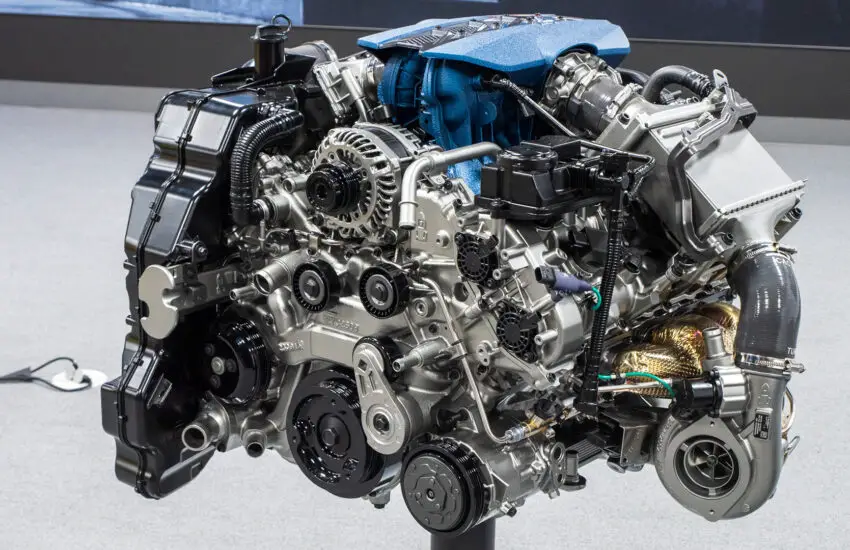
We have reached a point where electrification is truly ubiquitous in the automotive industry. It has long been discussed, emphasizing that our everyday cars as well as our performance vehicles would be battery-assisted, or even fully electric, and it must be acknowledged that these predictions were correct. At least, for the most part, since nine out of the ten powertrains on Wards Auto’s Best Engines and Propulsion Systems list are electrified in one way or another. The Chevrolet Corvette ZR1’s LT7 V8 is the only pure combustion engine to have made it onto this list, and, let’s face it, that makes sense.
Wards has been publishing this list for 31 years now, and there’s no need to recall how much the automotive industry has changed during that period. Until 2020, Wards simply called it the “10 Best Engines” list, but it adapted its title at the turn of the decade to better reflect the nature of the powertrains being honored.
The Complete 2024 Winners List
Before continuing, here is the full list of winners, presented in alphabetical order:
- BMW M5 – 4.4L Twin-Turbo V8 PHEV
- Chevrolet Corvette ZR1 – 5.5L Twin-Turbo V8
- Dodge Charger Daytona – Electric Propulsion System
- Ford F-150 – 3.5L Twin-Turbo V6 HYBRID (2024 Repeat Winner)
- Honda Civic Hybrid – 2.0L Inline-4 HYBRID (2024 Repeat Winner)
- Hyundai Ioniq 9 – Electric Propulsion System
- Lexus LX 700h – 3.4L Twin-Turbo V6 HYBRID
- Lucid Gravity – Electric Propulsion System
- Mercedes-AMG E53 – 3.0L Inline-6 Turbo PHEV
- Nissan Leaf – Electric Propulsion System
Thus, this list clearly includes hybrids where a robust internal combustion engine does the bulk of the work. Two of them are reigning champions: the Honda Civic Hybrid and the Ford F-150 Powerboost.
The Corvette ZR1’s LT7 V8, a Remarkable Exception
It is important to note that Wards does not rank its winners. The vehicles above are simply listed in alphabetical order. That said, no one expects the Nissan Leaf to outperform the ZR1.
The Corvette’s 5.5-liter V8 is a true beast in every sense of the word. It is a flat-plane crank engine equipped with the largest turbochargers ever fitted to a production car (76 millimeters each, for the curious). Without the aid of a lithium-ion battery, it produces an impressive 1,064 horsepower and 828 lb-ft of torque.
As explained by the LT7’s Assistant Chief Engineer, Dustin Gardner, the entire history of the Corvette led to the creation of this engine.
“These engines [LT6 and LT7] – the Gemini twins, as we call them – I’ve been working on them for over seven years. This was always the plan. The C8 architecture was there to enable this. The LT6, simply by its height, could never have been placed in the front, and the LT7, by its width… and with that much power and torque, you need a chassis like this to be able to use it. You put 1,000 horsepower in a front-engine car and you won’t be able to enjoy it.”
All this work is paying off, resulting in awards like this one as well as lap times on the Nürburgring under seven minutes. It’s quite crazy to think that no other purely internal combustion engine found its place on this list, but rather than lamenting it, we can rejoice that manufacturers continue to invest in overpowered internal combustion engines for as long as they can.