
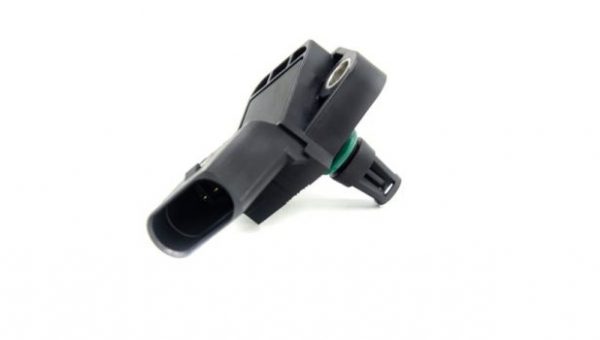

The manifold absolute pressure sensor measures the intake manifold pressure (IMP) downstream of the throttle valve to indirectly calculate – through the relationship between pressure and engine speed – the amount of air drawn in. It measures the pressure in the intake manifold (IM) and sends this information as an electrical signal to the engine control unit.
Typically, it is mounted directly on the IM. Pressure usually acts on a piezoelectric element, which then produces a corresponding output signal via an electronic circuit. This can be a PWM signal or an electrical voltage.
SYMPTOMS OF MALFUNCTIONS
It can become clogged, damaged, or contaminated. Sometimes, excessive engine heat can damage it or the vacuum lines. If it is not working properly, the computer cannot accurately calculate the air-fuel mixture, meaning the mixture is too rich or too lean. Here are some symptoms of a faulty MAP sensor:
INCREASED FUEL CONSUMPTION
A MAP sensor showing increased pressure in the intake manifold indicates a high engine load to the PCM (Powertrain Control Module). This results in more fuel being injected into the engine than necessary. It also increases fuel consumption, as well as the amount of gaseous emissions into the environment. Hydrocarbons and carbon monoxide are some of the components found in smog.
Lack of performance or low engine power
A sensor indicating low IMP actually means the power load for the PCM is low. The PCM responds by decreasing the amount of fuel injected into the engine. Although you may notice fuel savings, you will also find that the car does not perform as well as before. Reducing the engine’s fuel supply increases the temperature in the combustion chamber. This raises the level of nitrogen oxides produced. Nitrogen monoxide is also a component of smog and has a negative effect on our environment.
ENGINE FAILURE WHILE DRIVING OR WHEN STARTING
If the MAP sensor is faulty, the car may not run when expected or run poorly, or in both cases, performance will be affected. For example, when trying to pass another vehicle, the car may not accelerate smoothly. A lean or very rich air-fuel mixture makes it difficult to start the vehicle. If it only starts when you press the accelerator, there is a high chance the sensor is failing.
WHAT HAPPENS IF I UNPLUG IT
It is not recommended to drive without it. Your vehicle will not run as efficiently without the sensor readings. The engine and catalytic converter could be damaged and wear out faster. If you suspect a problem, it’s a good idea to test it immediately.
HOW TO TEST A MAP SENSOR

Most are connected to the intake manifold via a hose. Ensure it is connected and in good condition. Also check if the hose is clogged or cracked. This can lead to abnormal readings. If it is properly connected to both the electrical system and the intake manifold, use a voltmeter to measure the output voltage. After reading the output voltage, compare the result with the manufacturer’s specifications. Check the intake manifold sensor connector and the system wiring. The connector may be damaged by corrosion, or some wires may be short-circuited. If the sensor is corroded, the issue may be resolved by cleaning the MAP sensor.
TESTING WITH A MULTIMETER
If you choose to test a malfunction with a multimeter, make sure to use one with at least 10 megohms. This ensures you won’t damage any other sensitive electrical devices in your car.
HOW TO CLEAN A MAP SENSOR
First, wearing a pair of rubber gloves and safety glasses, disconnect it. Using a paper towel or a soft cloth and an electrical parts cleaner, remove dirt from the sensor. Spray the cleaner inside – a few sprays are enough. Shake off any excess cleaner and let it dry completely. Take a look at the vacuum hose or the intake manifold connection. If you see more dirt or grime, clean the hose with the same product and a brush. Once everything is dry, it should be clean and can be reinstalled.