
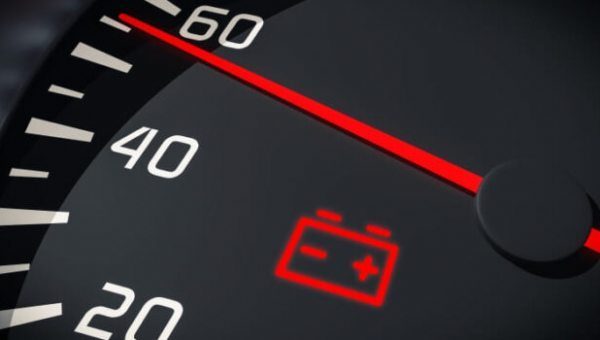

Many drivers have faced the situation where the engine was impossible to start due to a dead battery. This often happens when it’s freezing cold outside or, for example, when you forgot to turn off the exterior lights or the car radio. The problem of starting the vehicle can be solved by connecting your battery to the battery of another vehicle. For this, you will need a set of jumper cables. In this article, we explain how to properly connect the jumper cables. Let’s find out the correct order of steps.
- 1 Safety Precautions
- 2 Which Vehicles Are Unsuitable for Jump Starting
- 3 How to Find Out if It Is Safe to Jump Start Your Vehicle?
- 4 16 Steps for Properly Jumping Your Car
- 5 How to Jump Start a Car Without Another Car?
SAFETY PRECAUTIONS
- Make sure there are no children near the area where the procedure will be performed. If necessary, move them to a safe distance.
- Read the vehicle’s manual carefully. Some models cannot be jump-started.
- When performing the work, wear rubber gloves and protective glasses. Do not touch the terminals and metal parts of the car body with bare hands when they are live.
WHICH VEHICLES ARE UNSUITABLE FOR JUMP STARTING
- Never start a car with another car whose on-board voltage is higher or lower than your car’s. For example, if your vehicle is equipped with a 12 V battery, it should not be connected to a 24 V or 6 V battery, to avoid overvoltages.
- It is not advisable to connect vehicles with gasoline and diesel engines because their batteries have different cold cranking amps, therefore the process will be either ineffective or risk damaging the electronic devices.
- It is forbidden to jump-start a car with faulty wiring, a leaking battery, or other defects. Therefore, for example, if your battery has become discharged due to long unsuccessful attempts to start the engine, seek professional help.
- It is not advisable to connect to a vehicle whose battery is not fully charged.
HOW TO FIND OUT IF IT IS SAFE TO JUMP START YOUR VEHICLE?
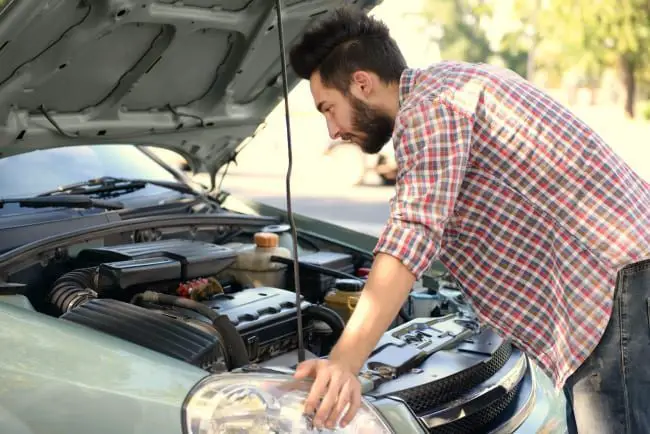
Make sure your car is in good working order. For this purpose:
- Inspect the engine compartment. The wires should not be covered with a thick layer of dirt and there should be no cracks or streaks on the battery.
- Inspect the alternator wires. If they are cracked, the voltage will likely not reach the battery terminals. In this case, jump-starting a car with another battery is pointless because the battery of the started vehicle will discharge immediately.
- Try turning on your headlights, side lights, and ambient lighting. If they turn on and are bright, it means the battery is not the problem and jump-starting will not help start the car. If the listed devices do not turn on and the horn does not work either, the battery is dead. Sometimes, the dim light of the lamps is a sign of a low battery charge.
- If possible, measure the voltage at the battery terminals. If it is above 12.6 V, the battery is in good condition and you need to look for a malfunction in other components and assemblies: the starter, starter solenoid, ignition switch, etc.
- Check if a strong smell of fuel is coming from under the hood. If so, jump-starting your car with jumper cables is dangerous as it can cause a fire.
16 STEPS FOR PROPERLY JUMPING YOUR CAR
- Park the vehicles facing each other at a distance of 45 to 50 cm between them – so that the length of the cables is sufficient to connect them. Caution: the vehicles must not contact each other in any way.
- In cars with automatic transmission, set the gear selector to “Park” mode, in those with manual transmission – to “Neutral”.
- Make sure to stop the donor vehicle’s engine.
- Engage the parking brake on both vehicles.
- Remove the keys from the ignition switches of the cars and open the doors of the car with the dead battery. Otherwise, when voltage is supplied, the car’s anti-theft system may trigger and lock the doors.
- Open the hood. Find the battery. Its exact location is specified in the vehicle’s manual.
- Inspect the battery. Find two terminals. The positive is usually the larger one and marked as “POS” or “+”, and the negative – as “NEG” or “-“. The positive terminal is often red in color, negative – black. When connecting the jumper cables, it is very important not to mix up the terminals.
- If necessary, clean dirt and oxides from the terminals with a cloth or a wire brush.
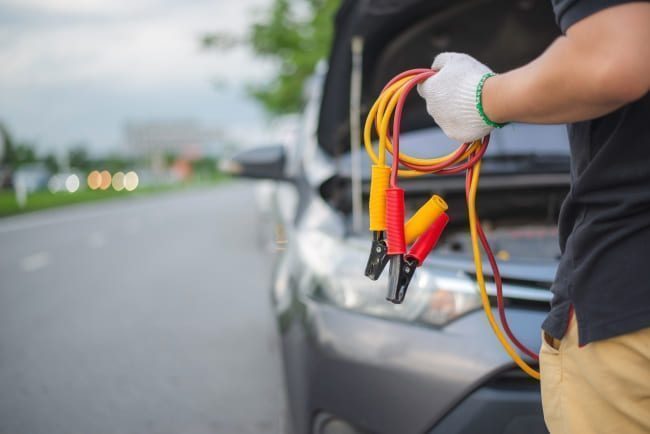
- Look at the set of jumper wires. The kit should include two cables. One of them is usually red and the second is black. Note that the cables themselves may be a different color but the alligator clips at their ends are almost always red and black. This color coding helps avoid errors when connecting the wires.
- Connect the cables in the following order:
- a red clip – to the positive terminal of the dead battery;
- the second red clip – to the positive terminal of the donor car;
- a black clip – to the negative terminal of the battery on the donor car;
- the second black clip – to an unpainted metal part of the vehicle with the dead battery. This could be a nut or bolt on the engine block.
- Make sure the cables do not touch the moving parts of the engine.
- Start the donor car’s engine and let it run for 10 to 20 minutes. Stop the engine.
- Try to start the engine of the car with the dead battery. If you succeed, do not turn off the engine for 10 to 20 minutes. This duration should be enough to recharge the battery a bit.
- If the car does not start, repeat the procedure: start the donor car’s engine and let it run for a while, stop it, and try to start the other vehicle. Caution: do not engage the starter of the car being jump-started while the donor car’s engine is running: this can cause its alternator to fail.
- If the start was successful, disconnect the cables in the reverse order:
- black clip – from the negative terminal of the donor car;
- the second red clip – from the positive terminal of the donor car;
- red clip – from the positive terminal of the donor car;
- red clip – from the positive terminal of the battery that was dead.
- If, after several attempts, you cannot start the engine, visit a garage for help: your battery may be completely depleted and it will be necessary to restore or replace it, or some other vehicle systems may be faulty. In particular, the engine may not start if the following components are defective:
- fuses;
- input;
- ignition switch.
HOW TO JUMP START A CAR WITHOUT ANOTHER CAR?
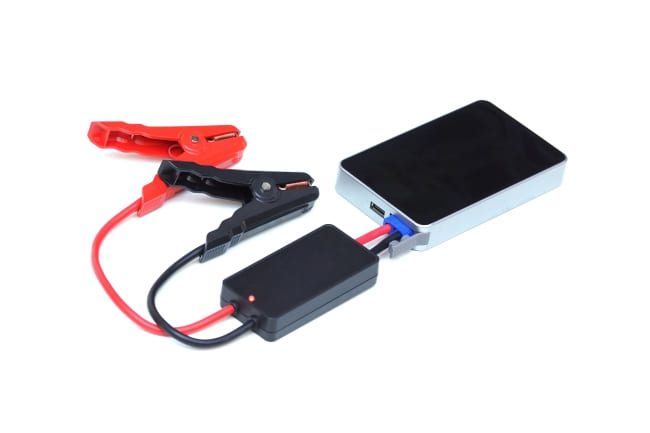
To start a vehicle, you can use a portable jump-starting device – a jump starter. It operates based on lithium polymer batteries and, therefore, despite its compact size, it provides fairly high starting amps. You can buy such a device if, for example, your vehicle is used in difficult conditions, especially in regions with cold winters.
The device must be directly connected to the battery terminals. During this operation, it is also very important to observe the polarity. For more information on how to properly connect the jumper cables, carefully read the jump starter’s manual.
Usually, it is necessary to follow these steps:
- Connect the red cable provided with the device to the positive terminal of the battery.
- Connect the black cable to the negative terminal of the dead battery.
- Insert the connectors from the other ends of the cables into the corresponding outlets of the portable jump-starting device.
- Select the desired mode of the jump starter and turn on the device.
- Start the engine.
Conclusion
A dead battery is a problem that even experienced drivers can encounter. It’s good that it can be solved by a relatively simple method – jump-starting. All you need is a set of jumper cables and another battery. By following all the advice above, you can easily jump-start a car with another battery, even if you became a driver not so long ago.