
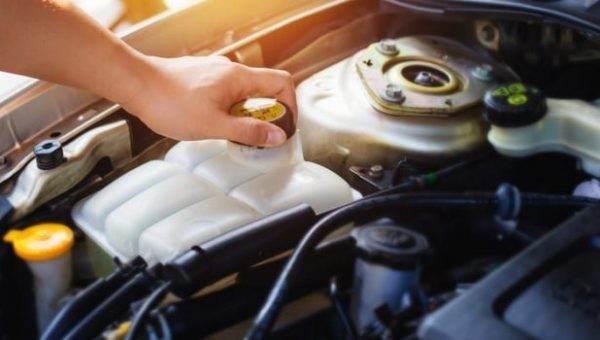

If the engine temperature rises for no apparent reason while driving, there is likely a malfunction in the cooling system. If you can rule out a leak, the most probable cause is air entering the cooling circuit.
The solution: Bleed the radiator!
Bleeding the radiator must always be done correctly. We will show you what you need to consider to restore the smooth circulation of the coolant.
WHY DO YOU NEED TO REMOVE THE AIR?
Heating and cooling systems operate on the same principle: water is designed to circulate in a self-contained system. If air enters, this circulation is compromised and can lead to reduced efficiency as well as potential damage. In a heating system, the problem can be resolved by bleeding the radiators. The same applies to the vehicle’s cooling mechanism. Here too, air that has entered can be removed by bleeding. Otherwise, tiny air bubbles prevent the proper circulation of the coolant. The result is a decrease in cooling capacity and a subsequent rise in temperature, which can lead to overheating. This is why you should bleed the radiator after every refill of coolant or antifreeze.
HOW TO BLEED A RADIATOR
First, you need to drain the coolant and dispose of it in accordance with legal requirements. Please note that it must be disposed of in the same way as used oil. Then, you will need to mix the coolant in a clean container following the ratio specified in the instructions. If there are bleed valves, you can now proceed by opening the expansion tank and filling it up to the maximum mark with the new coolant. Then close it and start the engine, letting it run. Now, you can open the bleed valves slightly. Check if any bubbles are coming out. If only liquid without bubbles emerges, you can proceed and close the bleed valves. Start the engine, let it warm up, and monitor the temperature gauge. Set the fan to the lowest setting and the heater to maximum. You can now close the expansion tank and shut the hood. At this point, it’s a good idea to take a quick test drive and top up the coolant if necessary.
Basically, you can use these instructions for any vehicle model. Some vehicles do not have bleed valves, others have one or more. The position of the bleeders also varies depending on the vehicle. If you are unsure or not confident enough to do it yourself, we recommend entrusting the bleeding of the cooling system to a trusted mechanic.
BLEEDING THE COOLING SYSTEM WITH NEGATIVE PRESSURE
For some car manufacturers, the bleeding process is a bit more complicated. Some BMW or Porsche models cannot be properly bled using the previous instructions. That’s why we will show you another way to bleed the cooling system—with negative pressure.
Tip: To bleed the cooling system with negative pressure, you need a special tool—a so-called cooling system fill and bleed device. This device first creates a vacuum in the empty cooling circuit. You can then pump new, bubble-free coolant into the system via a suction hose. At the same time, you can check the circuit to ensure it is sealed and free of any leaks.
To begin, screw on the coolant reservoir and install and secure the universal adapter. Connect compressed air with a maximum of 8 bars to the bleeding unit. Open the compressed air valve and create negative pressure. As soon as the system has been bled and a vacuum has been created, close the valve. Have suitable coolant ready in a separate container. Fill the suction hose with coolant so that no air bubbles are drawn in. Now place the suction hose into the container you have on hand. Open the valve on the intake hose and let the coolant enter the system without air bubbles. As soon as the cooling system circuit is full, close the intake valve. Remove the unit again and screw the sealing cap onto the coolant reservoir.
WHEN SHOULD I BLEED THE AIR FROM THE COOLING SYSTEM?
You should bleed the radiator after every refill of coolant or antifreeze. Before going on vacation, it is also advisable to bleed the radiator as part of a thorough general check to avoid unpleasant surprises during your trip.