


What is the most stressful aspect of driving? Possible traffic collisions? Road rage? Breaking down for no apparent reason? No. Apparently, nearly half of drivers aged 18 to 34 find parallel parking to be their biggest stress. It’s the maneuver everyone dreads being asked to perform during their driving test and long after people have obtained their driver’s license, they can struggle with it. Fortunately, our guide is here to explain and give you some tips and tricks to help you parallel park, as well as reverse bay parking and forward bay parking, perfectly every time.
FORWARD BAY PARKING
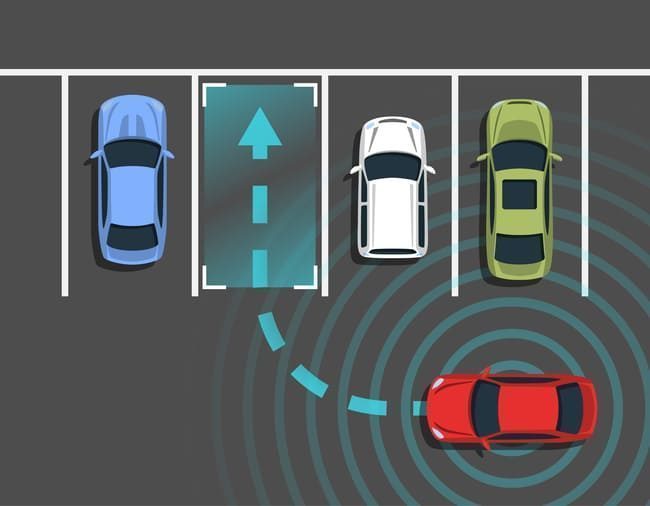
We will start with an explanation of forward bay parking, which is often considered the simplest of these three parking maneuvers. This procedure involves driving the car forward into an empty parking space. Although it doesn’t seem that difficult, the obstacles on each side must be taken into account, as well as the distance from the bay, where and when to start turning relative to the bay, and the speed of the car. Entering the bay itself is normally not a problem when there’s nothing around, but it’s a real test of observation to enter and exit in a very busy parking lot because there can be many hazards around us.
Here are some tips to avoid parking fears:
- The first step is to ensure you are at a good distance, ideally as far as possible, from the bay you wish to park in. This gives you the widest possible turning radius and more time to turn and correct your angle, without having to reverse or straighten up once you’re in the bay.
- This should go without saying, but before turning, make sure to use your indicators to signal your intention to other road users. Also check your mirrors at this point, looking for current or potential hazards.
- You are now looking for the first reference point to help you park – the boundaries of the parking area you wish to park in, often white lines on the ground. When you see the first white line just under your right side mirror, you can check one last time in your mirrors, then steer to full lock (turning the steering wheel as far as possible to the left or right). An important aspect of this is to make sure to take your time and go as slowly as possible; the slower you drive, the more time the vehicle has to turn and the less you’ll have to make adjustments. Even if it seems like a great idea to swing the car into place as quickly as possible, it certainly is not!
- As you turn into the bay, start to straighten your steering once your car is parallel or nearly parallel to the white lines of the bay (you can see them in your mirror) or if you can tell the car is straight using visible objects through the windshield. You can use both outside mirrors to check if the car is straight, then apply the handbrake, and you’re done!
REVERSE PARKING INTO A BAY
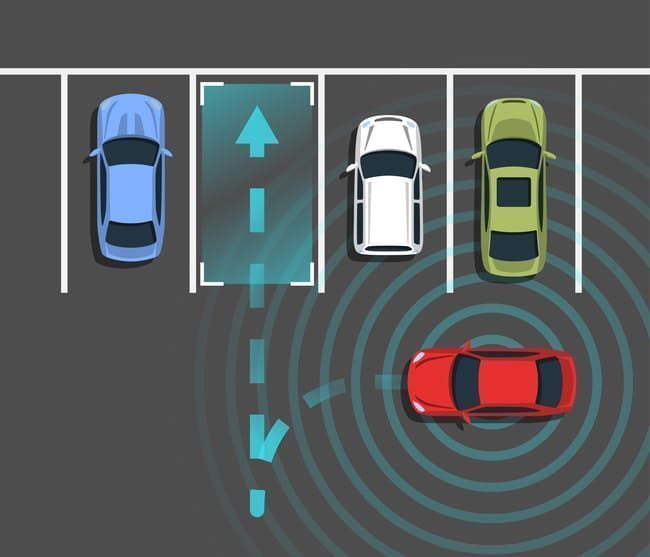
To paraphrase Isaac Newton, what goes into a parking space must come out of a parking space. If you park forward into a bay, you will have to reverse out of it. This can be quite tricky or time-consuming when there is a lot of traffic or movement in a parking lot. What many drivers prefer, therefore, is reverse bay parking, to ensure you can escape quickly and comfortably when you want to.
Even if you opt for forward bay parking, it’s really worth familiarizing yourself with reverse parking, as you’ll be reversing out of your spot anyway. This turn uses the same principles as forward bay parking but, since the car is moving in reverse, it just requires a bit more observation and awareness.
Here are some simple steps to help you perfect your reverse bay parking:
- Again, try to position the car far from the bay you wish to park in (to get a wide turning arc) and ensure your car is opposite the desired bay. If you are turning into a bay that is on the side of a road, you are in the middle of the road at a good distance, but this of course means extra precautions must be taken to check and alert other road users of your intention. Also be aware that the front of your car will swing out when you reverse into the bay and there is a risk of hitting objects on the other side of the bay, such as low walls or fences, so take extra care! If there are vehicles or cyclists behind you, as well as pedestrians nearby or approaching, stop and let them pass.
- Next, reverse your car slowly until you reach the turning point. This point is slightly different for all cars, so you will need to establish your own way of recognizing when you have reached this point. It’s roughly when the first white line of the bay is parallel to the middle of your vehicle. As with forward bay parking, you can use your mirrors and look out the window to help establish this. When you reach this point, check once more for cars or pedestrians nearby, stopping if necessary, then turn your steering wheel to full lock in the direction you wish to go.
- Continue moving slowly in reverse, checking both sides and all around you to ensure you are not going to collide with any object either behind or to the side of you. You can also check the white lines of the bay and use your rearview mirror to see when you are inside the bay. When your car is parallel to the white lines and directly inside the bay, straighten the wheel.
- Once your car is directly inside the bay, continue moving very slowly in reverse until the front of the lines that mark the bay are in front of your car. This may not be possible for some larger or longer vehicles, but for most ordinary cars, it’s a good indicator that you have reached a point where your car is safely parked in the bay. Your perfect reverse bay park is complete!
PARALLEL PARKING
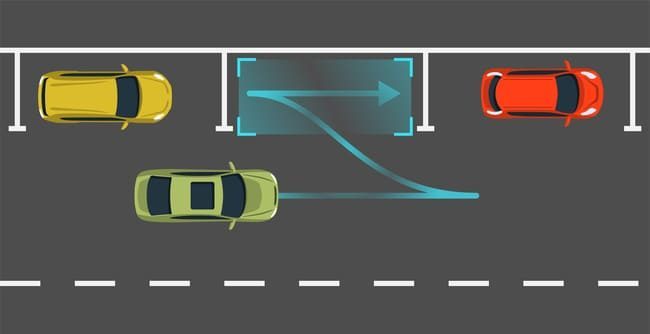
What is it about parallel parking that makes people break out in a cold sweat? Why do so many people consider it the most stressful aspect of driving? As with reverse bay parking, the car is reversing, which limits one’s ability to see potential hazards the car is heading towards and forces them to constantly turn their head to detect any potential danger.
Furthermore, the timing must be perfect when parallel parking: since you often park your car behind an already parked vehicle (and sometimes even between two already parked cars), the risk of collision increases and the space is much smaller or tighter than a predefined parking space.
But fear not, if you follow these tips for parallel parking correctly, your parking nightmares will be over:
- Find the space you want to parallel park in. This is often likely to be between two cars or at least behind one car. Drive a good distance (about a car’s length) past the car you wish to park behind, so you have enough time to reverse slowly and think about when and where to start turning. When you are about to stop, check your mirrors and around you for other road users.
- Before starting to reverse, check if any vehicles or cyclists are approaching and wait for them to pass.
- Once you are satisfied it’s all clear, look through the rear window, then move the car backward, taking your time and moving slowly until the rear of your car is level with the rear of the car in front of the space you want to park in. It is important that you reverse far enough – if you don’t, you risk hitting the car next to you.
- Once the rear of your car is level with the rear of the already parked car, you are at the turning point and are about to steer into the space. This is the most dangerous part of the maneuver, as the front of your car will swing out into the road. Before doing anything else, observe the road again to ensure there are no cyclists, cars, or pedestrians nearby. Remember to always check your right blind spot.
- If all is quiet, reverse very slowly and while moving the car, turn the steering wheel one full turn (360 degrees) in the direction of the space (e.g., if it’s on your left, turn the wheel to the left). By turning the wheel one full turn instead of full lock, the steering angle will be slightly less sharp at about 45 degrees. This eliminates the possibility of you reversing into the car next to you.
- You now need to determine when to straighten the car. While reversing, you will need constant all-around observation and must stop if vehicles are approaching. Also, if you are reversing towards pedestrians, stop and let them pass before continuing. Remember to check your rearview mirror frequently. The moment you straighten up varies from car to car, but generally aligning the left corner of your car with the right corner of the car you are parking behind serves as a good reference point. Once aligned, turn the steering wheel in the opposite direction, this time to full lock. You can even stop at this point to give yourself more time to check around for hazards or to turn the wheel.
- Turning your steering wheel to full lock position will bring the car parallel to the curb. As you reverse, continue to check your outside mirror to ensure you are not going to hit the curb or are too far from it; leaving your car too far from the curb can be extremely dangerous. If you are too far away, you will need to pull forward slightly, then reverse again, this time turning more in the desired direction to get closer to the curb.
- Once you are close enough to the curb and have started to straighten your car, continue moving slowly until the car is completely parallel to the curb, using your mirror to judge. It’s always best to ensure your car is not too close to the car in front of you, to give them space to reverse slightly and help them move. A gap of about a quarter of a car’s length or 1 meter can be a blessing for drivers when they need to maneuver out of a tight space.
PARKING AIDS: REVERSE PARKING WITH CAMERAS AND SENSORS
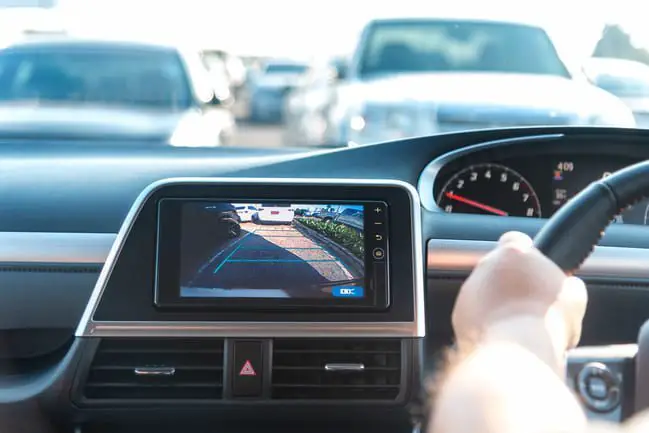
Reverse parking should now be straightforward thanks to the best tips and tricks we’ve given you, but if it all still seems a bit daunting, there are now tons of gadgets that come standard or can be fitted to your car to help you with reverse bay and parallel parking. The most helpful are reverse or parking sensors or cameras.
Parking sensors are proximity sensors designed to alert drivers to the presence of obstacles, moving or stationary, when parking. These systems use electromagnetic or ultrasonic sensors. Ultrasonic systems use sensors located on the front or rear bumper to detect objects, while electromagnetic systems often come with cameras and do not require additional holes to be drilled in your car (like ultrasonic sensors) as they can be discreetly mounted on the inside of the bumper. When ultrasonic sensors were first developed in the 1970s, they were dismissed by Jaguar as unnecessary and likely to be unpopular. Times have definitely changed; now, they can often come standard from the manufacturer.
Both systems often use sounds to alert drivers when there is an obstacle behind them and make the job easier if your car is about to hit the curb or another car while parallel parking or reversing.
In addition to sensors, a wide range of parking cameras is also available. These are cameras that attach to the rear of your car and are linked to a screen that can be positioned on your dashboard. They give the driver a picture of what is directly behind their car and are often accompanied by software that shows you the “parking line” (the potential position of your vehicle if you continue moving on that trajectory). This can be extremely useful when aligning your car in a parking bay or in a parallel parking space. A handful of cameras even come with night vision settings and variable angle settings, allowing you to adjust how much you see behind you. Many of these cameras are relatively inexpensive and all are user-friendly and easy to use. Some of the best parking cameras come from Pioneer, Vordon, or Valeo, and for reliable parking sensors, a wide range comes from Amio, Stark, and Ridex.
With all these tips and some of this fantastic technology, you should be able to reverse, bay, and parallel park perfectly.