
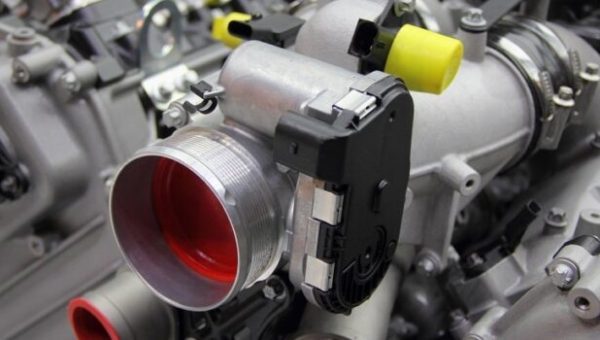

Modern air intake systems can operate for a long time without maintenance. However, it is still necessary to take preventive measures every 120,000 km to ensure their proper functioning. In particular, it is worth cleaning a throttle body. You will be able to handle this task yourself after spending only 10 to 20 minutes. In this article, we will discuss the symptoms of a contaminated throttle and explain how to clean it yourself.
- 1 What is a throttle body?
- 2 What are the symptoms of a contaminated throttle body?
- 2.1 How to clean a throttle body without removing it from the vehicle?
- 2.2 How to clean a throttle body when it is removed from the car?
- 2.3 Readjusting a mechanically controlled throttle
- 2.4 Readjusting an electronically controlled throttle
- 3 How to prevent the throttle body from getting dirty?
WHAT IS A THROTTLE BODY?
This component is an element of the air intake system that controls the amount of air supplied to the combustion chambers. It has a direct effect on the air-fuel mixture formation process. It can have mechanical or electric actuation. It is installed in a housing connected to the hoses of the cooling, crankcase ventilation, and evaporative emission control systems, sensor connectors, etc. The throttle shaft is equipped with a position sensor that measures the opening angle and speed of the throttle. The readings from this sensor are used by the engine control unit to adjust injection and ignition.
In mechanical components, the throttle plate is connected to the accelerator pedal with a cable or lever: when the pedal is pressed, the plate opens to a corresponding angle.
Electrically actuated assemblies include an electric motor that is responsible for opening the air passage; the engine control unit gives commands to this motor based on readings from various sensors.
WHAT ARE THE SYMPTOMS OF A CONTAMINATED THROTTLE BODY?
- Engine starting problems. Due to deposit formation, the throttle valve may let less air through than necessary at small opening angles. This leads to reduced traction, especially at low speeds. Sometimes the engine even stalls.
- Unstable or high idle speed. This occurs when more air than necessary is supplied to the engine due to the mechanism being stuck in the open position.
- Increased fuel consumption. In some vehicles, excessive air supply causes more fuel than necessary to enter the engine. It burns in vain.
- Reduced engine power. If the valve does not open to the required angle, the combustion chambers receive an insufficient amount of air. The driver may notice that the vehicle’s dynamics have significantly deteriorated.
HOW TO CLEAN A THROTTLE BODY WITHOUT REMOVING IT FROM THE VEHICLE?
- Park your car on a flat surface to have access to the engine compartment from all sides. It is best to work outdoors or in well-ventilated rooms.
- Secure your vehicle with wheel chocks.
- Open the hood. Disconnect the negative terminal of the battery.
- Locate the throttle body. It should be somewhere between the air filter and the intake manifold. If you have trouble finding the component, ask your companion to press the accelerator pedal to see how the throttle opens.
- Identify the tools you need to detach the air filter hose. Prepare them. In addition to tools, you will need gloves and protective glasses, paper towels, a little engine oil, a small soft brush or a soft cloth, masking tape or special adhesive tape, and a can of throttle cleaner.
- Using masking tape or adhesive tape, mark all the hoses you will need to remove to access the throttle body and the air duct.
- Using a screwdriver or wrench, loosen the clamp that secures the air duct.
- Carefully detach the hose. Be sure not to damage the gasket if there is one. Perform the work carefully so as not to disconnect electrical connections and hoses. If the throttle body is connected to air ducts on both sides, it is sufficient to remove only one.
- Put on your glasses and gloves.
- Spray the throttle cleaner on the internal surface of the component. Let the compound penetrate for 5 to 10 minutes.
- Remove dirt with a soft brush or cloth. Caution: some throttle bodies have a special molybdenum coating. You must clean them with particular care.
- Use paper towels to remove the residue of the cleaner with dissolved deposits. If necessary, treat the surface a second time.
- Wipe the assembly dry.
- Apply a drop of oil to the throttle shaft. Spread it with a cotton swab, for example.
- Attach the intake manifold hose and tighten the clamp with approximately the same force as it was originally tightened. Put all removed hoses back in their place.
- Start the engine. Let it idle for a few minutes.
- Take a test drive. If the engine problems were caused by a dirty throttle body, they should disappear.
HOW TO CLEAN A THROTTLE BODY WHEN REMOVED FROM THE CAR?
Disassembling the component allows you to clean it as thoroughly as possible. However, this will take more time.
Proceed as follows:
- Repeat steps 1, 2, 3, 4, and 5 from the previous list. Keep in mind that you may need more tools because you will have to remove the entire assembly. Additionally, it is advisable to prepare a clean container for draining the coolant and also fresh coolant, identical to what you are currently using.
- Remove the air filter housing, if necessary to access the throttle body.
- Loosen all clamps, then detach all electrical connectors, hoses, and pipes from the throttle body. Be especially careful when removing the cooling system hose, especially if the engine was running before this: the coolant may be hot.
- Unscrew the throttle body fasteners and remove it from your car. In some vehicles, there is an additional fastener – a bracket. If the throttle is mechanically actuated, you will need to disconnect the throttle cable.
- Cover the intake manifold opening to prevent dirt from entering inside the unit.
- Detach the idle air control valve from the throttle body. It must also be cleaned.
- Apply some cleaner to the surface of your car’s throttle body and treat all hard-to-reach cavities with it. Remove contaminants with a brush and paper towels or a soft cloth.
- Dry the cleaned elements.
- Clean the throttle body mounting seat and install a new gasket.
- Put all components back in their place in reverse order.
- Check the coolant level. Refill if necessary.
- Readjust the component. Read on to find out how.
READJUSTING A MECHANICALLY CONTROLLED THROTTLE
- Remove the battery terminals for 15 minutes. Then, reconnect them. If you already removed them while cleaning the device, you can skip this step.
- Start the engine. Let it idle for 10 minutes. Remember not to turn on any additional consumers.
- Turn off the engine for about 10 seconds. Start it again.
- Wait for the power unit to reach operating temperature. After that, you can start using the vehicle.
- Note: you may need to drive 150 to 200 km until the idle stabilizes.
READJUSTING AN ELECTRONICALLY CONTROLLED THROTTLE
The readjustment process may vary by vehicle. Therefore, before starting the procedure, consult the vehicle manual for the exact sequence of steps.
The general algorithm is as follows:
- Study the procedure and try to remember it. You will need to act quickly so you don’t have time to check the details.
- Start the engine. Warm it up to operating temperature.
- Turn it off for 10 seconds.
- Turn the ignition on for 3 seconds.
- Quickly press the accelerator pedal 5 times. One depression should take one second.
- Press the accelerator pedal to the floor for 7 seconds. Hold it down until the “Check Engine” light burns steadily and hold it for 3 more seconds.
- Release the accelerator pedal and start the engine.
HOW TO PREVENT THE THROTTLE BODY FROM GETTING DIRTY?
- Use only high-quality fuel. Otherwise, impurities and contaminants will enter the engine, causing rapid formation of carbon deposits on the throttle body. For the same reason, fuel filter replacement should not be neglected. It is recommended to flush the fuel tank from time to time.
- Replace the air filter on time. Always ensure that the intake system is airtight. This simple check prevents unfiltered air from being drawn into the intake system at points where its components are not tightly connected.
- Always ensure the crankcase ventilation system is fault-free. Its malfunctions cause rapid formation of oily deposits on throttle body elements.
Conclusion
Engine stability and performance depend on the proper functioning of associated assemblies. Therefore, cleaning the throttle body is one of the mandatory maintenance procedures of the intake system. Our tips will help you do it yourself and save on repair shop services.