
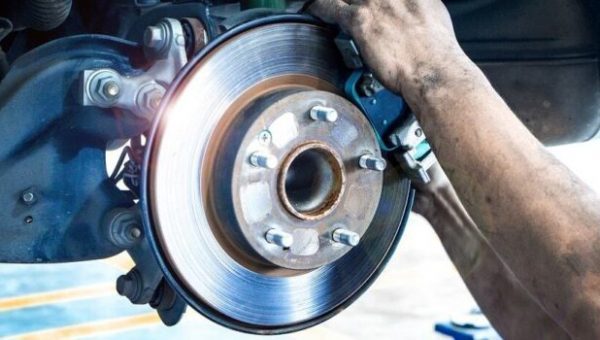

The efficient operation of the braking system is one of the essential conditions for safe driving. Therefore, keeping the brakes in good working order is a duty of every car owner: you must replace consumables on time, check for leaks in the lines, and remove air from the system if it has entered. Let’s explore the causes of air in the system. In this article, we tell you the correct order for bleeding brakes.
5 MAIN CAUSES OF AIR IN THE SYSTEM
- Insufficient fluid level in the reservoir. For this reason, ambient air can be drawn into the system.
- Worn rubber components. The wheel cylinder (or brake caliper) seals, exposed to moisture, dirt, and road chemicals, lose their elasticity and begin to leak. Over time, the hoses also start to crack.
- Not changing the working fluid in a timely manner. The hoses it flows through have a porous structure. This means that through them, albeit in small quantities, water enters the system. It mixes with the brake fluid, resulting in a decrease of the latter’s boiling temperature. Because of this, during repeated braking, for example, when driving on a winding road, the fluid can boil. The boiling process is accompanied by the generation of steam, and consequently, air pockets are formed in certain parts of the pipes and hoses.
- Leaking fittings and connectors. Due to vibrations caused by driving on bumpy roads, clamps and fasteners loosen over time. This leads to air leaks.
- Repairs. If you have changed pistons, cylinders, pipes, or hoses, be sure to remove air from the braking system immediately afterward: when these components are disassembled, air freely enters the lines and, after reassembly, remains there.
HOW DO YOU KNOW WHEN YOUR BRAKES NEED BLEEDING
The presence of air is accompanied by characteristic signs. When pressing the pedal, you can feel that its resistance has significantly decreased. Sometimes, you need to press the pedal several times to get the brakes to work. With each press, the pedal becomes stiffer. Sometimes, braking starts when the pedal is pressed almost all the way down. Overall, your vehicle’s braking distance becomes considerably longer than usual.
HOW TO PREPARE YOUR CAR FOR BLEEDING
The sequence of steps for bleeding air from the brake lines varies depending on the vehicle’s make and model. It is also determined by the structure of the braking system and the presence of additional units and assemblies. Therefore, before starting the procedure, be sure to carefully read the vehicle’s manual. It should contain a detailed description of the bleeding process for your exact model. In some cases, if your car is equipped with many electronic systems, you won’t be able to do it without the help of a professional.
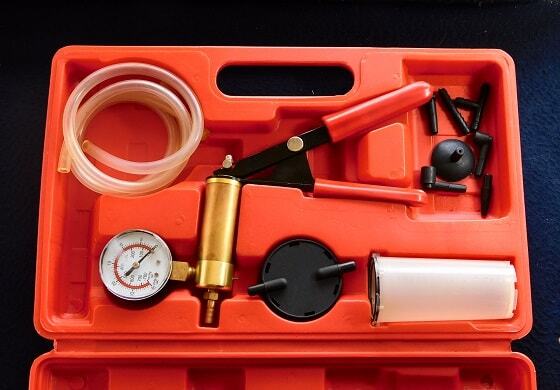
Prepare the brake bleeding tools and other necessary means and accessories.
You will need:
- A clean, stable, preferably transparent container for the drained working fluid.
- A transparent hose with the diameter to fit the brake bleeder screw, as well as a socket or Allen key to unscrew it.
- WD-40 spray. This will help loosen stuck fasteners and connections.
- A lug wrench and a jack, in case you have to remove wheels to access the wheel cylinders (brake calipers).
- Wheel chocks. It may be necessary to secure your car in place, as in some models, it is not recommended to engage the parking brake during bleeding.
- Brake fluid of the same type as used in your car.
SPECIFICS OF THE BRAKE BLEEDING PROCEDURE ON DIFFERENT CAR MODELS
The order of steps depends on the following:
- Presence of a brake proportioning valve on the rear axle. It is usually installed on utility vehicles and early-generation passenger cars. Under certain road conditions, it prevents brake fluid from being supplied to the rear wheels. Therefore, to properly bleed the brakes on these vehicles, do not unload the rear axle by lifting the car on a lift or jack.
- Layout of the brake circuits. The procedure involves bleeding air from each brake mechanism. First, air is removed from one brake circuit, then – from the other. If the circuits are diagonal, start with the brake mechanism farthest from the master cylinder: most often, this is the right rear wheel. Then move to the front left, then the rear left, and finally, the front right.
If the circuits are parallel and connect the rear and front wheels, the system should be bled in a circle. First, air is removed from the rear brake mechanism farthest from the master cylinder, then – from the other rear. After that, move to the front wheels.
- Presence of the Anti-lock Braking System (ABS). This system prevents the wheels from locking completely during braking to avoid skidding. It can be found on most modern cars. It helps avoid loss of control during emergency braking or when trying to stop on a slippery surface. Its design includes a brake pressure modulator, and air must also be removed from it.
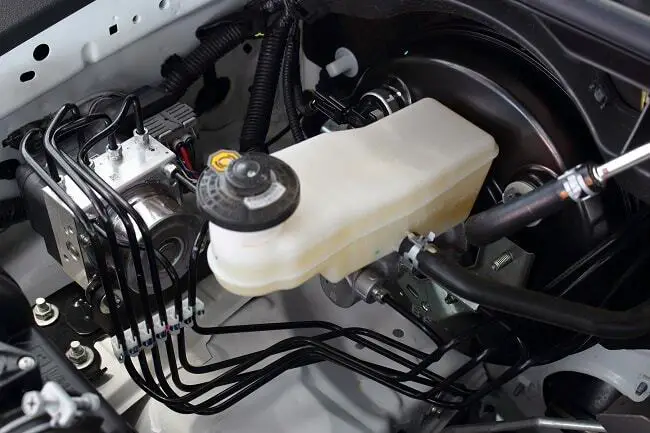
- Hydraulic pump instead of the vacuum brake booster. You can see it on the BMW 7 Series (E32), Nissan Cedric Y32, Toyota Land Cruiser 105, Mitsubishi Pajero III, and other vehicles. In some cars, it is used in addition to the vacuum booster. In this case, you will need to turn on the pump to remove the air.
- Additional features. If your car is equipped with, for example, an electronic stability control system, it is better to seek help from specialists at a garage to bleed the brake lines. You should also opt for professional service if the ABS units are located in different parts of the vehicle; because in this case, the procedure requires the use of a diagnostic scanner and is initiated using software. The Land Cruiser 200, BMW X5, and other cars are among such models.
HOW TO BLEED BRAKES ON A VEHICLE THAT HAS NO ABS
- Unscrew the reservoir cap.
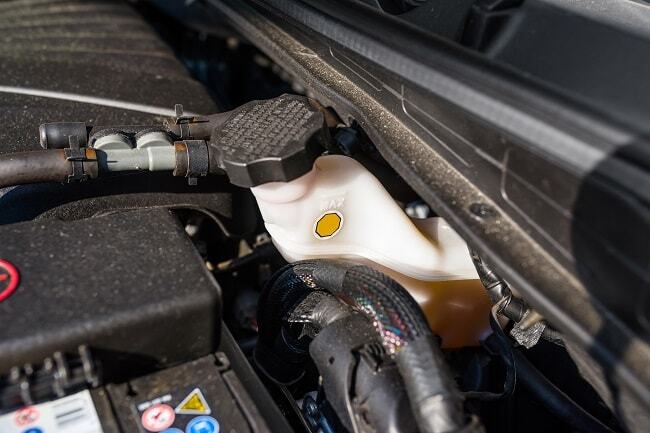
- Fill the brake fluid up to the “Max” mark.
- Pour fluid into the drain container.
- Attach the hose to the brake bleeder screw and dip its other end into the drain container with fluid.
- Ask an assistant to press the brake pedal several times in a row, then press it all the way down.
- At the same time, unscrew the bleeder screw to allow the fluid to flow through the hose.
- Tell your assistant to press the pedal all the way down.
- Monitor the fluid coming out of the bleeder screw. There will be bubbles in it.
- Tighten the bleeder screw. After that, your assistant can release the pedal.
- Repeat the procedure 4 to 5 times for each brake mechanism.
- Don’t forget to monitor the fluid level in the reservoir and top it up to “Max”.
- While performing the work, ensure that the fluid does not get on the car body. It contains components that have a destructive effect on the paint. You must also prevent the substance from spilling onto the brake pads. If this happens, replace them.
HOW TO BLEED BRAKES ON CARS EQUIPPED WITH ABS
To bleed the brakes in vehicles where all ABS units are combined into a single module, proceed as follows:
- Remove the ABS fuse.
- Perform all the steps described above.
- Reinstall the fuse.
- Ensure that the dashboard warning light indicating an ABS malfunction is not lit.
HOW TO BLEED BRAKES IN CARS WITH A HYDRAULIC BRAKE BOOSTER PUMP
Proceed as follows:
- Remove the ABS fuse from its socket.
- Attach the hose to the bleeder screw. Dip its other end into the drain container filled with brake fluid.
- Ask your assistant to press the pedal all the way down. In this case, there is no need to press it multiple times.
- Tell your assistant to turn the ignition key to the corresponding position. This will activate the pump.
- Wait for the pump to remove all the air from the system. In other words, until the fluid flowing from the bleeder screw has no bubbles.
- Repeat the procedure for each of the wheel cylinders (brake calipers).
- Monitor the fluid level in the reservoir. Top it up to the “Max” level before each cycle and also after completing the bleeding operation.
- Ask your assistant to turn off the ignition.
- Put the fuse back in place. Ensure that the dashboard warning light indicating an ABS malfunction is not lit.
HOW TO BLEED BRAKE LINES IF THERE’S NO ONE TO ASSIST
If you have no one to assist you, it is possible to perform the procedure yourself. There are several methods:
- Bleeding is done in the same way as with an assistant, but you need to use a gas strut to hold the pedal down. For this, you can temporarily remove one from the hood or trunk lid. For convenience, you can purchase a special brake bleeding kit. It includes fittings, adapters, hoses, and a drain container. It is very convenient that the container is equipped with a powerful magnet, allowing it to be attached to any part of the car body and preventing it from tipping over and spilling the fluid.
- Bleeding using a special vacuum pump. It is performed as follows: fill the reservoir with working fluid to the maximum level. Connect the pump hose to the bleeder screw of the wheel cylinder (brake caliper) you are working on. The fluid sucked out by the pump is collected in a special container, and the air is evacuated.
- Bleeding by increasing pressure in the reservoir. You might need various devices for this: syringes, small manual compressors, and other tools. Their operating principle lies in supplying air or brake fluid into the reservoir under pressure. This circulates the fluid in the lines and replaces the process of pressing the pedal. The rest of the process is similar to a standard bleeding procedure: the brake fluid with air bubbles is drained through the hose attached to the bleeder screw of a wheel cylinder (brake caliper).
Conclusion
All malfunctions in the braking system, if any, must be eliminated immediately after they appear. There should be no air in the system. Therefore, as soon as you suspect air in your brakes, bleed them using our tips.