
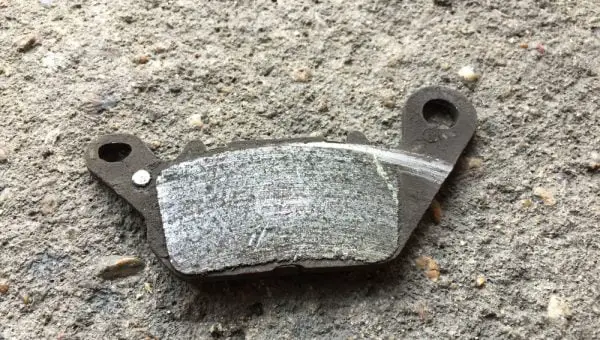

It is very dangerous to drive with worn brakes.
How often you change your brakes depends on the type of brakes you use, whether you are a diligent driver, and the type of loads you carry.
If you are the kind of driver who drives fast around difficult corners, you should expect your brakes to wear out faster than a cautious driver.
Brake pads are made from various materials: organic, semi-metallic, and ceramic. Ceramic brake pads have a longer lifespan, with organic pads being the least durable.
Finally, you should also consider the type of load you expose your car to. If you have a trailer, you should expect the brake pads to be subjected to greater loads.
Most people will change their brake pads every 40,000 to 60,000 miles. The factors above may cause you to change your brake pads sooner. You can check the thickness of the pads and ensure they are not less than ¼ inch thick.
Signs that you need to replace your brake pads
Several signs of brake pad wear should be observed. It is always best to check the inner and outer brake pads with a lamp to ensure there is still material on them.
1. The brake light comes on
The brake light may be yellow or red. If your brake light comes on, it may indicate that the brake fluid level is low, which suggests that the brake pads are worn.
2. Low brake fluid level
Brake fluid should not disappear from your reservoir unless you have a leak. However, if the brake pads are worn, the piston will move outward, creating more space for the brake fluid. This causes the brake fluid level in the reservoir to drop.
3. Squeaking noise
A sure way to know that you need new brake pads is to hear a squeak when braking. This indicates that the pads are worn and the steel underneath is making contact with the rotor. However, if you hear a grinding noise, it could be a problem with dirt getting into the calipers.
4. Vibrating brake pedal
If your brake pads are worn, you will notice that the brake pedal vibrates when you press it. This makes the car unstable, and it can be dangerous to drive the car at high speed. A vibrating pedal could be a symptom of other engine problems.
5. Metal grinding noise
Metal tabs are often attached to the underside of brake pads and signal to the driver that it is time to change the brake pads. If you are driving and hear the sound of metal grinding, you know that your brake pads are worn and the metal tabs are rubbing against the rotor. Such brakes make it very difficult to stop the car, and if you continue driving, you risk causing an accident.
6. Brake pads less than ¼ inch thick
Finally, you can find out if the brake pads need to be changed by simply checking their wear. You can check this through the wheel spokes. If the brake pads appear to be less than ¼ inch thick, it is time to replace them. In some cases, one part of the tire may be more worn than the rest. The solution is to rotate the tires every 6 months.
How to change your brake pads
As soon as you notice that your brake pads are worn, you should replace them immediately. If you have a trusted mechanic, they can do it for you for minimal service fees. However, changing your brake pads is not that difficult. With the right tools, you can change the brake pads yourself.
Note that some brake pads require a computer to reset the pistons in order to replace them. Check: replacing brake pads with an electric parking brake
Buying brake pads
First, get the recommended brake pads from the manufacturer. These are sold in pairs in many garages. Brake pads are made from various materials. The more durable they are, the more expensive they will be. Inform the service workshop of the car’s brand, year of manufacture, and price range. Note that rally brakes should be avoided on a normal car. This will cause unnecessary wear on the rotors.
Lift and remove the wheels
Next, place your car on a flat surface while waiting for the engine and brakes to cool down. First, loosen the wheel nuts with your wrench. Do not remove them completely; about one-third of the way will suffice for now.
Use the jack to lift the car. Most cars have jack points for attaching the jack. Make sure the area where you place the jack is sturdy. You can place stones or blocks on the other wheels to prevent the car from rolling back. Once you have lifted the car, you can place jack stands for added stability.
Remove the wheel on which you want to change the brake pads. If the wheel is stuck, you may need to tap your leg against the wheel to loosen it a bit. Use a wire brush to remove any rust that has accumulated on the rims, bolt holes, and rotor mounting surface. When you are done, apply an anti-seize agent.
Remove the brake caliper
A hex key should be used to remove the brake caliper bolts. Brake calipers wrap around the rotors and hold the brake pads. To brake the vehicle, the brake pads clamp onto the rotors. Due to the increased friction between the two, the brake pads wear out over time. All of this is done through hydraulic pressure. Just like the bolt holes, clean the rotors with a bit of WD-40 before reinstalling the brake calipers.
Replace, clean, and reinstall the pads
The pads are attached to the calipers with a set of metal clips. Remove your old pads. In some cases, the pads may be a bit tight, so you may need to use some force to remove them. Before applying the new pads, spray some lubricant on the metal edges. The lubricant should not come into contact with the brake pads, otherwise the friction between the pads and rotors will be reduced. Before testing your new brakes, make sure the vehicle has enough brake fluid. Reinstall the brake calipers and the tire.
Conclusion
Your brakes should be replaced every 40,000 to 60,000 miles, but this depends on how you drive the car. Because if you brake quickly and hard, you should expect the pads to wear out faster. The wear rate can also be caused by heavy loads.
If you inspect your brake pads and there is less than 3 mm or ¼ inch left, you should replace them. As soon as you hear a squeak from your brake pads, you know it’s time to change them.