
Buying a car and aspiring to its eternal lifespan might be the most refined desire of every driver. And for a component responsible for the car’s stability and regularity like the VSA system, its purely durable and flawless function until the end could be a miracle. However, in reality, things won’t always go as you wish.
The system will crash and eventually misbehave. And to be well-prepared and understand the amount you need to pay for unexpected system errors, we will now discuss the cost to repair the VSA system.
How Much to Repair the VSA System
When you notice the system starting to malfunction and showing very visible or sensitive symptoms, you’ll need to look into the base price and solutions. Repairing a VSA system malfunction will cost between $1,200 and $1,800. However, the price differences offered by centers across states and service centers are significant. If you intend to replace the VSA system, you shouldn’t spend more than the usual cost. But there is no definitive answer regarding the cost to repair a VSA system, as the nature and severity of the damage, as well as the vehicle’s brand and model year, will all affect the final price.
If you can repair the damage without replacing major components, it often costs less than if you had to replace them. For instance, if only a sensor or fuse needs to be changed, the cost would be minimal. You must keep in mind that if the entire VSA system is changed, the price for this service and the one-time fix will be much more expensive. There are many different VSA systems, and some can cost up to $700. However, an alternative system costing between $300 and $700 is available for many different vehicle brands and versions.
Overall, the simplest way to understand the cost of repairing the VSA system or making improvements is to consult a competent mechanic or a specialized dealer.
After getting the information on the VSA modulator repair cost, for those who want a better design and understanding of the entire system operation, follow the next parts.
What is VSA in a Car
In this section, we will clarify the working principle of the VSA system in the car. Loss of control and vehicle skidding are among the main causes of traffic accidents. International research shows that at least 40% of fatal accidents are caused by wheels skidding off the road.
And for those unexpected moments, VSA came to the rescue.
According to the National Highway Traffic Safety Administration (NHTSA), the Vehicle Stability Assist (VSA) system reduces the number of accidents by 35% and is one of the most advanced safety systems available today. In 2015, this stability control system was made almost mandatory for all car models sold in Europe.
Apparently, VSA can prevent up to 80% of skid-related accidents, as it will determine if a skid risk is imminent. The system will intervene very quickly, and the driver can always keep control of the vehicle away from these hazards, provided they do not exceed the limits of the laws of physics.
Basics of the VSA System
Specifically, VSA is an electronically controlled safety system that reduces the risk of loss of control due to errors made by car owners. This stabilization assist is always activated on the vehicle. Within a system, a microcomputer receives and checks signals from VSA sensors every 25 times per second to ensure that steering movements match the vehicle’s actual directions.
Furthermore, it will determine potential skidding turns, acceleration, and steering angle to intervene when the vehicle tends to roll over or lose control. Loss of car control can occur when the driver turns the steering wheel quickly to avoid an unexpected obstacle. They might also turn too much or too little in curves, causing the vehicle to deviate, spin out, and potentially cause an accident.
The system uses independent brakes on each wheel to steer the vehicle after losing control, which humans are less likely to do. Additionally, VSA not only triggers intervention in the braking system but can also intervene in the engine to help accelerate or decelerate the wheels.
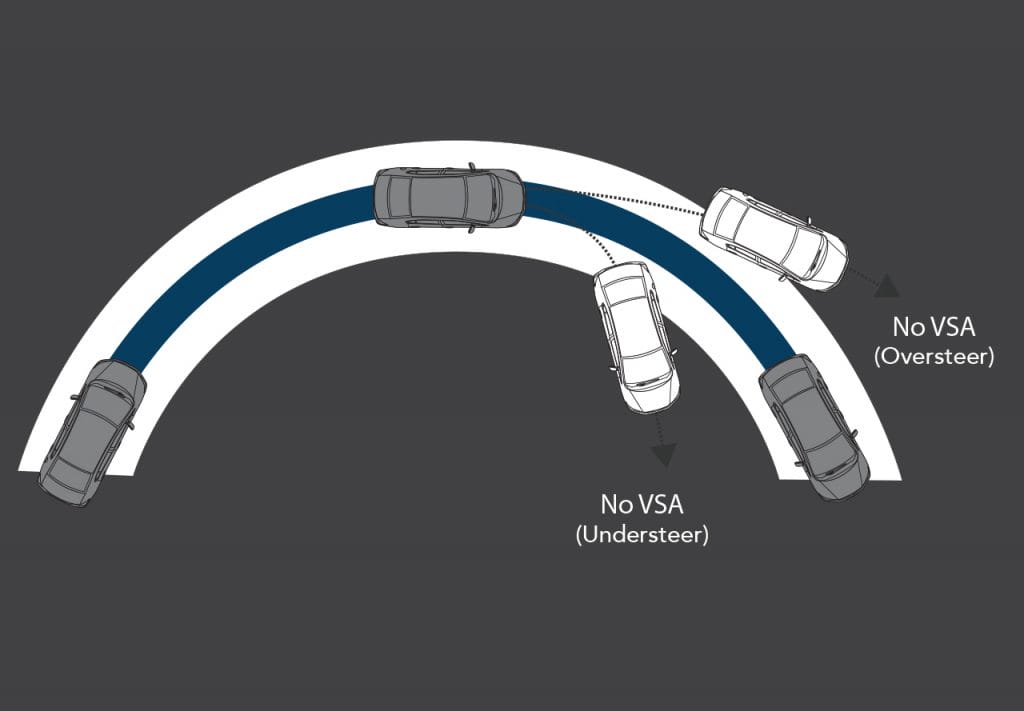
VSA is essentially a system composed of the following subsystems:
- ABS: The Anti-lock Braking System can minimize the loss of control phenomenon when the driver brakes and avoids obstacles at high speed. If the wheel sensor detects skidding on a wheel, the brake pressure on that wheel will decrease.
- ASR: The Acceleration Slip Regulation system prevents the drive wheels from skidding when the vehicle starts and accelerates abruptly. Another main task of ASR is to help improve vehicle stability by adjusting wheel traction during starting and acceleration. If ASR detects that the drive wheel is skidding, the wheel speed sensor will send this signal to the ECU. The ECU will command the braking system to act on the wheel and reduce unnecessary smooth turns. At the same time, the VSA system also sends a signal to the engine control unit to close the throttle or retard the ignition timing to reduce engine torque.
- EBR: The Engine Braking Regulation system prevents the drive wheels from skidding when operating in forced idle mode and ensures vehicle stability. This process occurs without the driver’s knowledge.
With the coordination of the above mechatronic systems, the main function of VSA is to minimize understeer and oversteer phenomena when the vehicle enters a curve or avoids an obstacle in case of an accident.
Additional Functions of VSA
As mentioned above, VSA’s main task is to prevent the vehicle from skidding out of rotation. But it can offer us more than that. The system then increases safety and provides the driver with a comfortable feel and an extremely flexible driving mode.
Hill Start Assist System
Starting on a slope is always a complex task, especially for large trucks. Drivers must act very quickly between the brake pedal, accelerator, and clutch to prevent the vehicle from drifting downhill. On the VSA system, the hill start function makes things easier. This function maintains brake pressure for about 2 seconds after the driver lifts their foot off the brake pedal. As a result, the driver has enough time to switch from the brake pedal to the accelerator without using the handbrake.
Emergency Braking Assistance
In an emergency, the driver often does not press the brake pedal hard enough. The emergency braking assistance function knows when to help the driver stop the vehicle by monitoring the sudden change in pressure on the brake pedal. If the driver isn’t braking hard enough, the system will increase the maximum braking force.
Load Adaptation
The payload and center of gravity of a utility vehicle can vary significantly from time to time. The vehicle’s load has a huge impact on brakes, traction, and balance. The adaptive load function identifies changes in the vehicle’s mass and center of gravity, then makes corresponding adjustments through interventions from the ABS, ASR, and ESP safety systems.
Vehicle Rollover Prediction
The rollover prediction function uses the ESP system’s sensors to intervene when the vehicle is at risk of rolling over. It can apply brake pressure on each wheel individually or reduce engine power to prevent the car from rolling over and keep it balanced.
Tire Pressure Monitoring System
A drop in tire pressure can lead to differences in speed and grip at the affected wheels. By comparing the speed of each car wheel, it’s possible to detect any pressure changes. This function will monitor tire pressure to avoid using additional pressure sensors in the tire.
When Does the VSA System Work
The indicator lights on most cars usually appear on the dashboard displaying full driving information, just like VSA. When this system is operating, the VSA light illuminates or flashes. Conversely, if the left light illuminates, we can recognize that the system has been deactivated.
If the indicator lights up, you can also understand that the traction control or anti-skid system (TCS or ASR) is working to help the car accelerate without the wheels skidding. Since these two systems (VSA and ASR) are interdependent, considering both lights as one is sometimes acceptable. However, at the same time, if both lights flash uncontrollably, there’s a high chance your stability assist system is malfunctioning. Then you need to take the car to a service shop for a full-speed check.
Meaning of VSA Lights
You can get the most out of your stability maintenance system and the vehicle in general through a series of lights that flash incessantly or dimly on the electronic control panel.
A Flashing VSA Light on the Dashboard
You might feel disturbed and worried when the VSA light flashes on your vehicle’s dashboard non-stop or suddenly. But there’s no need to carry these feelings with you since these flashes don’t indicate any defects or other serious warnings.
The flashing light on the dashboard is just a reminder that the car’s navigation and safety systems are working well together to help you steer safely. When the stability assist system is running, you might notice some changes in handling, including:
- The accelerator may not provide as much power increase as expected.
- If you don’t lift the accelerator, the engine power may slow down.
- The brakes may be applied automatically, although this should be relatively minor and gradual.
Although the VSA system is a great tool for drivers, it’s not without drawbacks. If you see the car light come on frequently, you might be pushing the car a bit too hard. And this act resembling overuse, in the long term, can lead to damage and cause dangerous situations if left unrecognized.
Steady VSA Activation Light
If the VSA activation indicator stays lit on the dashboard, it often means the system has been deactivated by turning it off using the console switch. If you turn the system back on, this light will go off.
VSA System Assistance Light
For better and more attentive observation of the entire system to get the fastest car treatment possible, you should also be aware of the second VSA light on the dashboard. When the VSA system light comes on and stays on, it can be a sign that the system isn’t functioning properly internally. If you notice this, stop if it can only be done safely, turn off the engine, and then restart it. If the light comes back on, you might consider setting up a service inspection as soon as possible to determine the root cause of the problem.
Meanwhile, you can still drive your car safely when the VSA indicates the light is flashing. But the VSA system won’t be able to protect you in surprisingly difficult conditions.
Why the VSA System Fails and Needs Repair
Besides the cost of VSA system repair and its basics, you should also be aware of the reasons why it might fail in the first place to be prepared for the well-prepared inspection and have a better plan for the following maintenance acts.
Tire Size
Every tire on your car should be set to the same dimension and be of a specific type to ensure the VSA system inside will function correctly. Replacing one or more tires with different specifications and varieties can cause the VSA unit to fail.
Using smaller, lighter, and thicker tires will make them less tolerant to breakage and malfunctions. It’s best to use winter tires of the same size as those provided by the manufacturer, otherwise the VSA might fail.
Faulty Braking System
The VSA system can influence your car’s engine power and the braking system to help slow your vehicle if necessary. VSA cannot help you if your braking system is malfunctioning due to rust, fatigue, or other relevant factors. To prevent your brakes from wearing out, you should inspect and maintain them regularly.
Faulty Sensor
The VSA system requires two sensors to be operational to function properly. This sensor monitors and controls the speed of your vehicle’s tires. The system’s sensitive sensors enhance grip on a rocky or slippery surface by automatically adjusting engine power. When you turn a sharp curve or bend, one of your tires might spin faster, forcing your driving steering angle to be out of sync with the others. In this case, the tire speed sensor will be activated to correct this issue.
Whenever the ABS light comes on alongside the VSA indicators, it means the ABS is faulty and not sending instructions to the VSA. In this case, the following operations won’t be performed as requested, leading to VSA system malfunction.
Steering Angle Sensor
This sensor ensures you will always drive and monitor your car in the desired direction. VSA sends information to the driver so that if the driver oversteers while negotiating a turn, this stabilization system can take control and ensure the car handles the turn correctly. Whenever the VSA light comes on, the steering angle sensor isn’t working properly, preventing the VSA unit from functioning correctly.
Faulty VSA Switch
You can use the VSA button to turn the VSA system on or off. The circuit is completed whenever the VSA system’s traction and tire movement systems regulate themselves. If the VSA button is broken, it won’t light up instantly. You can test the switch’s integrity by removing the VSA button and using an electronic multimeter.
Additionally, if the circuit is damaged, the VSA lighting will falsely indicate that the system is operational. For example, after pressing the VSA switch to activate the VSA system, the VSA lights might still be off.
Worn Tires
Your tires need good grip on their tread to help the car stay on the road and turn easily. The VSA system will help you take turns well. So, if your car’s tires are worn out, there will likely be a malfunction even if it performed the necessary commands.
VSA is designed to increase engine power and maintain a constant speed when climbing steep slopes. Due to the small friction between the tires and the road, if you use worn tires, it can make the process even more difficult.
FAQ on the VSA System in the Car
1. How to test a VSA modulator?
If you have a diagnostic system, note the neutral position of the VSA sensor as follows:
- Connect the system to the 16-pin data link connector under the dashboard on the driver’s side with the ignition off.
- In the Select System menu, choose VSA to open the VSA Properties dialog box.
- Select Neutral Test from the dropdown menu, then All Sensors. Follow the system’s instructions.
2. Can you drive with the VSA light on while ensuring your safety?
It’s essential to understand this when discussing the question of how much to repair the VSA system. Without VSA, your car will brake and turn normally, but it won’t have the VSA traction and stability enhancement.
The VSA system is activated when you start the car. So is it safe for you to drive when the VSA is still flashing? Yes.
