

Most drivers around the world have never driven a hybrid vehicle before. All they know about these hybrid vehicles is that they operate with an internal combustion gasoline engine and a battery-powered electric motor. But few of them know how this combination actually makes the car work. The truth is that drivers have a choice regarding how much electricity from the electric motor they can use for their driving and how much gasoline they get from the internal combustion engine.
Normally, a driver would use both the engine and the electric motor in order to save both battery power and gasoline. The battery inside a hybrid vehicle is much larger than the battery in your conventional classic car. Not only does the hybrid battery need to power basic accessories like the air conditioner and radio, but it also needs to power some of the vehicle’s movement. This requires it to be a much more massive battery that costs thousands of dollars and lasts about 100,000 miles.
The 6 Main Features of a Hybrid Vehicle’s Internal Structure
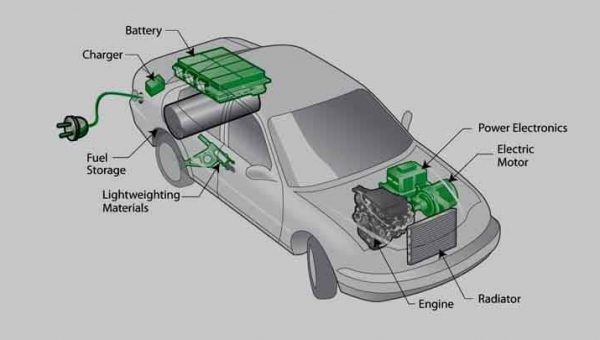
To understand how a hybrid vehicle works, you basically need to understand its internal structure. Here are the 6 main features of its structure.
- Fuel Tank – You will always have a fuel tank to store your gasoline as in a conventional vehicle. Due to the advanced technology of hybrid cars, gas will not need to be used as much. This will give you better fuel efficiency and produce fewer emissions.
- Transmission – Most hybrid vehicles will still use a conventional transmission that you would find in an ordinary gasoline car. However, new transmissions are built specifically for certain hybrid cars, like the Toyota Prius.
- Batteries – The batteries are what power the electric motor of a hybrid car. Not only that, but the batteries can also take back power from the electric motor. This is one way to preserve their lifespan.
- Generator – If you have a series hybrid vehicle, they have a generator that is powered by the gasoline engine. From there, the generator can then generate power for the electric motor and help recharge the battery. It is essentially a way to convert gasoline into electrical energy for the motor and battery.
- Electric Motor – This is the feature that makes the hybrid vehicle particularly special. The electric motor has the ability to accelerate the vehicle by taking power from the battery. However, it can also give power back to the battery if you slow the vehicle down.
- Gasoline Engine – The hybrid vehicle still has a gasoline engine. This remains the main source of power for the vehicle since 1 gallon of gasoline has the same energy as half a ton of battery energy.
Additional Information
Some hybrid vehicles can be plugged in to recharge the battery while others do not have this capability. Plug-in hybrids are considered electric vehicles while those you cannot plug in are not electric vehicles. Those you can plug in typically have an “electric-only drive” function that allows you to power the movement entirely with the electric motor. The only problem is that you can only drive at low speeds between 10 and 30 miles per hour. The electric motor is not powerful enough to accelerate the vehicle faster without drawing on the gasoline engine for more power. If you try to drive over 30 mph in “electric-only drive” mode, you will quickly deplete your battery power and will then be forced to drive on gasoline only as in a normal car.