
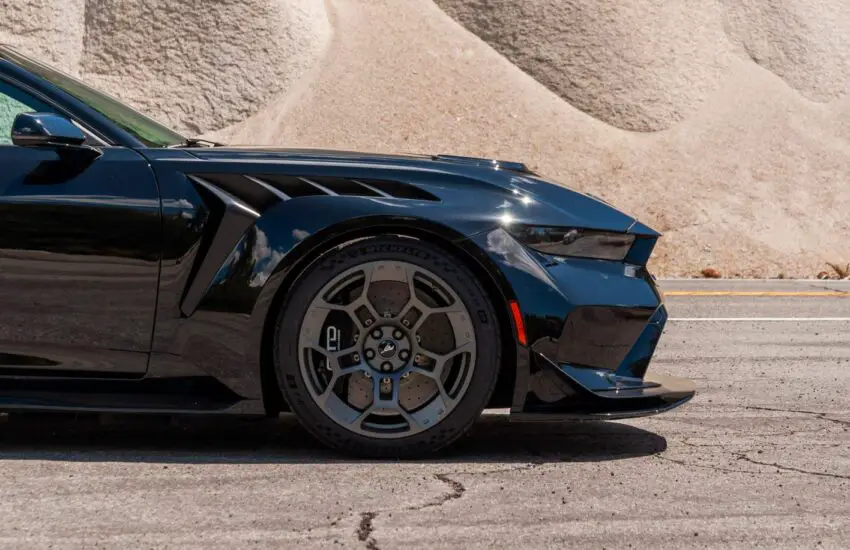
3D printing was the decisive tool for optimizing the Ford Mustang GTD on the legendary Nürburgring circuit. In the spirit of “Ford v Ferrari,” where every detail counts for victory, Ford’s engineering team adopted an unconventional, real-time development approach to push the boundaries of performance.
A Revolutionary Development Philosophy
At the launch of the 2025 Mustang GTD, Greg Goodall, Chief Program Engineer, revealed a complete break from the traditional process. Typically, development stops abruptly to focus on production. For the GTD, this rule did not exist. The team printed and tested parts directly on the Nürburgring track, a first that allowed for live data analysis and instant feedback into the design process.
The Birth of “Click Flicks”
The major innovation came from a call by vehicle dynamics specialist Steve Thompson from the ‘Ring. He informed the team that he had tested 3D-printed parts around the hood vents, small “ski bumps” dubbed “click flicks.” These additions, not part of the initial design, proved effective enough to shave off precious (undisclosed) time per lap.
A Fast and Effective Collaboration
Motivated by these results, an intense collaboration between Goodall’s engineering team and Anthony Colard’s design team enabled the finalization of a viable design within one to two weeks. The goal was clear: replicate the aerodynamic effect of the prototypes while seamlessly integrating it into the bodywork. After seven to eight iterations and nearly 20 wind tunnel runs, the solution was found.
A Decisive Impact on Performance
The result was a major aerodynamic innovation: the “click flicks” are neutral in terms of drag but generate crucial additional downforce. These appendages were attached to a pre-existing lower lip on the hood. Their contribution was such that Greg Goodall admitted that a lap under 7 minutes would have been “very tight” without them. Proof was delivered in August 2024 when the Mustang GTD became the first American car to complete a Nürburgring lap in under 7 minutes (6:57.685), before setting a record time of 6:52.072 in April 2025.