
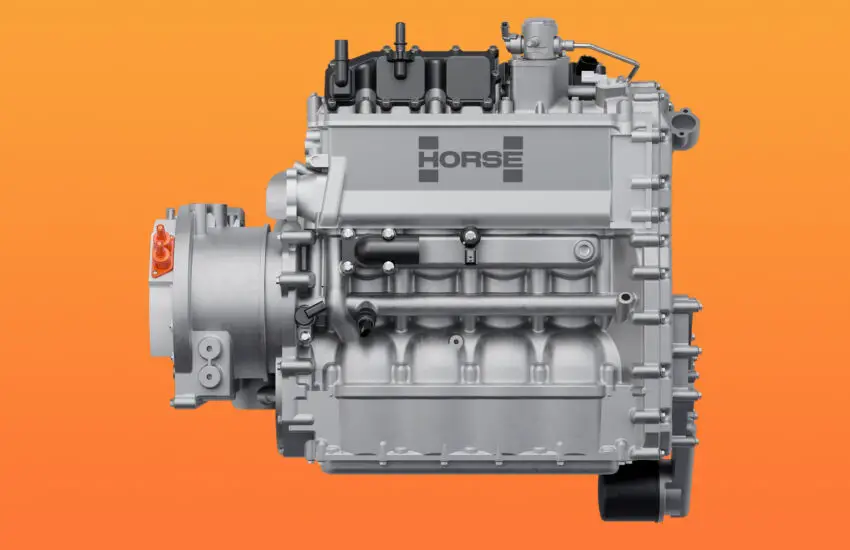
Horse Powertrain made headlines this month by presenting its new C15 engine at the IAA Mobility show in Germany. This 1.5-liter 4-cylinder block, the size of a carry-on suitcase, delivers nearly 100 horsepower and is designed as a range extender for electric vehicles. Shortly after, a Caterham Seven race car was equipped with a Horse engine. This has sparked curiosity about this little-known yet massive engine manufacturer.
Horse Powertrain: An Industrial Giant in the Shadows
Although discreet, Horse is not a newcomer. Based in Madrid, the group produces no less than eight million powertrains per year. It has 17 production sites and 5 R&D centers spread across Europe, South America, and Asia. Built on the heritage of 125 years of Renault and Geely, Horse positions itself as an independent leader in thermal and hybrid engine technologies.
A Franco-Chinese Alliance Supported by Saudi Arabia
Horse was born from a joint venture between French Renault and Chinese Geely, each holding 45% of the shares. A third entity joined the capital last year: Aramco, the Saudi national oil company, which now holds 10% of the company. Horse supplies engines and hybrid systems to the Renault and Geely group brands but also works for other manufacturers such as Mercedes, Volvo, Proton, Nissan, and Mitsubishi.
The C15 Engine: A Modular Range Extender
The big news is the C15. Its goal is to allow manufacturers to focus on their electric platforms without having to develop a small thermal range extender engine internally. Modular and adaptable, it is designed to fit into different vehicle compartments. A turbocharged version is planned for larger models. Its dimensions (50 x 55 x 27.5 cm) already include a generator, an exhaust system, and a cooling system.
Horse and the Racing World: The Caterham Case
The other facet of Horse is supplying engines for performance applications, as evidenced by the partnership with Caterham. The English brand uses the HR13DDT engine (already found in the Dacia Duster, Nissan Qashqai, and Mercedes A-Class in Europe) for its Caterham Academy program, following the discontinuation of Ford Sigma engine production. This is currently the closest gateway to the world of enthusiasts and DIY for the engine manufacturer.
The Future of Range Extender Vehicles
Electric vehicles with range extenders could gain popularity. As battery energy density improves, they might not only match the range of thermal models but significantly exceed it between charges, thanks to their small auxiliary engine. If this vision materializes, Horse engines could equip a multitude of new vehicles.