
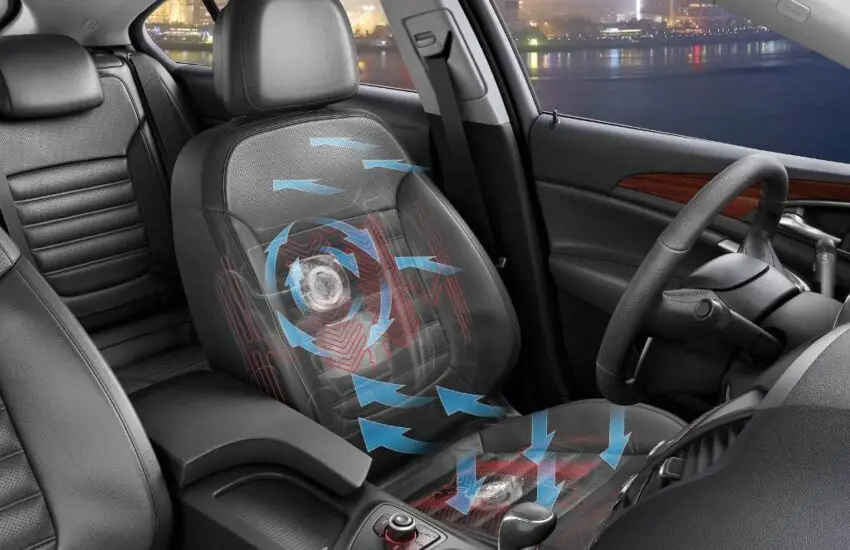
We are fortunate to have such a range of luxury features in our cars these days. Aren’t you grateful to have fresh air blown on your face when it’s hot outside, and your heater to keep you warm during the cold months? That said, if you live in extreme weather conditions, your heating and air conditioning might fall far short. This is where heated, cooled, and ventilated seats come into play.
While your HVAC system takes some time to bring the cabin temperature to a comfortable level, these high-tech seats would warm or cool you directly and thus instantly. If you’re still unsure whether they are essential or just nice to have, read on to find out how each of these seats works and if they are worth it.
Are Heated, Cooled, and Ventilated Seats Worth It?
If you are lucky enough to enjoy bearable weather year-round, your car’s heating and air conditioning might be all you need. However, if you live somewhere extremely hot in summer and freezing in winter, heated, cooled, and ventilated seats would not be luxury features, but actually an essential upgrade.
Instant Relief and Safer Driving
First, they provide almost instant comfort, and in extreme weather conditions, this can mean safer driving and not having to wait for your HVAC system to restore your car to a livable temperature before setting off. Imagine heading to work early in the morning when it’s freezing outside and sitting on that icy cushion: you might have to turn up the heat and wait a while until you’re no longer shivering to drive properly. Or perhaps you park your car outside in summer and, when you return, the seat cushion is so hot it could practically fry an egg. You won’t be leaving anytime soon!
So, how do they provide instant relief? Your air conditioning and heater blow cool or warm air through the vent and try to regulate the entire cabin. In contrast, heated seats have an internal component that heats up from electrical energy, while cool or ventilated seats blow cool air directly onto the person sitting on them. This means the seating surfaces your body is in contact with will feel warmer or cooler almost immediately.
In hot weather, your back and seat will be very cool, and your clothes won’t develop those embarrassing sweat stains. And you might be one of those people who prefer having cool, refreshing air blown directly onto their overheated body rather than having it blown on their face through the vents.

Remote Activation
Some cars offer heated, cooled, and ventilated seats that can be activated remotely. Therefore, you can turn them on before getting into the car, and it will save you from burning your bottom on the scorching upholstery. Many of these seats also allow drivers and passengers to easily adjust their own comfort level.
Less Fuel Consumption and Pollution
This more efficient temperature regulation mechanism also means that heated, cooled, or ventilated seats consume less fuel and are more environmentally friendly than ordinary heating and air conditioning. Of course, these seats still consume fuel, but they minimize fuel consumption and air pollution.
How Heated, Cooled, and Ventilated Seats Work
Heated Seats
Heated seats are more common than cooled or ventilated seats, and on many luxury models, they have become a standard feature. Heated seats work through a heating element placed between the seat cushion and the padding. When the heated seat is activated, an electric current passes through the heating element, heating it up.
Cooled Seats
Cool seats use many different methods, but the most common includes several fans inside the seat. These fans blow air through a layer of material to diffuse the air and then circulate the air through the padding.
These cool seats may or may not refrigerate the air before blowing it onto the occupant. A cooling unit is necessary in the case of refrigerated air. Even when it’s not refrigerated, the circulation of air blown directly onto your overheated body makes a big difference in keeping you cool in your seat.
You might be skeptical, but remember that our body initially ejects heat through pores as sweat. But when your back and buttocks are pressed against the car seat, that moisture cannot escape from the pores; it’s like wearing a jacket in summer.
Meanwhile, a cooled seat with a typically porous covering allows your skin to breathe and eject moisture, enabling your body’s natural cooling system to function even when your back and buttocks are pressed against the padding. The porous material helps air pass through the seat and escape into the environment instead of being trapped under the padding. Such air circulation across your skin helps draw heat away from your body, allowing sweat to work as usual.
In the case of cooled seats that operate through non-refrigerated air circulation and thus without a cooling unit, the cooling process requires much less energy than cooled seats with a cooling unit. In fact, it would consume less energy than a classic light bulb.
In cooled seats with a cooling element that produces refrigerated air, the cooling element may be located in the seat or in the car’s larger air conditioning system. These cooling units operate on a compression, condensation, expansion cycle, like any typical air conditioner.
In a closed loop, a gas (freon, but now more commonly hydrofluorocarbon) is compressed and then condensed to cool into a liquid. Air is blown in front of the cold liquid in the loop and is thus also cooled. The heated liquid is then turned back into gas, and the process repeats.
Ventilated Seats
Cooled and ventilated seats both help you cool down, the only difference being that ventilated seats use only non-refrigerated air. As their name suggests, ventilated seats also have multiple fans and ducts inside the seat cushion and backrest to circulate air. Some systems use these fans to blow air toward the occupant through tiny perforations in the upholstery, while others draw air into the seat.
With ventilated seats, you can often adjust the air strength in addition to turning the function on or off. In some models, like Chevrolet, you can set ventilated seats to automatic, so they turn on when the cabin temperature reaches a level you previously set. In other cases, when it’s hot outside, ventilated seats turn on when remote start is used.
Where You Can Find Them
Heated and cooling seats have been a common feature in automobiles for some time. You can expect to find these features in most models after 2015, either as a standard feature or as a trim level add-on. Note that you might find cooled seats listed as “ventilated seats,” so read further to find out if they use refrigerated air, if that’s what you want.
Meanwhile, ventilated seats are a rarer luxury feature. You are more likely to find this comfort feature in high-end models like the Audi A4, Lexus ES 350, and BMW 540i. Ventilated seats are also offered in some non-luxury models, albeit in higher versions, such as the Toyota Camry XLE, Honda Civic Hatchback, Subaru Outback and Crosstrek, Hyundai Tucson and Sonata, and Ford Mustang Escape.
If you need more than heated, cooled, or ventilated seats to survive driving in extreme heat or cold conditions, there are also models that offer these comfort seats with a heated or ventilated steering wheel as well as other heated interior features.
But note that although these comfort features have become a staple over the years, the technology and execution of this feature differ from one manufacturer to another. Many car buyers have complained about their ineffective heated or cooled seats, and once you’ve already purchased the vehicle, there’s nothing you can do about it. Therefore, do your homework and take the time to go through reviews.
Other Temperature Regulation Options for You
As mentioned above, heated seats are the most common feature in the group. So you can add them if your car isn’t equipped with them, and most installations will cost less than $500 per seat.
Although you cannot install cooling seats in your vehicle, an affordable solution in hot weather is to buy air-conditioned seat cushions that plug into your car’s electrical system. Many car manufacturers offer them for models without cooled or ventilated seats. This method is less permanent, so you can take it from one vehicle to another. These cushions have built-in fans and sometimes cooling units. One advantage is that they don’t consume much energy.