

Since their very first iterations in the early 20th century, cars have evolved significantly. From changes in engine operation to better braking systems, everything has developed to improve the driving experience for drivers. One of the most significant changes we have seen in recent years has been the development of vehicle transmissions and how power is distributed to the wheels. While these early cars were mostly rear-wheel drive, many modern drivetrains are either four-wheel drive (4WD) or all-wheel drive (AWD). Thanks to the evolution of clutches and couplings, some vehicles are equipped with systems that allow power to be transferred between the front and rear wheels, or to engage all wheels if necessary, to maximize a vehicle’s potential and make driving easier.
Thanks to these systems that allow users to choose (or dictate situations) whether power should be transferred to four wheels or only two, car owners benefit from better safety and improved fuel economy. They can, for example, benefit from the economy of a front-wheel drive vehicle in everyday driving conditions and the performance and handling advantages that come from a four-wheel drive car when things get tricky. One of the most well-known coupling systems is Haldex. While there are many all-wheel drive systems (all-wheel drive), for example Audi’s quattro or Subaru’s symmetrical all-wheel drive, the name Haldex appears more than any individual system.
You may have heard of Haldex AWD before and you will certainly have heard of some of the cars equipped with it, for example the Audi S3, the Volkswagen Golf R, or the Mercedes-Benz A45 AMG. Although each of these companies has its own name for its drivetrain systems, they are all related to Haldex. So, what is this AWD system, how does it work, and what are its advantages and disadvantages?
WHAT IS HALDEX AND HOW DOES THIS SYSTEM WORK?
<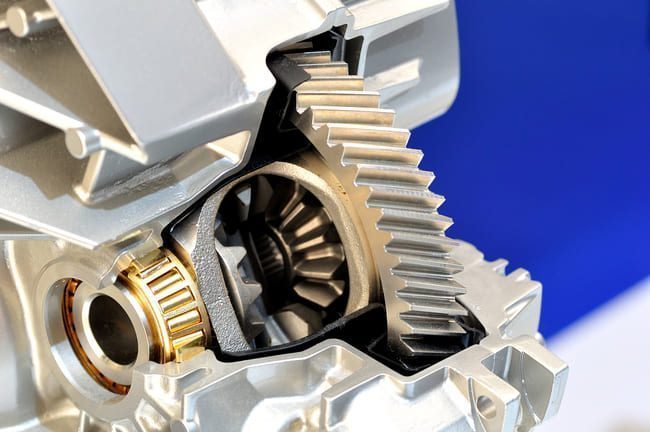
Haldex Traction is a product of the Swedish company HaldexAB, which has specialized for many years in converting front-wheel drive systems into all-wheel drive systems. Haldex 4WD typically takes a front-wheel drive configuration, like that found in the VW Golf or Audi A3, and converts it into an all-wheel drive system, normally using electronic sensors and differentials to redirect power to the rear wheels when needed.
A “Haldex” system is present on the majority of small and medium-sized four-wheel drive vehicles. Basically, it uses an oil pressure-activated clutch coupling system on the rear differential to allow the car to instantly switch from FWD to 4WD as the ECU deems necessary, without driver intervention.
Haldex AWD is not actually a “proper” all-wheel drive, because in all-wheel drive vehicles, the standard drivetrain configuration drives all the vehicle’s wheels. Haldex is technically a four-wheel drive system because the default configuration for Haldex AWD only drives the front wheels, so it should really be called Haldex four-wheel drive. It is only when wheel slip is detected that the Haldex computer systems redirect torque to the rear wheels to compensate for the loss of traction at the front, driving all four wheels. Under normal driving circumstances, vehicles equipped with Haldex will operate only in front-wheel drive. Because this change happens without the driver doing anything, the system detects it itself, the system is often described as an automatic all-wheel drive system. Essentially,
The Haldex 4WD coupling is mounted on the rear axle differential and is driven by the driveshaft. Engine torque is transmitted to the driveshaft via the gearbox, the front axle differential, and the front axle drive. The driveshaft is connected to the input shaft of the Haldex coupling. Torque can only be transmitted to the rear axle differential when the Haldex clutch discs are engaged.
DIFFERENT GENERATIONS OF HALDEX
Haldex itself has evolved significantly since its inception and there have been 5 different generations to date.
Haldex gen 1 is the model for all other Haldex generations. The main components of the system are a mechanical-hydraulic pump activated when the wheels slip, a wet multi-plate clutch, working pistons, and a controllable throttle valve.
The unit is essentially a hydraulic pump with two connected shafts, one leading to the front axle and the other to the rear (input and output shafts). These two shafts are connected via the wet multi-plate clutch pack and this clutch is normally “unloaded,” meaning no torque is transferred between the two. When both shafts rotate at the same speed, the pump is inactive.
When a speed difference between the wheels on each axle is detected, between the input and output shafts, the input shaft pumps a piston and creates oil pressure in the pump. As the oil pressure is diverted via an oil channel to the working piston, this forces the working piston to compress the clutch disc pack. The input shaft and the output shaft of the clutch are now interconnected, and thus the front and rear axles are connected. We now have all-wheel drive!
Under normal driving conditions (driving at constant speed without slipping), the torque distribution is 90/10 front to rear. When the clutch is locked, torque is evenly distributed between the axles (50/50).
Haldex gen 2 still uses the mechanical hydraulic pump and works exactly the same way as generation 1, with some minor improvements. This system is still reactive.
The biggest change for Haldex gen 3 and Haldex gen 4 is that they are proactive systems rather than reactive. This means the ECU electronics can “pre-tension” the clutch and activate all-wheel drive before wheel slip occurs, making it much more effective and also increasing driver safety. Generation 4 does not use a mechanical pump, but instead uses a feed pump.
In 5th generation Haldex couplings, a new electro-hydraulic clutch actuator uses a centrifugal overflow valve to help accurately distribute power between the front and rear axles. Makes the system smoother and eliminates the need for some components, streamlining the process. To assist, there is also an integrated electronic control unit.
WHAT ARE THE BENEFITS OF HALDEX?
Haldex offers several advantages, especially for manufacturers without an unlimited budget. Rather than researching and developing their own all-wheel drive systems, they can simply use Haldex systems. They can be fitted to almost any front-wheel drive vehicle and, as such, are popular with many manufacturers because FWD is the standard drivetrain system. This allows companies to easily produce a more sporty all-wheel drive model of a car that was previously only front-wheel drive.
One of the main advantages for drivers is that Haldex offers greater energy efficiency because it only drives 2 wheels for a large portion of the vehicle’s use, resorting to 4-wheel drive only when circumstances require extra traction.
The system of course makes driving much safer. With the same kind of operating principle as ABS systems, recognizing when a wheel is slipping can mean a car has better traction on slippery surfaces and eliminates some of the risks when driving on difficult terrain. This is true for all 4WD or AWD systems, but many of them must be activated by the driver. Since Haldex is automatic, as the Haldex controller decides when the system should be activated, it makes it stress-free and better at coping with unexpected changes in road surface.
WHAT ARE THE NEGATIVES OF HALDEX?
Because the Haldex system is rather complicated in its nature – using a specific oil, relying on high tolerances, and generating a buildup of friction particles over time – it must be maintained in the best condition and requires special oil and maintenance. Haldex repairs are difficult to do yourself (and not recommended!), so regular maintenance can be expensive.
No old oil can be used in the system; you should ideally only use the original VAG Haldex oil designed for your specific vehicle and this can be costly. Haldex oil is a non-lubricating oil to promote friction of the clutch discs and using any other oil can result in a total loss of drive to the rear, effectively converting your car to front-wheel drive. This means Haldex oil changes are extremely important for the proper functioning of the system.
There are also performance issues for cars equipped with Haldex systems. Since Haldex is primarily front-wheel drive, under heavy loads, vehicles equipped with Haldex tend to understeer massively, as the computers are often too slow to distribute torque to the rear axle, and because the default torque distribution remains biased towards the front wheel. This was a common problem with vehicles such as the Audi RS3, known for its chronic understeer.
Because the oil is specifically designed to promote friction between the clutch discs, this friction causes the slow buildup of more material particles in the oil and means it can quickly become ineffective, potentially requiring more frequent, costly changes.
WHEN SHOULD I HAVE MY HALDEX SERVICED?
On vehicles equipped with a Haldex filter, i.e., first and second generations, it is wise to change the oil and filter every 20,000 miles. For vehicles that do not have a filter, changing the oil every 10,000 miles is a good idea, as the pump strainer can become blocked, eventually leading to pump failure. A garage will be able to run a more comprehensive and accurate Haldex diagnostic test for you.