
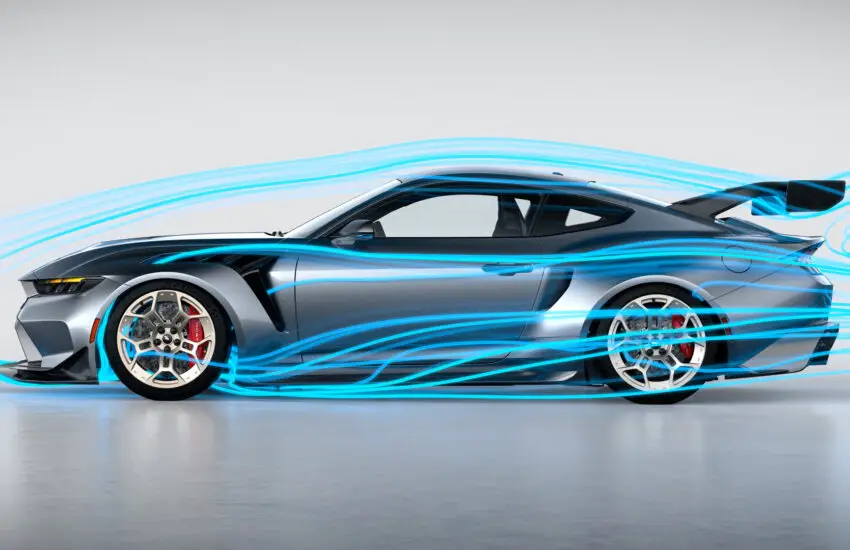
Secret Shared: The Ford Mustang GTD Gave Its Wing to the Mustang GT3. The traditional motorsport adage, “race on Sunday, sell on Monday,” has been reversed by Ford. For once, it’s the road car that inspired the race car, and not the other way around. The innovative aerodynamics of the Mustang GT3 are actually a direct legacy from the Mustang GTD, its road-legal sibling.
An Aerodynamic Shift
During the development of the Mustang GT3, the team initially considered a conventional rear wing, mounted on the trunk. But the arrival of the GTD project, a road-going version of the track monster, changed everything. Anthony Colard, Design Manager, and Greg Goodall, Chief Program Engineer, revealed that the design of the swan-neck wing, attached to the C-pillars, was born for the road car.
The Genesis of an Innovation
The idea emerged six months after the start of the GTD’s development. A designer proposed this specific mounting, a solution that was both aesthetic and ingenious. By attaching the wing to the already reinforced C-pillars, the team solved a major technical challenge: managing significant downforce loads without overstressing the trunk.
A Functional and Aesthetic Decision
Once validated on the GTD, the team quickly realized that this solution would also be perfect for the GT3. The decision was made to harmonize the two models. This choice wasn’t just stylistic; it proved to be remarkably functional. It notably paved the way for the much simpler integration of active aerodynamics.
The Advent of Active Aero
Active aerodynamics wasn’t part of the GTD’s initial program. However, the mounting on the C-pillars, a fixed structure, facilitated the routing of the cables and lines necessary for the active system. This innovation was crucial for performance, allowing the Mustang GTD to lap the Nürburgring in under 7 minutes, with a record time of 6:52.072.
As Greg Goodall pointed out, without active aero, breaking the 7-minute barrier would have been “tighter.” This unique technology transfer, from road to track, was therefore a decisive vector of performance and innovation for Ford Performance.