
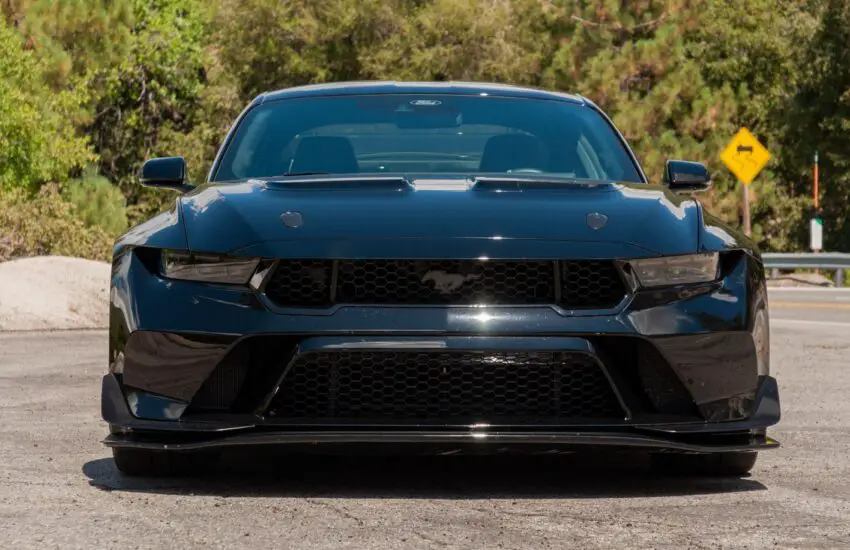
The Ford Mustang GTD is so wide that, in theory, it should be equipped with amber marker lights like a Ford Raptor. But Ford found a regulatory loophole to avoid them on this $325,000 gem.
A Width That Pushes Legal Limits
There is a reason why very wide vehicles, like the Ford F-150 Raptor or the Ram TRX, feature amber clearance lights at the front and rear. The reason is not aesthetic; it’s legal. The U.S. Federal Motor Vehicle Safety Standard (FMVSS 108) states that any vehicle 80 inches (about 203 cm) wide or more must be equipped with clearance and identification lights.
A standard Mustang is about 75 inches wide. The Mustang GTD, however, spans 81.8 inches, giving it almost cartoonish proportions. Theoretically, this width required the addition of the famous amber lights. Ford’s team was not enthusiastic about this idea and sought—and found—a way out.
The Loophole: Single-Purpose vs. Dual-Purpose Vehicle
Anthony Colard, head of design for the Mustang GTD, explained that the key to the problem lies in the vehicle’s certification. The regulation on clearance lights mainly applies to pickup trucks, SUVs, and trailers, as they are considered “dual-purpose” vehicles. This means they can be purchased by businesses and registered then used as utility vehicles.
Ford certified the Mustang GTD not as a dual-purpose vehicle, but as a “single-purpose” vehicle. In other words, its primary purpose is not work but performance. As Colard clarified: “It’s not a utility vehicle. It’s not like a big truck. You’re not going to tow anything with it.”
A Clever Technical Interpretation
Ford thus relied on a very precise technical interpretation of the FMVSS regulation to avoid having to add lighting reminiscent of a pickup truck. This move preserves the supercar’s clean and aggressive lines.
One question remains: what happens if an owner, who has a business, still decides to use their GTD as a service vehicle (for example, as a “taxi” on the track)? Technically, this could fall into the dual-purpose category. Ford relies on good faith and the intended use of the car, considering this an exception that proves the rule and validates their clever interpretation.