
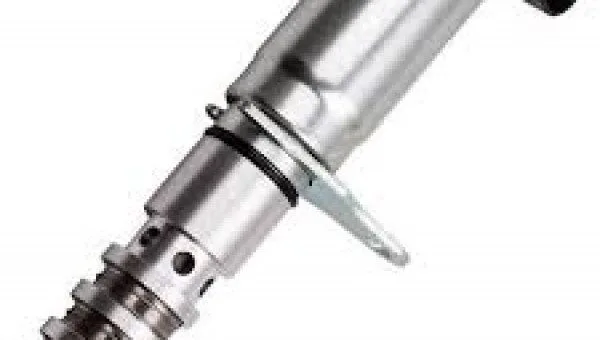
Variable Valve Timing (VVT) solenoids are one of the greatest innovations in the automotive industry.
Almost all modern cars use VVT technology to improve their performance and fuel economy. The VVT solenoid helps engines modify their valve lift control, which ensures the correct amount of oil is supplied to the engine, reducing fuel consumption.
Electronic principles of electromagnetism in the form of a solenoid valve are used to control this oil flow. The solenoid valve draws a small amount of current from the car’s battery and activates it.
When the ignition is turned on, the connection to the solenoid valve is established, and a metal bracket is pulled down, overcoming the spring force and pushing the bracket back. This pressure closes the contact between the terminals and connects the battery to the starter so that a significant current flows through the contact to the starter and the engine starts.
If the solenoid coil is faulty, the current flow is interrupted, leading to a starting problem. This can be due to burnt or corroded contacts.
If the VVT solenoid malfunctions, incorrect lubrication can damage the transmission and timing chain.
Bad Variable Valve Timing (VVT) Solenoid Symptoms
A faulty timing belt can exhibit various symptoms and effects. They are all as follows:
1. Check Engine Light
Flashing check engine light
With the help of the Electronic Control Unit (ECU) that modern new vehicles are equipped with, you can learn about any unusual activity occurring in your vehicle via the check engine light. Your ECU monitors, compares, and reports any ongoing activity in your car, and if any of the current situations do not match the predefined values, the check engine light comes on.
In this case, it is advisable to consult a highly professional mechanic and have your car checked, as only they can verify and decode the check engine light using their manual.
2. Rough Idle
Excessive oil flow to the VVT gears is one of the possible results when the VVT solenoid coil fails. This leads to a rough engine idle. The engine speed varies when the VVT gear operates. If the speed fluctuations are ignored, it can lead to premature engine wear.
3. Dirty or Bad Engine Oil
The performance of VVT magnets heavily depends on the quality of your engine oil. With clean engine oil, they tend to work perfectly. Engine oil containing many impurities lowers its viscosity, leading to clogging of the VVT solenoid, which ultimately affects the chain and transmission.
4. Reduced Fuel Economy
The VVT solenoid manages the opening and closing times of the valves to ensure efficient fuel consumption. Therefore, any malfunction of the VVT solenoid is certain to lead to inefficient fuel consumption. So, if you notice a significant drop in your average fuel consumption and a smell of unburned fuel, it is very likely that your variable valve timing sensor is faulty.
Replacing the Variable Valve Timing (VVT) Solenoid
Once it has been determined and confirmed that your car’s VVT solenoid is faulty, it is recommended to have it replaced by a professional mechanic or replace it yourself if you know how. The following steps should be performed for the replacement.
Disconnect the Battery
First, carefully disconnect the car battery from your vehicle by gently loosening both terminals, taking care to avoid any battery acid spillage. Keep the two terminals away from each other to prevent a potential short circuit due to stored charge in the capacitors.
Open the Engine Hood
Your engines are covered by a plastic body (different for each model) under which all other engine parts are hidden. So, first remove your engine cover by loosening the nuts on the cover, and store it securely to one side.
Locate the VVT Solenoid
When the cover is removed, now carefully search for your VVT solenoid. It is normally located around the valve cover. If you don’t know and have a new VVT solenoid, try comparing the two and find a similar part mounted somewhere nearby, as this will make your search easier. When you have found it, ensure that area is cleared of wires and other parts.
Look for Mounts and Bolts
Normally, solenoid valves are secured with a single bolt, but in some cases, there are also two bolts. Carefully remove these bolts and keep them safe, taking care not to drop them into the engine.
Remove the Old Solenoid
First, carefully remove the connector attached to the VVT solenoid by pressing the tab to release the locking device, ensuring no connection to the connector is disturbed. Now remove the solenoid using a pair of channel locks. Grip the metal part and pull on it. Try twisting and pulling, as this might make your pull more effective.
Inspect the Faulty Solenoid
When you have removed the solenoid coil, look at it carefully. Ensure the entire solenoid coil has been removed and none of its side parts such as the O-ring, etc., are still there. Also, make sure you remove any dust and debris if present.
Install a New Solenoid
After unpacking your new solenoid coil, lubricate it before starting the repair. Also, lubricate the seals with lithium grease.
Secure It Firmly
Now, bring back the mounting screws you removed from the old solenoid and tighten them firmly. Ensure they are tightened to the precise torque.
Now plug all the sockets and plugs onto this newly attached VVT solenoid. It is recommended to apply dielectric grease to the seal and connector surfaces as this helps prevent corrosion.
Reassembly
Once all the above steps are completed, put the engine cover back in place and reconnect the battery. You are now ready to start.
Conclusion
VVT solenoids play an important role in your car’s overall performance. A malfunctioning VVT magnet means a disruption in engine activity, which can eventually lead to engine wear.