

Many people have stated that measuring rotor thickness is an important aspect of brake repair. But why is that? And what is the best time to check rotor thickness and how to do it? Let’s find out the answer right now in this blog with the automotive experts from CarFromJapan.
Important Things to Know About Rotor Thickness
In the past, most rotors were designed with sufficient thickness to allow for 02 or more brake pad replacements. Nowadays, to reduce weight and save on some costs, many car manufacturers often produce rotors with thinner thicknesses. Consequently, rotors are prone to wear down to the minimum thickness (which is usually indicated in the factory maintenance manual or on the rotor casting) by the time the first set of brake pads needs to be replaced – or perhaps even sooner in some situations.
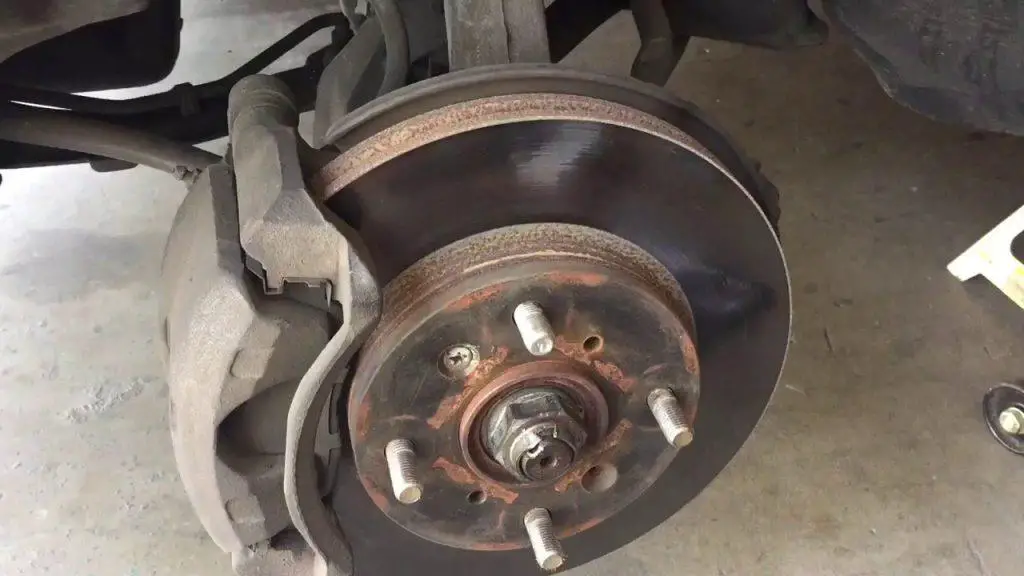
Knowing your vehicle’s minimum rotor thickness is very important because if your car’s rotor thickness is below the minimum level, your safety will be compromised. A worn or thinner rotor has less mass than a normal rotor, leading to a decrease in its ability to absorb and dissipate heat. Furthermore, the rotor’s strength is also diminished, resulting in more risks of cracking, or even braking failure.
For this reason, it is essential to check the rotor thickness during brake pad maintenance. If a rotor’s thickness is below the minimum specifications or cannot be resurfaced, we must replace the rotor immediately. In some regions, this is the law.
All vehicle rotors typically undergo the same wear. Therefore, when it comes to replacing a worn rotor, it means you need to replace both rotors on the vehicle. Automotive experts advise changing both rotors simultaneously (even if one of them is still functioning well) to maintain even braking from side to side. A noticeable difference in rotor thickness can cause the brakes to pull to one side.
When to Check Rotor Thickness?
Checking rotor thickness should be done whenever you replace the brake pads or before resurfacing the rotors. This will ensure that the rotors contain enough metal for safe braking. It is good practice to do this every time you change the brake pads, regardless of the interval between changes. The checking process takes you less than 5 minutes and is a good safety measure to consider.
How to Measure Rotor Thickness?

When it comes to measuring rotor thickness, you just need to follow the detailed testing procedure found in any factory maintenance manual. Most procedures often indicate that you can simply use a micrometer to measure the rotor thickness, at 8 to 10 different locations. During measurement, keep a distance of about 45 feet and 10 mm from the edge of the rotor. It is important to note that all readings must be greater than the required minimum thickness. Furthermore, it must in no case exceed the minimum brake parallelism values indicated in the manual’s list. This is mandatory to ensure consistent and smooth braking performance.
After that, here is the proper guide for measuring rotor thickness:
First, depending on which rotors the drivers want to measure, you may need to lift the rear or front of the automobile. After that, the car owner can use the jack stand, a tool that must be used to secure the car.
Second, it’s time to remove the wheel nuts to take off the wheels. And then remove the brake pads. Remember to give the braking surface a good look: you want that spot to be clean and smooth, without cracks and without any visual damage.
Third, drivers need to measure the brake disc thickness. It is located inside the outer circumference of the rotor every eighth of a rotation.
Finally, car owners check the rotor to see if it matches the minimum thickness. Otherwise, you must replace it.
Brake Disc Thickness Chart;
| Passenger Cars and Light Trucks | Heavy Trucks and SUVs | |
| Minimum Front Rotor Thickness | Generally between 10 mm (0.394 inches) and 28 mm (1.102 inches). | Between 28 mm (1.102 inches) and 38 mm (1.496 inches). |
| Minimum Rear Rotor Thickness | Generally between 8 mm (0.315 inches) and 20 mm (0.787 inches). | Between 20 mm (0.787 inches) and 30 mm (1.181 inches). |
Related Questions and Answers
1. What is the Average Lifespan of Rotors?
Many factors affect the average lifespan of your brake components. These include the type of brake pads, rotors, your driving style, and your maintenance. According to most companies producing brake pads and qualified mechanics, brake pads can last from 30,000 miles to 70,000 miles. The lifespan of brake rotors is much longer (3 times longer than that of pads). But again, all depend on many other factors such as how you maintain your braking system and your driving conditions.
2. How Much Do New Rotors Cost?
The average cost of new rotors varies from $30 to $75 each. Some higher-performance rotors can cost you over $100 each. Furthermore, prices heavily depend on many other factors such as type, brand, and quality.
When it comes to replacing brake rotors, some people often wonder whether they should buy aftermarket parts or Original Equipment Manufacturer (OEM) parts. Aftermarket and OEM parts have their own advantages. For example, aftermarket parts are generally cheaper and available in a wide range of options, while OEM parts are easier to choose and offer better quality assurance and come with a warranty.
3. Can I Drive with Faulty Rotors?
Rotors play a crucial role in allowing your car to stop once it is in motion. If the rotors are not functioning well, you may not be able to stop your car properly in an emergency. This can lead to many dangers if you need to stop to avoid pedestrians, a bicycle, a car accident, or other driving situations. Therefore, when you find that your brakes are not working as they should, you need to take your car to a mechanic for inspection as soon as possible.