
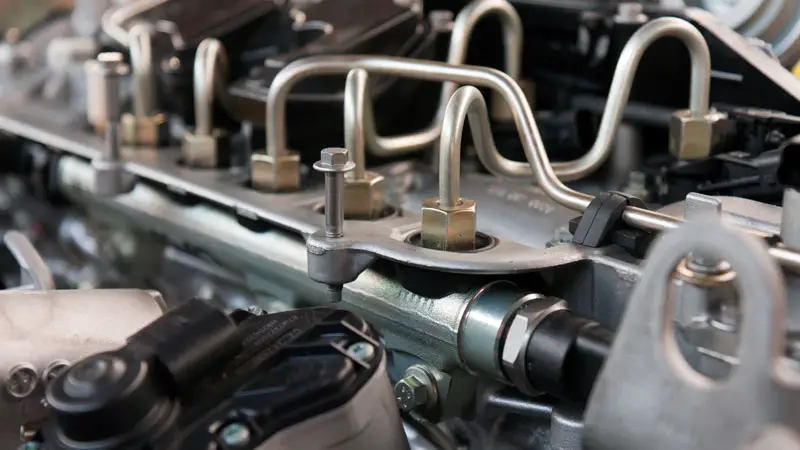
The fuel supply system is a vital network for any internal combustion engine vehicle (gasoline or diesel). Its role is simple but crucial: to store, filter, pressurize, and precisely meter fuel to the combustion chambers, where it will be mixed with air and ignited. Optimal operation of this system is essential for the engine’s performance, efficiency, and longevity.
The fuel system must be maintained regularly to prevent unexpected breakdowns. Clean filters ensure proper engine operation by preventing impurities from harming the system. Fuel pressure must be properly regulated to ensure efficient combustion. Any fuel leak can have serious consequences for the vehicle’s safety and performance. Technologies are evolving to make fuel systems more efficient and environmentally friendly.
The Fuel Supply System is essential for the proper functioning of a vehicle, enabling efficient and optimized fuel combustion.
Furthermore, the Fuel Supply System plays a central role in reducing fuel consumption.
Here are the essential components of this system, detailed with their functions:
Fuel Supply System and its Importance
- The Fuel Tank:
- Function: To safely store fuel (gasoline or diesel) in sufficient quantity for the vehicle’s range.
- Details: Typically made of high-density plastic resistant to shock and corrosion, or metal. It is equipped with a ventilation system to maintain internal pressure and prevent the formation of excessive vapors. It also contains the fuel level gauge (float sensor).
- The Fuel Pump:
- Function: To draw fuel from the tank and deliver it under pressure to the engine.
- Details:
- Location: Often submerged in the tank (an “in-tank” pump) for better cooling and to avoid priming issues. Sometimes mounted in-line on the chassis (less common today).
- Type: Mostly electric with a rotor or vane wheel in modern vehicles. Mechanical pumps (driven by the engine) are now rare, especially on fuel injection engines.
- Control: Its speed (and thus its flow rate) can be electronically controlled by the engine control unit (ECU) to adapt the pressure to requirements.
- The Fuel Filter:
- Function: To trap impurities (dust, rust, water particles to some extent, deposits) present in the fuel before they reach sensitive downstream components (injectors, diesel high-pressure pump).
- Details: This is a consumable item, essential for protecting the injectors and ensuring clean flow. It is generally replaced periodically according to the manufacturer’s recommendations. Diesel filters are often more complex and include water separation systems.
- The Fuel Pressure Regulator:
- Function: To maintain a constant and optimal fuel pressure in the fuel rail, regardless of engine demand (RPM, load) or pressure in the intake manifold.
- Details:
- Principle: It acts as a relief valve. It allows excess fuel to return to the tank via the return line (“fuel return”) when the pressure exceeds the set value.
- Variation: In some returnless systems, regulation is achieved by modulating the speed of the fuel pump itself, controlled by the ECU, thus eliminating the need for a mechanical regulator and the return line.
- The Fuel Rail (or Injector Rail):
- Function: To distribute pressurized fuel to each of the injectors equally and to serve as a buffer volume to dampen pump pulsations.
- Details: Rigid piping (usually made of steel or aluminum) connected to the pump/regulator outlet and to which the injectors are attached. It often includes a fuel pressure sensor.
- The Injectors:
- Function: To spray the fuel as fine droplets (atomization) into the intake manifold (indirect injection) or directly into the combustion chamber (direct injection), according to precise metering and timing controlled by the engine control unit (ECU).
- Details:
- Control: Electrical. The ECU sends an electrical signal that opens the injector valve for a very precise duration (injection time, in milliseconds), thus controlling the amount of fuel injected.
- Precision: These are high-precision components. Their orifices are very fine and sensitive to clogging (hence the importance of the filter).
- The Piping (Fuel Lines):
- Function: To ensure the transport of fuel between the different components of the system.
- Details:
- Supply (HP): High-pressure resistant pipes (usually made of steel or reinforced synthetic material) between the pump and the fuel rail.
- Return (LP): Low-pressure pipes (often made of hydrocarbon-resistant rubber or plastic) for excess fuel returned to the tank (in systems with a return line).
- Sealing: The sealing of the entire circuit is paramount for safety and proper operation.
- The Filler Cap:
- Function: To allow filling of the fuel tank while ensuring a tight and secure closure. It usually includes a vapor venting system.
- Details: Often equipped with a locking system and a sealing gasket. It must be compatible with the type of fuel and comply with anti-pollution standards (vapor recovery).
- The Canister (Vapor Canister):
- Function: To trap hydrocarbon vapors that naturally escape from the fuel tank to prevent them from being released into the atmosphere.
- Details: Contains activated charcoal that absorbs the vapors. The engine control unit periodically commands a valve (purge valve) to purge these vapors into the intake manifold where they are burned in the engine, thus contributing to compliance with anti-pollution standards.
- The Fuel Pressure Sensor:
- Function: To measure the fuel pressure in the fuel rail in real time.
- Details: Sends an electrical signal proportional to the pressure to the engine control unit (ECU). The ECU uses this information to:
- Control the fuel pump (flow/pressure).
- Correct the injector opening time for optimal metering.
- Detect anomalies (pressure too low = lack of power, pressure too high = risk of leak).
- The Engine Control Unit (ECU):
- Function: The “brain” that supervises and controls the entire injection system (and much more).
- Details: Receives information from multiple sensors (fuel pressure, air flow, throttle position, temperature, engine RPM, lambda sensor, etc.). Based on this data, it calculates in real time the optimal amount of fuel needed and commands:
- The injector opening time.
- The fuel pump pressure (in returnless or diesel common rail systems).
- The canister purge.
Component Interaction:
The operation is a chain: Fuel is drawn from the tank by the pump. It passes through the filter to be purified. The pressure is regulated by the regulator (or by controlling the pump itself in returnless systems). The pressurized fuel is distributed by the fuel rail to the injectors. The ECU, based on information from its sensors (including the pressure sensor), commands the precise opening of the injectors to inject the right amount of fuel at the right time. Vapors from the tank are captured by the canister and purged to the engine. The whole system is connected by the piping and sealed by the filler cap.
Conclusion:
Each component of the fuel supply system plays a specific and indispensable role in the chain from storage to injection. A malfunction of any one of them (weak pump, clogged filter, fouled injector, faulty regulator, leak in a pipe) can lead to a range of problems: hard starting, loss of power, misfires, high fuel consumption, excessive smoke, or even the inability to start. Regular maintenance (replacing the filter as recommended, using quality fuel) and prompt diagnosis in case of symptoms are essential to ensure the vehicle’s reliability, performance, and environmental cleanliness.
Technological advances allow for the optimization of the Fuel Supply System for better energy efficiency.
In summary, the Fuel Supply System is crucial for the vehicle’s performance and durability.