
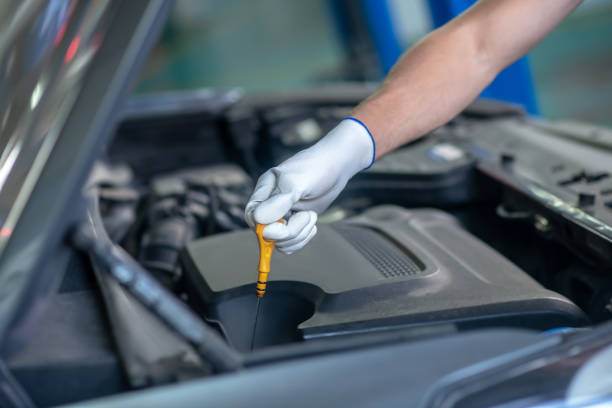
When it comes to maintaining your car’s lifespan, getting the oil checked is always a necessity. Ensuring your car’s engine has enough oil is the best way to help it continue running at its best for a long time. To know the condition and the oil level in the engine, drivers always use the dipstick to check the engine’s health. For some reason, the engine oil dipstick is hard to read, how can we see this? Let’s find the answer in the article!
What is the engine oil dipstick?
Checking the engine oil plays an important role in maintaining the operation of the car’s engine system. This solution has the effect of lubricating, reducing friction, and cleaning the internal parts of the engine. You can notice and understand what is happening with the oil inside the engine if you regularly check the engine oil condition. And the dipstick is a useful tool that helps you perform the process simply and quickly.
All internal combustion engines have an engine oil dipstick and this also includes diesel engines. The dipstick is a long, flat metal rod for measuring the level of liquids, especially oil in a car engine.
The position of the dipstick depends on your car’s engine type. Usually, what you see in the engine compartment will be the oil dipstick handle, which looks like a yellow plastic ring, with the text “Engine Oil”.

Step by step to check when the engine oil dipstick is hard to read?
If you are having difficulty reading your car’s dipstick, it might be due to the oil cooling down. When the oil cools, the viscosity is high and the dipstick is hard to read. If the engine oil dipstick is hard to read, you can add at least one liter of oil to the engine. It is important to maintain the engine oil level at the correct level to protect the engine from wear and ensure proper lubrication. To read the oil level on the dipstick correctly, follow the steps below:
Step 1: Park the car on a flat surface and turn off the engine
Try to find a relatively flat surface to park and check the oil. You need to do this to be able to accurately read the information on the dipstick. For example, if the car is on a sloped surface, the oil dipstick may be misread.
You should wait at least 10 minutes after turning off the engine or check the oil when the engine is cold:
- Do not check the engine oil when the car is running.
- Make sure the engine has been idling for a few minutes.
- Wait a few minutes to check the oil to ensure any oil near the top of the engine can drain down.
Step 2: Open the hood and identify the dipstick’s position.
Do not confuse the engine oil dipstick and the transmission dipstick. If you are unsure which dipstick to use, consult the manual provided with your car. Some newer models have an electronic oil display and do not have a traditional dipstick for manual checking.
Step 3: Remove the dipstick and clean it
This is a very important step. Use a cloth to clean the bottom of the dipstick; this will help you get rid of any oil residue that might be splashed onto the dipstick and you can read the oil level accurately.
Step 4: Reinstall the oil dipstick into the engine
Put the oil dipstick back into the engine as it was. Push it all the way down until it is completely back in place. If there is a squeaking sound during reinstallation, remove it, clean it, and try again.
Step 5: Remove the dipstick again
Take out the dipstick and hold it in a horizontal position, find the exact spot on the dipstick. Where should the oil be on the dipstick? Near the end of the oil dipstick, there will be two marks that are standard for “low” and “full,” the lower line is the minimum oil level and the upper line is the maximum oil level. If the oil streak is between the two lines, the oil is at a stable level, good for the engine. If the oil level is near or below the minimum, you need to add more oil.
Make sure the dipstick indicates the correct condition of your engine oil, let’s look at the tips below:
- You should observe and ensure that the oil dipstick is in good condition. If it is damaged or loose, the dipstick may give incorrect results and make reading difficult.
- Make sure the dipstick is clean and free of any debris. This will help reduce friction when reading the dipstick.
- You should notice if the dipstick is pointing in the right direction? If not, you need to change it.

FAQ
What happens if the oil level is too high?
In some cases, the oil level may have increased since the last oil check or there is too much oil on the dipstick. This could be due to condensates (from combustion) or a coolant leak, both of which can be concerning.
The car’s crankshaft is aerated during overfilling of engine oil. Foamy oil does not lubricate your vehicle well and, in many cases, it will completely stop the oil flow, overheat your oil, and cause a drop in oil pressure.
Signs of oil aging
We need to change our oil on time because it is influenced by driving conditions, fuel quality, engine age, and climate. Otherwise, the oil will degrade and not protect your engine. So look carefully at the oil on the dipstick:
- The oil looks quite clear like golden honey: in good condition
- Dark brown to black oil: Need to change the oil
How to know about coolant leak through the dipstick?
If the coolant is leaking, the cooling process will not reach its optimal performance and the engine will overheat. Using the dipstick will help you detect this problem earlier and address it in a timely manner. Brown bubbles or solid brown deposits above the level mark on the dipstick may indicate a coolant leak in your engine.
Another sign is smelly white exhaust smoke. In this case, the oil level on the dipstick may actually increase, indicating that a significant amount of coolant has leaked into the oil reservoir. If you see coolant in your engine oil, your engine must be serviced immediately.
How can I read the dipstick with 4 dots?
Reading a 4-dot dipstick is a bit difficult if you are a beginner. But it’s not as hard as you think. We will show you the detailed way to do it:
- First, you need to adjust the lighting angle and the distance between the dipstick and the reader. Once you’ve done that, you’re ready to start reading!
- Identify 4 marks. The 4 dots on the dipstick correspond to 4 different engine oil levels. To read it, you will need to determine which dot corresponds to which degree of oil level.
- Read between the marks – If there is heavy oil, the line on the dipstick will stay still while the other lines move around it. This means you will need to read between these marks to get the correct result!
Conclusion
Taking a minute can help keep your car in good running condition. Regularly checking your car’s engine oil is an important part of keeping the engine running properly and getting the most miles. Every regular car user, everyone must understand the role and how to use the oil dipstick. This will help maintain the engine’s lifespan, which is likened to the “heart” of the car.
A healthy and durable engine will make each of our trips with our loved ones and family safer and more enjoyable. We hope the article helps you know how to see when the engine oil dipstick is hard to read.