
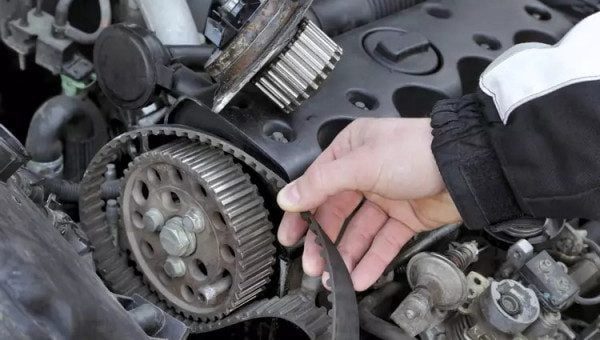

All cars have an accessory belt that drives features such as the alternator and air conditioning compressor, and possibly water and power steering pumps. This belt is usually mounted on the outside so you can see it on the front end of the engine (the engine is mounted transversely in most front-wheel drive cars), and it is typically a serpentine belt that slides around various pulleys. It needs to be replaced when it shows wear, such as cracks, fraying, or stretching.
Some car engines also have a timing belt that is hidden from view but connects the crankshaft at the bottom of the engine to the cylinder head at the top; it controls the opening and closing of the valves. Many engines have a timing chain instead of a belt. A key difference is that a timing chain is generally considered a lifetime part that does not require periodic replacement. A timing belt must be replaced, although the manufacturer’s maintenance schedule may not require it until 150,000 miles, as with some current Ford engines.
If any of the belts break, a car will soon stop. Once a timing belt breaks, the engine stops and you cannot restart it. With many cars, you may be able to restart the engine after a serpentine belt breaks, but you won’t get far if it drives the alternator. Without the alternator, you rely on the battery’s electrical power, and once that runs out, you’ll really be out of luck.
Although serpentine belts can last over 100,000 miles, they should be periodically inspected by a mechanic (if you know what to look for, you can do it yourself). Check your owner’s manual or service schedule to find out how often it should be inspected. This varies by manufacturer: Hyundai, for example, says that on some current four-cylinder engines, it should be done after six years or 60,000 miles, then every two years or 15,000 miles; Volkswagen requires it every 40,000 miles; on some Ford vehicles, you have to wait until 100,000 miles.
Serpentine belt replacement costs also vary, and we’ve seen estimates ranging from less than $75 to over $150 for the accessory. The best approach is to have it inspected before the recommended interval, and if you decide to have it replaced, you’ll have time to shop around. You may hear warning signs that a serpentine belt is on its last legs, such as squealing when you start the engine or accelerate, or rattling noises from a pulley or tensioner.
Replacing a timing belt is a more complex and costly procedure, typically ranging from at least $500 to over $1,000 depending on the type of car you drive. Worse, on some engines, if the timing belt breaks, the pistons may continue to move up and down, and in the process, the piston can hit and bend valves that have lost their timing mechanism. This can cost a lot of money—perhaps $3,000 or more.
This makes timing belt replacement more critical, but since it’s not visible, you can’t easily check it. It involves removing the accessory drive belts, the engine cover, and any other hardware just to take a look, and no repair shop will do it for free (they also have to put everything back together). That’s why you should pay close attention to the manufacturer’s recommended timing belt replacement schedule. Here too, recommendations vary: some Honda V-6 engines require timing belt replacement at 60,000 miles, for example, but the 1.8-liter four-cylinder used in some Chevrolets specifies it at 100,000 miles.
With some engines, the timing belt also drives the water pump, so repair shops may recommend replacing the water pump at the same time as the belt. This makes sense because if the water pump breaks a few months after the timing belt is replaced, a mechanic will have to go back in, take everything apart, replace the coolant, and charge you at least a few extra hours of labor—again.
In both cases, these serpentine and timing belts can fail prematurely. The key is not to wait too long to replace either belt, as you could end up stranded and at least inconvenienced, if not forced to shell out more money.